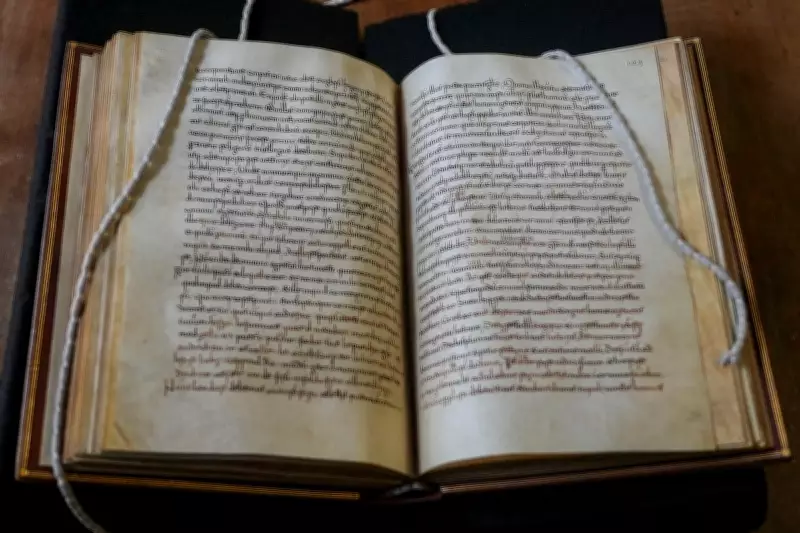
Researchers in Dublin have uncovered the oldest surviving English poem hidden within a medieval book in a Roman library. The discovery, made by scholars at Trinity College Dublin, has astonished the academic world.
Unexpected Discovery
Elisabetta Magnanti, a visiting research fellow at Trinity College Dublin's school of English, described the moment of discovery as extraordinary. "We were extremely surprised. We were speechless. We couldn't believe our eyes when we first saw that," she told The Associated Press. The poem, composed in Old English by a Northumbrian agricultural worker in the 7th century, is known as 'Caedmon's Hymn'. It appears within the main body of Latin text in a copy of the 'Ecclesiastical History of the English People' by the Venerable Bede.
Significance of the Find
Mark Faulkner, an associate professor of medieval literature at Trinity, considers Caedmon's poem to be the start of English literature. The manuscript they found dates from the 9th century, making it one of the oldest copies. Earlier copies contained the poem only as marginal notes or appendices, not within the main text. This discovery sheds light on the early diffusion of the English language. "Prior to the discovery of the Rome manuscript, the earliest one was from the early 12th century. So this is three centuries earlier than that," Faulkner said.

The Poem's Origin
According to Faulkner, Caedmon composed the nine-line hymn while working at Whitby Abbey in North Yorkshire. After guests at a feast began reciting poems, Caedmon, embarrassed that he knew nothing suitable, left and went to bed. A figure appeared in his dreams, telling him to sing about creation, which he miraculously did.
Manuscript's Journey
The manuscript's provenance is long and complex. Monks transcribed this copy of Bede's history at the Benedictine abbey of Nonantola near Modena, Italy, in the 9th century. In the 17th century, as the abbey declined, the manuscript moved to another abbey in Rome, then to the Vatican, and finally to a small church. It later passed into the hands of English antiquarian Thomas Phillipps, Swiss bibliophile Martin Bodmer, and Austrian-born rare bookseller H.P. Kraus in New York. Italy's culture ministry bought it from Kraus in 1972, and it has since resided in Rome's National Central Library, largely unstudied.
Future Discoveries
The library has digitized the entire Nonantolan collection, making it freely accessible. Andrea Cappa, the library's head of manuscripts, noted that this discovery is just one starting point. "The discovery made by the experts of Trinity College is just one starting point, a single manuscript that might pave the way for countless other discoveries, in countless other fields, through international cooperation like this," he said.