Alexander Whitley's Tech-Heavy Dance Double Bill Overwhelms Human Drama
At Sadler's Wells East in London, Alexander Whitley's latest double bill, featuring Mirror and The Rite of Spring, presents a visually stunning yet emotionally detached exploration of technology's role in performance. The production, running until 21 March, showcases Whitley's signature use of digital, generative, and VR technologies, but critics argue that the spectacle often sidelines the human elements, leaving the drama feeling incidental.
Mirror: Digital Doppelgangers Upstage the Dancers
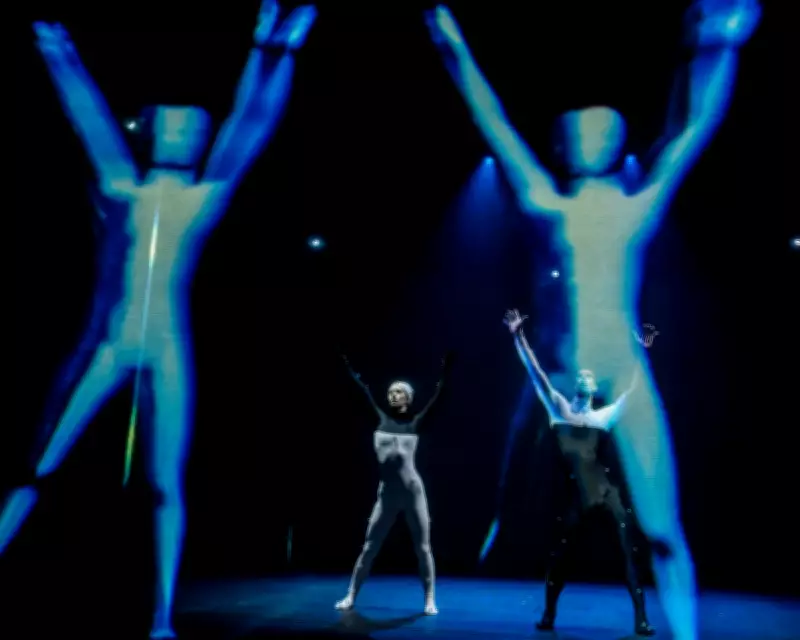
In Mirror, a new duet performed by Gabriel Ciulli and Daisy Dancer, the dancers wear black and white leotards studded with motion-capture markers. They engage in spirals and symmetries that shift between closeness and counter-pull, creating an unstable yet interdependent dynamic. However, this human interaction is interrupted by an impersonal beam of light that scans the space, triggering rectangles to flicker on the front cloth like screen frames.
This portal gives rise to luminous digital doppelgangers that initially echo the dancers but quickly upstage them. As the performers turn their attention away from each other and towards these ghostly avatars, the technology takes center stage. While the human drama persists—with one dancer leaving, the other staying in angst, and a reconnection later—it becomes almost secondary to the concatenation of scenes set in spacey soundscapes.

The special effects, including bodies multiplied, motion transmuted into dendritic flickers, and shadows dissolved into cosmic dust, dominate the piece. Ultimately, Mirror suggests that technology wins without good reason, overshadowing the physicality and emotional depth of the dancers.
The Rite of Spring: A Techno-Primitivist Sequel
Whitley's version of The Rite of Spring serves as a techno-primitivist sequel to Mirror, using similar digital effects of multiplication and magnification. The set features front and back cloths for projections, a closed circle of light center stage, and a trunk of ropes at its axis resembling a makeshift maypole. Five dancers channel Stravinsky's totemic score, played in a glitched and layered version that matches the blunt edges and blocky spacing of their torques and lunges.
Critics note that Whitley's choreography here is uncharacteristically rudimentary. Gabriel Ciulli delivers another tortuous solo, while Elaini Lalousis is chosen for the somewhat anticlimactic sacrificial dance. An intriguing moment connects a tight circle of dancers to an iridescent coloured ring, reminiscent of Meta's AI icon, but it passes quickly, with the piece's energies oddly dissipated.
Despite the visual spectacle, the production struggles to maintain emotional engagement, as the digital effects often overwhelm the human drama. The double bill highlights the tension between technology and artistry, raising questions about balance in contemporary dance.
Key Details:

- Performances at Sadler's Wells East, London, until 21 March.
- Features works by Alexander Whitley, known for integrating digital technologies.
- Dancers include Gabriel Ciulli, Daisy Dancer, and Elaini Lalousis.
- Music includes a glitched version of Stravinsky's The Rite of Spring.
- Themes explore technology's impact on human interaction and performance.