Mary Hammond: The Octogenarian Vocal Coach Behind Music's Biggest Stars
In the high-pressure world of professional music, where egos often collide with expectations, one octogenarian vocal coach has become the secret weapon for some of Britain's most celebrated performers. Mary Hammond, with her flaming red hair and glacier-blue eyes, has quietly shaped the voices of artists ranging from Adele and Coldplay's Chris Martin to Yungblud and Sir Ian McKellen.
The Super Bowl Preparation That Defined a Partnership
It was February 2016, backstage at Levi's Stadium in Santa Clara. Minutes before Coldplay were set to headline the Super Bowl 50 halftime show before 115 million viewers, Chris Martin was doing vocal exercises with a Bristolian woman in her seventies. Martin had flown his vocal coach from London specifically for this moment, despite being one of the world's most recognizable frontmen.
"When she got wind of who else was on the bill – Beyoncé! Bruno Mars! – her eyebrows shot up," Martin recalls. "Well, you'd better have a lesson, then," she told him.

This exchange captures the essence of Mary Hammond's approach: no-nonsense, honest, and completely focused on the artist's needs. For 26 years, Martin has been her student, relying on her guidance through five Glastonbury headline performances and countless world tours.
A Teaching Philosophy Built on Truth and Trust
"She's never going to bulls*** you," says Martin, who describes Hammond's praise as particularly valuable precisely because it's so sparing. "A tiny drop of praise is worth barrelsful from anyone else. Her soul is warm. And because she's a singer herself, she knows you need a kind of emotional protection."
This combination of surgical precision and emotional intelligence has made Hammond the go-to coach for performers across genres. Yungblud, the three-time Grammy winner known for his theatrical rock performances, credits Hammond with transforming his approach to vocals.
"Singing is such an exposing thing," Yungblud explains. "Obviously, she's unbelievable at exercises and strengthening the voice, but her ability to access an artist's mindset, and pivot to how I'd approach a song, blew me away."
From Southend Pier to the World Stage
Hammond's journey to becoming Britain's most sought-after vocal coach began in the 1960s at the Royal Academy, where she trained in both singing and piano. While her contemporaries headed for prestigious opera houses, Hammond chose a different path: performing as a singer in a summer variety season on Southend pier.
This unconventional beginning proved formative. "A baptism of fire," she calls it, but one that aligned with her effervescent personality. A stellar career as a session singer followed, working with everyone from Paul McCartney to the Three Tenors, close enough to Pavarotti, Domingo, and Caballé to hear them breathe.
In the late 1980s, Hammond served as a vocal coach on the first production of Les Misérables. Through the 1990s, she established the first postgraduate musical theatre course at the Royal Academy, gradually becoming the coach that West End producers called first.
The Science and Soul of Vocal Training
Hammond was ahead of her time in blending classical technique with cutting-edge scientific research. While well-versed in traditional methods, she became an early proponent of ideas developed by American researcher Jo Estill, whose videos of the vocal tract explained the precise physical mechanics of different singing styles.
Terms like "belt" (think Aretha Franklin), "twang" (Dolly Parton), and "tilt" (Sam Smith) that are now standard in voice-coaching vocabulary were once revolutionary concepts that Hammond helped introduce to British training.
"When you read about it in a book," Hammond says, "I find it difficult to teach. I have to feel it."
Creating Safe Spaces for Vulnerable Performers
Two-time Olivier winner Janie Dee, who has known Hammond for nearly 50 years since first being taught by her at age 14, describes the coach as someone who "vibrated with energy" from their first meeting.

"She's always been there at the important moments," Dee recalls. "I lost my voice once, just before an opening night. She dropped everything and came to the theatre. Afterwards, she told me to inhale steam to soothe my vocal cords and then rest, and that everything would be alright. She was right. But it was the fact that she came."
This protective, almost maternal approach extends to all her students. Actor Arty Froushan, who played Patrick Bateman in the Almeida's production of American Psycho, calls Hammond "the guru to end all gurus" and credits her for the acclaim he received.
"Her touch is so light that you don't even realise you're transforming," Froushan says. "And then, all of a sudden, one day, you can just do it."
Unconventional Methods for Unconventional Artists
Yungblud's experience with Hammond has been particularly unconventional. She had him treat his entire 2025 album, Idols, like a Broadway score – "very different for a rock musician," he admits. His band now calls her Yoda.
"My favourite moments are when she comes to rehearsals – she sits in the back like the Queen, her in-ears in, microphone in hand, shouting at me through the songs to drop my jaw," Yungblud reveals.
This no-nonsense approach extends to Hammond's famous students. When Chris Martin visited her in hospital with his then-wife Gwyneth Paltrow and their children, causing the entire ward to go quiet, Hammond simply shrugged when her surgeon mentioned her "important visitor." "Just somebody I teach," she said.
"The bigger you get, the more truth you need to hear," Yungblud observes. "She doesn't care who you are."
More Than a Coach: A Lifelong Confidante
Beyond technical instruction, Hammond has become a confidante and friend to those she teaches. Over the course of a year working with journalist Patrick Smith, who documented his experience with Hammond, their relationship evolved from student-teacher to something deeper.
"The thing about her being a mother figure, or even a grandmother – that's part of her magic," says Martin.
Both Dee and Martin express their affection in identical terms: "I love her very much." Yungblud puts it differently but no less emphatically: "She's a true rock star."
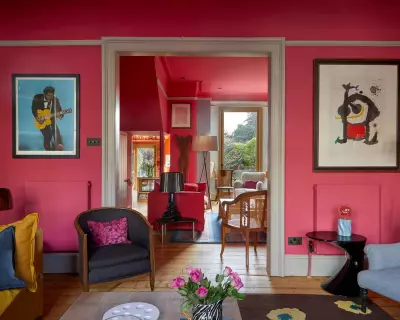
At her north London home, where triple-glazed windows mercifully contain the sounds of practice, Hammond continues to teach from a space filled with musical history. A harpsichord built by her husband of more than 60 years, Peter, formerly a cellist with the London Philharmonic, occupies one wall. A tuba with flowers arranged in its bell sits in the corner, while framed photographs of famous students crowd the bookshelves.
Here, in this sanctuary of sound, an octogenarian with a lifetime of experience continues to shape the voices that define British music, proving that sometimes the most essential figures in entertainment are those who work quietly behind the scenes.