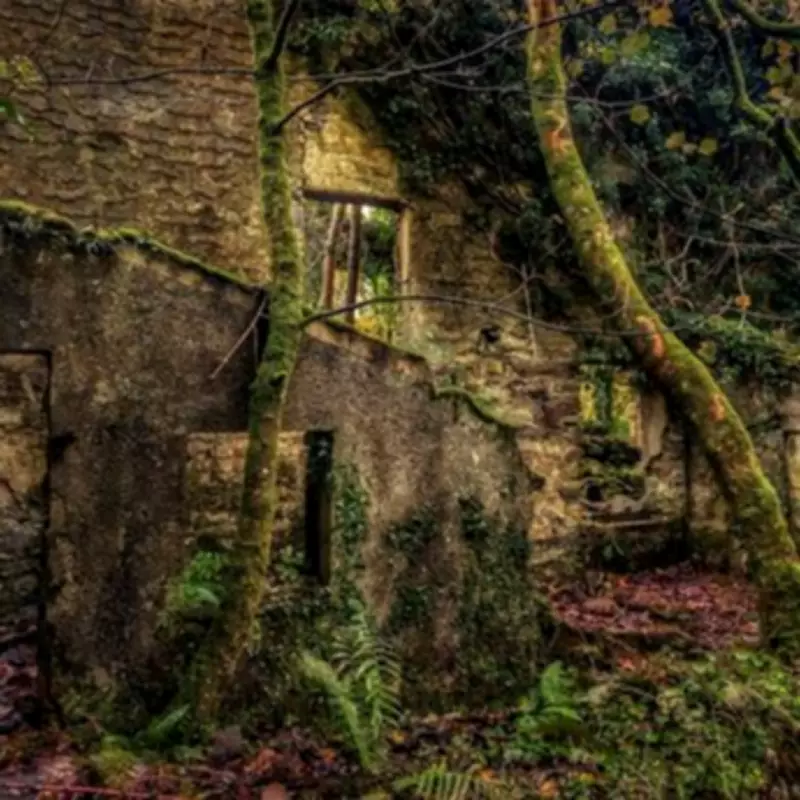
The haunting remnants of a Welsh village, forcibly abandoned to accommodate the expansion of a slate quarry, are now being dramatically reclaimed by nature in what explorers describe as a "vast and wild" landscape. This site, which includes the ruins of cottages and a substantial Victorian mansion, offers a poignant glimpse into the industrial history that reshaped communities across north-west Wales.
The Relocation of Talysarn Village
Nestled in the far western corner of the United Kingdom lies the village of Talysarn, currently home to approximately 2,000 residents. While it appears as a typical Welsh settlement today, its history is marked by a significant displacement. Roughly a century ago, the entire village was relocated from its original position slightly eastward to make way for the burgeoning slate industry. The original site now stands abandoned, with visible ruins that have drawn comparisons to ancient archaeological wonders.
Industrial Expansion and Community Displacement
The forced removal of Welsh communities to facilitate industrial projects or water supply reservoirs remains an emotionally charged topic. While the flooding of Capel Celyn to provide water for Liverpool is perhaps the most infamous example, the expansion of the slate industry during the 19th century similarly displaced entire villages, each with their own unique identity and heritage. Talysarn found itself in the path of this industrial growth as slate mining spread throughout Snowdonia.

Small quarries in the Dyffryn Nantlle valley were gradually absorbed into larger enterprises, most notably the formidable Dorothea quarry. This quarry proved so historically significant that it has since been designated as part of the Slate Landscape of Northwest Wales World Heritage Site by UNESCO in July 2021. Whether this contemporary recognition offers any comfort to the displaced villagers remains debatable, but they successfully established new roots approximately one kilometre west, where Talysarn continues as a stronghold of the Welsh language.
Exploring the Abandoned Ruins
Several original structures from the abandoned village continued to serve the quarry operations, and their remains can still be observed today. The most notable among these is Plas Talysarn, an 18th-century country house that was later extended into a Victorian villa. This remarkable location now draws visitors from across the country, captivated by its atmospheric decay.
Photographer's Discovery
Photographer Tony Harnett, who operates the Gems of Snowdonia website showcasing hidden treasures of the national park, expressed his astonishment at the scale of the ruins. "I'd seen photos of Plas Talysarn and knew it was an interesting place," he said. "But I thought that's all there was. When I went there, I did not expect to find so many other old buildings in the area. Some I just stumbled across, others I could see in the distance but didn't have time to visit."
Harnett arrived during the golden hour for photography and had only two hours to explore, but noted he could easily have spent an entire day discovering the site's many secrets. The ruins include a Cornish beam engine, the overgrown remains of a chapel, and various outbuildings that began to merge with the encroaching quarry works.
A "Welsh Angkor Wat"
Daniel Start, photographer and author of Wild Guide Wales, has likened the surviving ruins to a "Welsh Angkor Wat," noting that "only the baboons are missing." He describes it as "a vast, wild site with many fascinating, overgrown ruins" that create an extraordinary atmosphere of abandonment and reclamation by nature.
The History of Plas Talysarn
In its prime, Plas Talysarn was a grand residence featuring remarkable amenities including a fountain that was a 21st birthday gift for the daughter of the Robinson family, who owned the property. The fountain was transported by stagecoach, highlighting the property's significance during its heyday. An old track behind the house, formerly the Nantlle horse tramway (which continued using horses until the early 1960s), now leads to a bridge to nowhere and more walled enclosures.

A large lodge house and an assortment of other buildings were situated nearby, with remnants of one structure believed to be a gothic chapel or folly. All these structures, nestled in damp woodland, are now covered in moss, entwined with vines, and adorned with graffiti, enhancing the profound feeling of desertion.
Decline and Abandonment
Plas Talysarn remained in the Robinson family's possession until 1905 when it was sold to a quarry company. Local residents recall that it was last inhabited in 1946 and was ultimately deserted when a landslip brought the Dorothea quarry uncomfortably close to the property. Close by is the entrance to what used to be a stable block and kennels, later converted into a shower block for quarrymen. A former boiler house, now largely roofless, still houses two decaying Lancashire boilers, while other surrounding structures are draped in moss and tree roots.
The Slate Industry's Legacy
The story of Talysarn's abandonment stretches back 500 million years to the formation of an extensive belt of Cambrian slate between two valleys in north Wales. Some of the largest and most prolific slate quarries globally were located along this belt, with the area reputed to have "roofed the 19th century world." Slate was to north Wales what coal represented to the south, with numerous small independent quarries eventually merging into larger enterprises like Dorothea.
Dorothea quarry commenced operations in 1820 and continued production until 1970, though output declined substantially following the outbreak of the Second World War. By the 1840s, the quarry showed promising extraction levels but confronted severe flooding challenges, including an 1884 incident where several workers perished when the pit was inundated. The quarry has long been submerged, with the resulting lake exceeding 100 meters in depth in certain areas.
A Spy Plot Connection
In a curious historical footnote, the abandoned village area was at the centre of a spy plot in January 1982. A couple residing near Talysarn observed unusual activity in a red telephone box opposite their home during a period when detectives were investigating arson attacks on holiday homes in Wales. Eifionwen and Moses Edwards noticed two unfamiliar men in a white car making repeated visits to the phone box, placing an object inside that resembled a walkie-talkie.
When the men returned unexpectedly, one claimed to be working for the GPO (General Post Office), which managed telephone services at the time. However, local police attempting to trace the car's registration number were obstructed by the Home Office. Lord Dafydd Wigley, the local MP at the time, later revealed that the men were "secret agents who were not associated with the local constabulary and were acting without authority."
The abandoned village of Talysarn stands today as a testament to the complex interplay between industrial progress, community displacement, and nature's relentless reclamation. Its overgrown ruins, including the once-grand Plas Talysarn, offer visitors a tangible connection to Wales' industrial heritage while serving as a dramatic example of how landscapes transform when human presence withdraws.