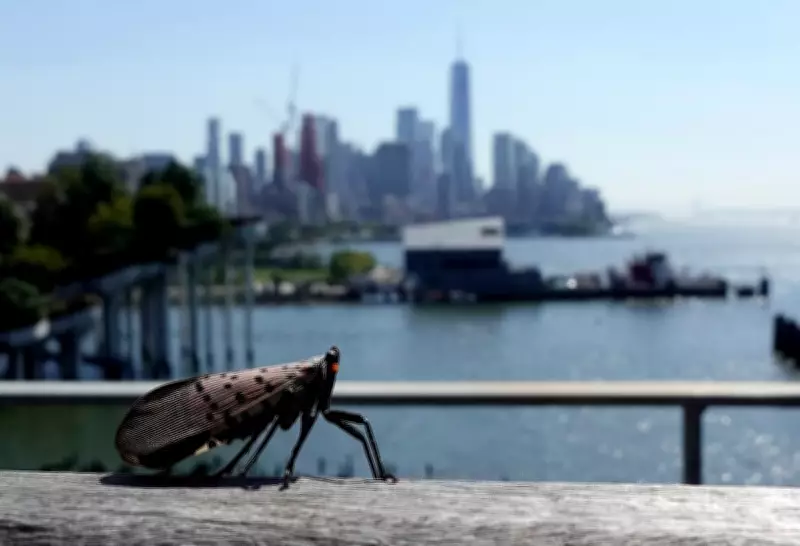
The US population of spotted lanternflies has surged in recent years, wreaking havoc on the winemaking and forestry sectors. These invasive insects, native to China, were first detected in the US in 2014 in Berks County, Pennsylvania, and have since spread to 19 states and Washington DC, according to an August 2025 report by the US Department of Agriculture.
Impact on Vineyards
Around grape harvest time about three years ago, an employee at Zephaniah Farm Vineyard in Leesburg, Virginia, noticed bugs about an inch long with gray and black wings and a bright red underwing atop some trees. While the insects were pretty, they were unwelcome guests at the vineyard, which sits atop a farm the Zephaniah family has run since 1949. These were spotted lanternflies, invasive insects that likely contributed to the vineyard producing about half as many grapes in 2025 as the previous year, according to Tremain Hatch, a co-owner and viticulturist. "If we spend as much time farming the grapes but we have half the crop and we're able to make half the wine, that is not a good thing," Hatch said.
Zephaniah Farm is not alone. In New York, researchers estimated that the bugs could cost wineries millions of dollars. The insects suck sap from grapevines, hops, and fruit trees, then secrete honeydew, a sugary liquid that promotes the growth of sooty mold. When that happens on grapes, "that is not something you want to harvest or incorporate into wine or sell, so they can cause problems for those commodity crops," said Nathan Derstine, a visiting assistant professor of biology at the University of Richmond.

Spread and Challenges
Scientists are uncertain about lanternfly population numbers this summer and fall but expect continued spread. "It's pretty common with invasive insects that if they get established in a new place, they are not constrained by some of their natural enemies that were in their native range, so here they have expanded quite rapidly," Derstine said. The bugs often travel via cars, trucks, and trains, making squishing them a key prevention method. "They don't belong in our environment," said Brian Walsh, a Penn State Extension horticulture educator. "And while you may not be having a huge impact overall on the population by killing individuals, each one that you see and encounter and kill, that is one less that you're going to accidentally move to a new area."
David All, an arborist in Upper Arlington, Ohio, sees lanternflies everywhere during daily walks. When bugs infest a tree in summer followed by an especially cold winter, branches can break or roots decay. For homeowners, the key is smashing the bugs. "It might be a little messy, but it will save your tree," All said.
Mitigation Efforts
Cleveland Metroparks has seen a significant increase in lanternflies. Adam Regula, the parks' climate resilient forest manager, said the sweet liquid excreted by the bugs attracts yellow jackets and wasps. The organization removed all trees of heaven, the bugs' favorite host plant, from its parks. In 2025, they started dispatching volunteers with dogs trained to sniff out lanternfly egg masses, then scrape and destroy the eggs. Staff also installed lanternfly traps on tree trunks. "Our efforts are really focused on mitigating the nuisance and the impact it has on public spaces," Regula said.
In Virginia, vineyard owners struggle because adult lanternflies enter growing areas in late summer when grapes ripen. "They are really hard to manage," said Drew Harner, an assistant professor of viticulture at Virginia Tech. "Many times, a grower will have to use an insecticide, but they can't use specific products as we get closer to harvest." Even if they reduce the population, lanternflies re-enter vegetation, creating a rollercoaster population dynamic.

Research and Community Action
Scientists are researching potential strategies, including releasing parasitoids from east Asia that kill lanternfly nymphs and eggs, and spraying spores that create a fungus to infect and kill the bugs. Vineyard owners have also started removing trees of heaven. Despite the increasing population, Derstine does not expect the bugs to wreak as much havoc as the emerald ash borer, an invasive Asian beetle that killed hundreds of millions of ash trees. "This is a recent invasion," he said. "It's been about 12 years. That is not very long in the grand scheme of things."
Virginia vineyard owners are not waiting for nature to run its course. For three years, they have hosted Scrape for the Grape, an event where volunteers remove lanternfly egg masses from vines and posts to reduce adult bugs the next year. This year, Zephaniah Farm hosted about 60 volunteers over two days. "When there is a new pest and we are not sure how to manage it, it's very uncomfortable and scary," Hatch said. "To have community members come out and help us, that means a lot."