Ocean Salinity Crisis: Gulf Stream Collapse Fears as Key Region Loses 60% Salt
A critical ocean region historically known for its extreme saltiness has experienced a dramatic 60 per cent reduction in salinity over the past six decades. This alarming discovery has sparked serious concerns among climate scientists that the Gulf Stream could be moving perilously close to a catastrophic collapse.
The Salinity Shift in Southern Indian Ocean
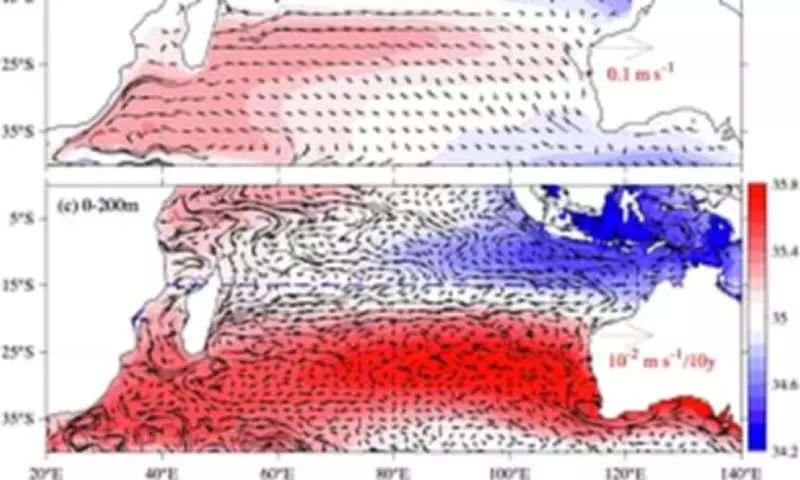
The southern Indian Ocean, located off the southwest coast of Australia, has traditionally maintained exceptionally high salinity levels due to the region's arid conditions. However, new research from the University of Colorado at Boulder reveals that this area of salty seawater has diminished by approximately 30 per cent in spatial extent over the last 60 years.
"We're witnessing a large-scale shift in how freshwater moves through the ocean," explained Professor Weiqing Han, the study's lead author. "This transformation is occurring in a region that plays a crucial role in global ocean circulation patterns."

Understanding Ocean Circulation Systems
While global ocean salinity averages around 3.5 per cent, significant variations exist worldwide. The southern Indian Ocean represents one of the planet's saltiest regions, whereas areas stretching from the eastern Indian Ocean into the western Pacific Ocean in the Northern Hemisphere tropics naturally maintain lower salinity levels.
These salinity differences create what scientists describe as a massive "conveyor belt" of ocean circulation, formally known as the thermohaline circulation. This system distributes heat, salt, and freshwater across the globe, transporting warm, fresh water from the Indo-Pacific region toward the Atlantic Ocean. This process contributes significantly to western Europe's relatively mild climate.
The Atlantic Meridional Overturning Circulation (AMOC)
The Gulf Stream constitutes just one component of the broader Atlantic Meridional Overturning Circulation (AMOC), often characterized as "the conveyor belt of the ocean." This complex system moves warm surface water northward from tropical regions to the northern hemisphere.
When this warm water reaches the North Atlantic, it releases heat, cools, and becomes saltier and denser. Eventually, the water sinks before flowing southward back toward the Indian and Pacific oceans, where the cycle recommences.
Research Findings and Freshwater Equivalents
The research team's analysis of six decades of salinity data revealed that the southern Indian Ocean patch is becoming less salty at what they describe as an "astonishing rate."
"This freshening process equates to adding approximately 60 per cent of Lake Tahoe's freshwater volume to the region annually," stated first author Gengxin Chen. "To provide perspective, the amount of freshwater flowing into this ocean area could supply the entire United States population with drinking water for more than 380 years."
Climate Change as Primary Driver
The researchers conducted extensive computer simulations to identify the causes behind this dramatic salinity reduction. Their findings indicate that changes in local precipitation patterns are not responsible for the freshening phenomenon.
Instead, they attribute the transformation directly to climate change. Global warming is altering surface winds over the Indian and tropical Pacific oceans, with these wind shifts pushing ocean currents to channel more water from the Indo-Pacific freshwater pool toward the southern Indian Ocean.
"As seawater becomes less salty, its density decreases significantly," the researchers explained. "Because fresher water typically rests atop saltier, denser water, surface water and deep ocean water become increasingly separated into distinct layers."
This stratification creates stronger salinity contrasts between ocean layers, reducing vertical mixing—a critical process that normally allows surface waters to sink and deeper waters to rise, redistributing nutrients and heat throughout the ocean.

Potential Consequences of AMOC Collapse
Climate scientists have previously warned that AMOC collapse could devastate global weather systems. Professor David Thornalley, a climate scientist at University College London, emphasized that temperatures would plummet dramatically if the AMOC were to collapse.
"An AMOC collapse could trigger more extreme weather events," Professor Thornalley noted. "Beyond overall colder-than-average conditions, we would anticipate increased winter storms caused by stronger westerly winds. Unfortunately, this would likely result in fatalities due to intensified winter storms and flooding, with vulnerable populations particularly at risk from extremely cold winter temperatures."
If the AMOC were to collapse, Britain could face winter extremes reaching -20°C (-4°F) in London and -30°C (-22°F) in Scotland, according to climate models.
The Greenland Connection
The engine of this oceanic conveyor belt operates off the coast of Greenland, where climate change-induced ice melting introduces more freshwater into the North Atlantic. This freshwater influx slows the entire circulation system, with prior studies already demonstrating AMOC weakening due to climate change impacts.
Scientists believe melting glaciers represent the primary threat to AMOC stability, potentially causing the complete collapse of this vital ocean current system that helps regulate global climate patterns.