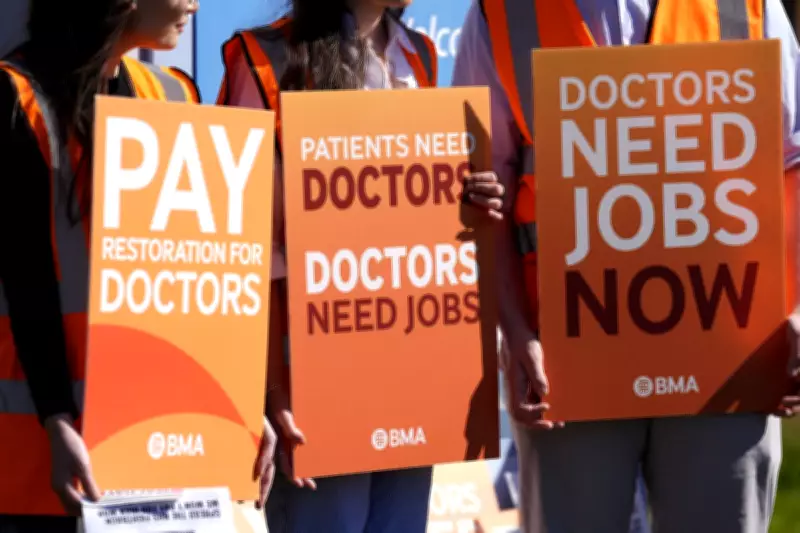
Public Opposition Mounts Against Resident Doctor Strikes After Costs Surpass £3 Billion
Opposition to resident doctor strikes among the British public is intensifying, according to fresh polling data, as the cumulative financial impact on the National Health Service has now exceeded £3 billion over a three-year period. The latest industrial action, which commenced on Tuesday, marks the 15th strike by resident doctors since 2023, further straining healthcare services across the nation.
Polling Reveals Significant Shift in Public Sentiment
New YouGov research, conducted on Tuesday with a sample of 4,385 adults in Great Britain, indicates that 55% of British adults now oppose resident doctors going on strike. In contrast, only 37% expressed support for the ongoing industrial action. This represents a notable shift from March, when 53% opposed the strikes and 38% supported them. The change is even more dramatic when compared to April 2023, when approximately one-third of the public opposed strike action while around three in five supported it.
Government Criticises Financial Impact of Strikes
Health Secretary Wes Streeting has been vocal about the financial consequences of the strikes, stating that the £3 billion spent on covering strike action could have been allocated to building "a few hospitals" or significantly accelerating reductions in NHS waiting lists. During an interview with LBC's Nick Ferrari, Streeting emphasised the opportunity cost, noting, "We could have run far more appointments and procedures with that money to cut waiting lists faster. Those would probably be the things that I would have chosen to prioritise."

Streeting also addressed the NHS's capacity to endure ongoing strikes, asserting, "We will be able to sustain and withstand strike action on an ongoing basis, if that's the way the BMA take things. But that comes with enormous waste of time, money and potential. The NHS is finally moving in the right direction. It is on the road to recovery." He estimated that the current six-day strike, which began at 7am on April 7, would cost the NHS an additional £300 million.
Training Places and Pay Disputes Remain Contentious
The Health Secretary further criticised the British Medical Association's position on training places, stating that additional positions for resident doctors are "not needed for the NHS or for patients." He argued that the public would think he had "lost the plot" if he proceeded with an offer of 1,000 extra training places after resident doctors rejected the Government's proposed deal on pay and jobs. That proposal included a 4.9% increase in average basic pay, which Streeting claimed would have left resident doctors 35.2% better off than four years ago.
In a pointed critique, Streeting highlighted what he described as hypocrisy within the BMA, noting that while the union rejected the 4.9% pay offer for doctors, it is offering its own staff only 2.75% on affordability grounds. "Why does the BMA think they can get away with telling their own staff they only get 2.75% because that's all they can afford, whilst rejecting a 4.9% offer because that's all the Government can afford?" he questioned during an appearance on BBC Breakfast.
NHS Leaders and BMA Respond to Latest Strike
NHS officials have acknowledged that the current strike—the joint longest walkout by resident doctors—will present significant challenges but have urged patients to attend appointments as usual unless advised otherwise. Rory Deighton, director of acute and ambulance care at the NHS Alliance, expressed disappointment at the timing of the walkout, which follows an extended bank holiday weekend. "We are hearing from members that the timing of this walkout has compounded the usual pressures you would expect to see at this time. That's adding to disruption and delays for patients and is hard to take for the many staff who have given so much," he stated.

Dr Jack Fletcher, chairman of the BMA resident doctors committee, defended the strike action during a press conference outside St Thomas' Hospital. "Nobody's asking for anything in one go, and nobody's asking for anything overnight. But the Government does need to move," he asserted. Fletcher emphasised that while progress has been made on some fronts, the Government must address both jobs and pay to resolve the dispute. "What the Health Secretary is asking us to reconsider now is essentially will you bake in more real terms pay cuts, not just this year, but for future years? We can't accept further real terms pay cuts," he explained.
Expressing regret for the impact on patients, Fletcher added, "I'm genuinely very sorry and it is regrettable that we're having to take this action and I'm very sorry to patients, however, we feel like we had no choice."
Additional Industrial Action Looms
In a related development, hundreds of BMA staff members are also engaged in a 48-hour strike over pay, which began on Monday. Furthermore, senior medics are preparing to ballot on industrial action after ministers announced a 3.5% pay award. Simultaneous ballots for consultants and specialists, associate specialists, and speciality doctors are scheduled to run from May 11 until July 6, potentially expanding the scope of healthcare industrial action in the coming months.
The ongoing disputes highlight the deepening tensions within the NHS as it navigates financial constraints, staffing challenges, and the imperative to maintain patient care amidst recurrent industrial action.