RFK Jr's Autism Committee Overhaul Sparks Formation of Rival Science Group
The first public meeting of US autism advisers since Robert F Kennedy Jr reshaped the committee was recently cancelled with minimal explanation, coinciding with the establishment of a rival organization that has prompted significant questions within the autistic community about representation and focus.
Controversial Committee Changes
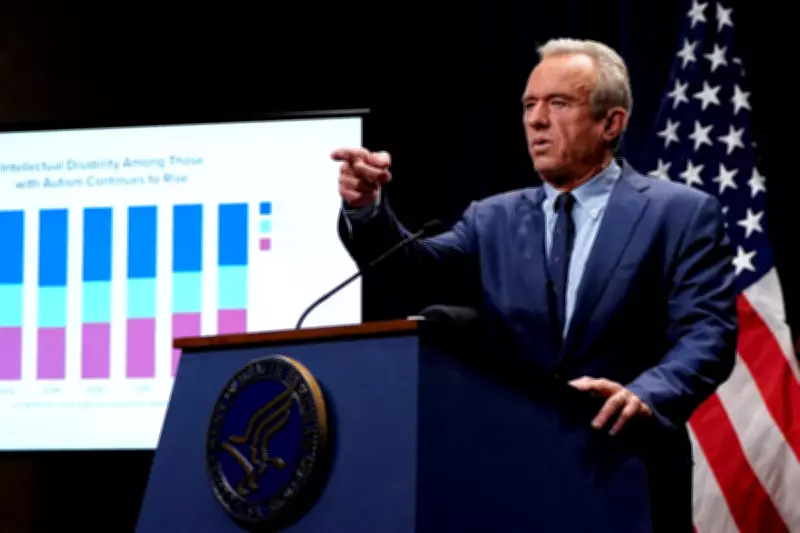
Kennedy, serving as secretary of the US Department of Health and Human Services, appointed entirely new members to the Interagency Autism Coordinating Committee in late January. The reconstituted committee now features fewer autistic individuals and includes several anti-vaccine advocates, despite Kennedy's long-standing promotion of debunked links between vaccines and autism.
The planned Thursday meeting was abruptly cancelled on March 7th without a rescheduled date being offered. The IACC, while relatively obscure, holds substantial influence over nearly $2 billion in federal autism research spending and can make recommendations affecting multiple government sectors including housing, defense, education, labor, and social services.

Emergence of Independent Counterpart
On March 3rd, a new organization called the Independent Autism Coordinating Committee was announced as a pro-science alternative that would provide research recommendations to private donors and institutions. This development reflects growing concerns about the federal committee's alignment with Kennedy's controversial positions.
Experts suggest this independent committee represents part of a broader movement of organizations emerging to fill leadership gaps at the federal level. However, critics have expressed reservations about the new committee's composition and approach.
Representation Concerns Persist
The independent committee currently includes only one autistic person, and some members have advocated for creating a separate "profound autism" category that many in the autistic community argue lacks scientific foundation.
"There's not many autistic people there, fewer than even the fraudulent IACC has, which isn't a good look," said Zoe Gross, director of advocacy at the Autistic Self Advocacy Network.
Steven Kapp, a senior lecturer in psychology at the University of Portsmouth who is autistic, noted that "despite efforts, no independent research teams have been able to identify valid subtypes of autism."
Historical Context and Current Controversies
The federal committee was originally established in 2006 under the Combating Autism Act, which framed autism as an epidemic requiring elimination. Kapp observed that officials appear to be returning to this approach under the current administration.
By legal requirement, the 21-person federal committee must include three autistic members. Prior to Kennedy's overhaul, the committee featured seven autistic public members and one autistic federal employee, including several people of color and women.
Questionable Appointments and Practices
Several appointees to Kennedy's committee have promoted dangerous and ineffective "treatments" for autism, including chelation therapy, hyperbaric oxygen chambers, and industrial bleach enemas. The FDA had previously warned about these practices on a webpage that has since been removed.
Matt Carey, a former committee member, described the current federal committee as a "sham" that Kennedy may use to justify questionable science. "It's like his ACIP," Carey said, referring to Kennedy's similar overhaul of the Advisory Committee on Immunization Practices. "The IACC is selected to give him the answers he wants."
Research Priorities Under Scrutiny
Autistic advocates express concern that the federal committee might fund research on long-debunked theories, particularly regarding vaccine connections. Gross characterized such research as "tantamount to setting money on fire – except worse than that, because not only will they be wasteful of government funds, they'll also be disastrous for public health."
HHS spokesperson Emily Hilliard stated that the federal committee would "fulfill President Trump's directive to bring autism research to the 21st century and support breakthroughs in autism diagnosis, treatment and prevention."

Independent Committee's Potential and Challenges
David Mandell, professor of psychiatry at the University of Pennsylvania and a founding member of the independent committee, acknowledged the group was assembled rapidly and is working to expand its membership. "One of the first items of business should be to ask who is represented and who is missing," Mandell said.
The independent committee plans to hold its first meeting on the same Thursday originally scheduled for the federal committee's cancelled session. Mandell indicated the group's name might change to reflect its narrower focus on research agenda development.
"We're really very focused on: 'What should the research agenda be?'" Mandell explained. He emphasized the importance of evidence-based discussions, stating he hopes "whatever people bring to the table, they cite their sources, and that those be rigorous, validated sources."
Broader Implications for Autism Community
Autistic advocates emphasize that autism does not require prevention and express concern about policies that could increase institutionalization and segregation across housing, education, and employment sectors. Instead, they advocate for greater inclusion and community support for autistic individuals.
Kapp suggested the independent committee's success would depend on "how willing the leadership would be to not just reach out to people, for showing that there's representation, but also for genuine listening across the organization and for genuine compromise" while allowing room for disagreement.
Gross expressed hope that the independent committee would evolve, stating "My hope is that they will change" regarding representation and priorities.