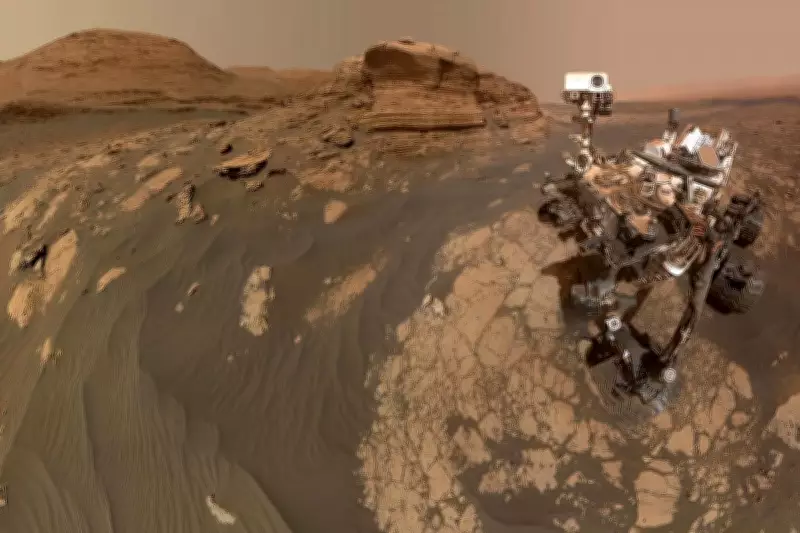
NASA's Curiosity rover has identified seven new organic compounds on Mars, according to research published in Nature Communications. Scientists believe this organic matter may have been preserved for over 3.4 billion years. But is it evidence of life?
The Challenge of Identifying Life
It is not yet possible to determine whether these compounds were delivered by meteorites, comets, or interplanetary dust, formed through geological processes, or linked to potential ancient life on Mars. This raises fundamental questions: What exactly is life? How do we know what to look for? Why is it so difficult to determine if an organic compound came from life?
As an astrobiologist, my work involves studying life in the universe. I have participated in NASA and Canadian Space Agency projects focused on detecting signs of life and training astronauts as field scientists. This has taken me to extreme environments on Earth, from Antarctica to hot springs in Western Canada, volcanoes in Hawaii, and underwater in British Columbia.

Studying Extreme Environments on Earth
Scientists study life in extreme environments on Earth—analogues for early Earth or other planets like Mars. Micro-organisms thrive in Yellowstone's hot springs, deep underground, or in icy regions like Antarctica. These analogue environments help us test equipment and operational concepts for life-detection missions and understand how life can survive in extreme conditions.
Importantly, these environments help us recognize biosignatures—unambiguous signs of life. On Earth, evidence of life is abundant; finding lifeless locations is often more challenging.
What Is Not a Sign of Life?
The moon, unlike Mars, does not contain life. It is constantly bombarded by meteorites and asteroids, which can contain organic molecules like amino acids and hydrocarbons that resemble those left by living organisms. Micro-organisms contain lipids, proteins, and nucleic acids; when they die, these organic molecules can become trapped in sediments or minerals and preserved for millions or billions of years.
However, life is not the only source of organic molecules. Abiotic chemical reactions can produce simple organic building blocks without life. Reports of methane or hydrocarbons on Mars could be related to life, but alternative explanations exist. Analysis of samples from asteroid Bennu in 2023 found organics like ribose, a component of RNA, but this does not indicate life on Bennu—it shows that biologically important molecules may be widely distributed in the solar system.
From the Moon to Mars
Exploration of the moon helps create an inventory of organic molecules that have non-biological origins. Studies of lunar regolith from Apollo and Chinese missions have identified amino acids, ketones, and amines. If these same organics are found on other planets, they are not necessarily signs of life on their own.
Prior to NASA's Artemis II mission, astronauts underwent geology training at sites like the Kamestastin Lake impact structure in Labrador, preparing them to make detailed geological observations. Geological features may play a role in preserving organics, shielding them from high temperatures and radiation. Similar features on Mars could be good targets for astrobiology investigations.
With a 2028 moon landing planned for Artemis IV, we will have more lunar material to study. These missions are critical for fine-tuning unambiguous signs of life to search for on Mars. As Curiosity and Perseverance rovers continue exploring, future missions may more confidently answer the question: Is it life?
Allyson Brady is an Assistant Professor in the Department of Biology at Carleton University. This article is republished from The Conversation under a Creative Commons license.