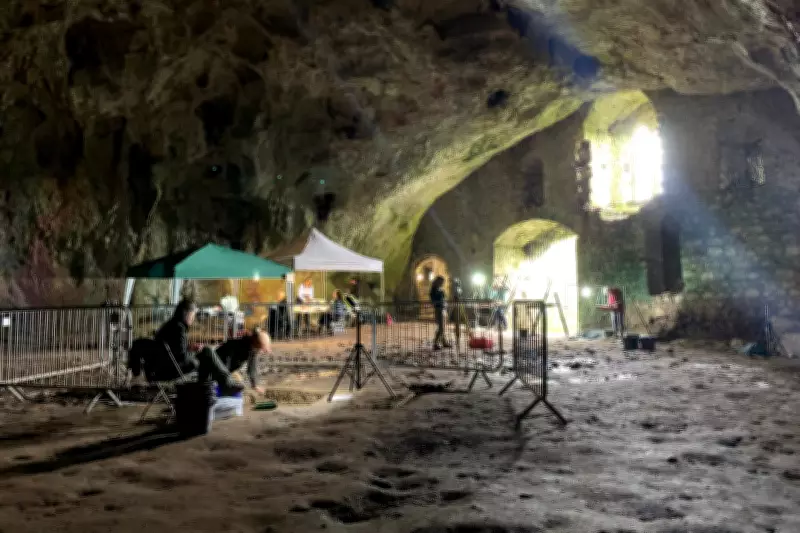
Archaeologists are preparing for a groundbreaking deep exploration of a "truly remarkable" Welsh cave that once sheltered a hippopotamus roaming Wales approximately 120,000 years ago. This extraordinary site also contains compelling evidence of early prehistoric human activity, making it a focal point for scientific discovery.
A Prehistoric Archive Beneath Pembroke Castle
The University of Aberdeen has secured significant funding to lead a comprehensive five-year investigation into Wogan Cavern, situated directly beneath the historic Pembroke Castle. Accessible via a spiral staircase, this vast cave was previously assumed to have been extensively excavated by Victorian archaeologists, leading many to believe that little archaeological material remained intact.
Unexpected Discoveries Challenge Assumptions
However, small-scale excavations conducted between 2021 and 2024 have dramatically overturned these assumptions. Researchers have unearthed abundant evidence of both human and animal visits spanning more than 100,000 years. Crucially, much of Wogan Cavern's ancient sediments have been found to be remarkably well-preserved and undisturbed.

These findings have led experts to declare that the cave is rapidly emerging as one of Britain's most important prehistoric archives. Dr Rob Dinnis, who directed the initial excavations, will spearhead the ambitious new project for the University of Aberdeen.
Unparalleled Historical Significance
"Despite the limited work done so far, we can already say that Wogan Cavern is a truly remarkable site," Dr Dinnis stated. "Not only is there extremely rare evidence for early Homo sapiens, but there are also hints at even earlier human occupation, probably by Neanderthals. There is no other site like it in Britain – it is a once‑in‑a‑lifetime discovery."
He emphasized the project's potential: "With this new investigation, we can learn a great deal about our early prehistoric forebears, about how they lived and what their worlds looked like."
Climate Change and Extinct Species
The researchers believe that larger scale excavations could provide unprecedented insights into past climate change, extinct species, and the multiple periods when humans inhabited the cave. Dr Dinnis elaborated on the timeline: "We are optimistic that the cave can chart a long sequence of human activity, from hunter-gatherers living there immediately after the last Ice Age around 11,500 years ago, back to Britain's earliest Homo sapiens between 45,000 and 35,000 years ago, and maybe also earlier traces likely left by Neanderthals."
He added: "We have also found hippo bones, which probably date to the last interglacial period, around 120,000 years ago. The site could therefore tell us about how multiple changes in climate and environment affected people living there over 100,000 years or more."
Cutting-Edge Scientific Techniques
The project, funded by the Calleva Foundation, will bring together researchers from the University of Aberdeen with other leading specialists across Britain and Europe. Professor Kate Britton, a specialist in science-based archaeology at the University of Aberdeen, highlighted the unique opportunities presented by Wogan Cavern.
"Wogan Cavern provides a unique chance to use all the scientific techniques now available to archaeologists," Professor Britton explained. "Because the bones are well preserved, we can learn a lot about past environments and ecosystems, and conduct high-resolution scientific dating. Furthermore, pilot studies have shown that ancient DNA is preserved, in both the bones and the cave sediments."
A New Chapter for Pembroke Castle
For Pembroke Castle – the birthplace of Henry Tudor and already a popular tourist attraction – this project marks an exciting new chapter in its storied history. Dr Jonquil Mogg, the newly appointed collections manager at the castle, expressed enthusiasm about the archaeological potential.
"Pembroke Castle has long been a very important part of Welsh and British history," Dr Mogg said. "Wogan Cavern has the potential to also establish it as a place of huge significance to British archaeology."

Castle manager Jon Williams described the news as "incredibly exciting," adding: "We have watched with great interest as Wogan Cavern has started to reveal its secrets – it's very different from the medieval history we usually deal with at the castle. We are thrilled that work on this wonderful cave will continue – we very much look forward to working more with Rob and his team, and securing the collection for the people of Pembroke, Wales and beyond."
New excavations are scheduled to commence at the end of May, promising to unveil further secrets from this unparalleled prehistoric archive.