Cornwall's St Piran's Day Marks Cultural Revival with Parades and Pride
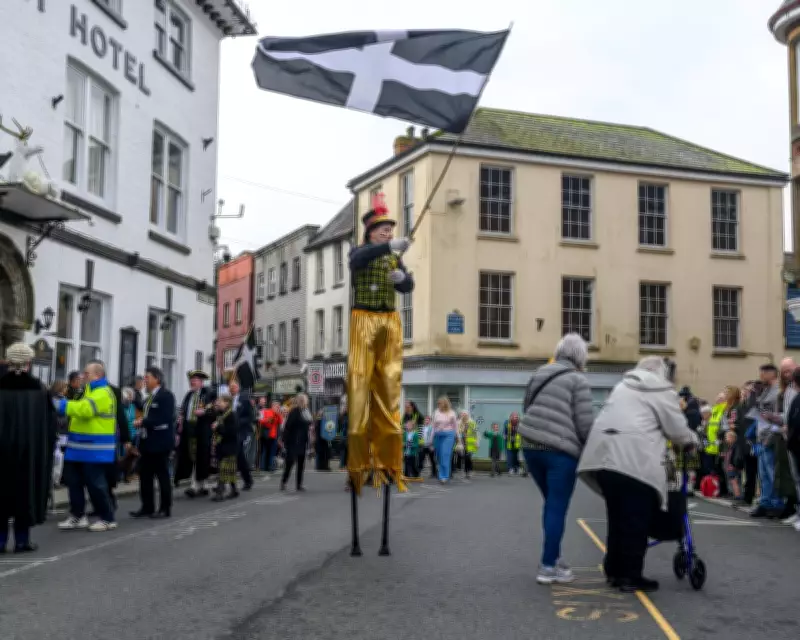
A crisp morning in Launceston, the ancient capital of Cornwall, set the stage for vibrant St Piran's Day celebrations, as the town buzzed with activity. Children paraded and danced through the streets, songs echoed in the air, and heartfelt speeches were delivered, with occasional tears shed in a collective embrace of Cornish heritage. This annual event has firmly established itself as a springtime highlight in Britain's far south-west, serving not only to honour the patron saint but also to reflect on the essence of Cornish identity in the modern era.
Celebrating Cornishness in the 21st Century
Launceston's mayor, Nicola Gilbert, a lifelong Cornish resident, expressed her enthusiasm for the day, stating, "We're very patriotic here, proud of who we are. We tend to get forgotten – we're at the other end of the country. But we don't forget who we are." The modern incarnation of St Piran's Day continues to grow in popularity, with festivities extending beyond the official date of 5 March into the weekend. Similar celebrations unfolded in Bodmin, Truro, and Falmouth, while a new two-day festival in St Austell highlighted cultural, academic, and economic ties between Cornwall and Wales.
Ross Wheeler, a stilt walker participating in the Launceston parade, noted a resurgence in Cornish culture, advocating for the day to become a bank holiday. Cornish artist and commentator Seamas Carey observed a significant shift from his school days, when St Piran's Day activities were scarce. "I think it's about Cornwall getting to grips with its identity," he remarked, drawing parallels to Wales' St David's Day and Scotland's St Andrew's Day. He added, "To be Cornish means to be other. I don't mind if people forget I'm Cornish, but what I'm definitely not is English."

Language Recognition and Devolution Prospects
In a landmark development, the Cornish language, Kernewek, received official recognition under part III of the European charter for minority languages in January, granting it enhanced protection and status. Concurrently, the UK government has signalled its intention to explore a bespoke devolution deal for Cornwall, potentially empowering the region with greater control over transport, housing, and economic development. Joanie Willett, co-director of the Institute of Cornish Studies at the University of Exeter, traced the modern rise of St Piran's Day to the late 1990s, a period marked by the 500th anniversary of the Cornish rebellion and efforts to secure EU funding for Cornwall and the Isles of Scilly.
"It created an environment that said Cornishness is really cool," Willett explained. "It really matters because of our heritage and it's also really useful." However, she emphasised the day's fun and high-spirited nature, noting that the institute planned an inaugural pasty toss as part of the celebrations. According to the Cornwall Heritage Trust, St Piran was a fifth-century Irish priest known for his merriment and resilience, who floated to Cornwall on a millstone and preached Christianity.
International Reach and Inclusive Identity
Rev Jess Lancaster, who joined the Launceston parade, highlighted the deep Celtic traditions in modern Cornish Christianity, describing it as calm and gentle. Meanwhile, in the House of Commons, Labour MP Perran Moon hosted an event with Global Cornish, underscoring Cornwall's broader significance. "When people think of Cornwall, they think of beaches and pasties and scones and cream and holidays. Actually, there's so much more to Cornwall in terms of our culture, our language, our heritage," he stated.
Moon pointed to Cornwall's industrial advancements in wind, thermal, and tidal energy, as well as critical minerals like tin and lithium. He also noted the international spread of Cornish culture, with St Piran's Day events held in Toronto, Mexico, Hong Kong, and Australia. "So this isn't just a Cornish thing. It's not even a British celebration. It's an international celebration," he affirmed.

In Redruth, the community leveraged St Piran's Day to promote its bid for UK Town of Culture 2028, screening a special film titled "The 'Druth Is Out There." Will Coleman, featured in the film, described a "palpable wave" of positive energy around Cornish identity and language over the past decade. "There has been a growing understanding of our distinctive past, as well as optimism about a distinctive and more prosperous future," he said.
Coleman emphasised that Cornwall is renegotiating its role within the British family as one of its five nations, with St Piran's Day serving as a platform to celebrate this newfound confidence. While acknowledging that flag-waving and parading might resemble defensive nationalism elsewhere, he asserted that Cornwall's resurgence is inclusive and empowering. "From the inside, the resurgence of Cornish identity and language feels inclusive, empowering and celebratory - long may it continue to be so," he concluded.