Carney Confronts Pressure Over Indian Interference Claims Following Modi Summit
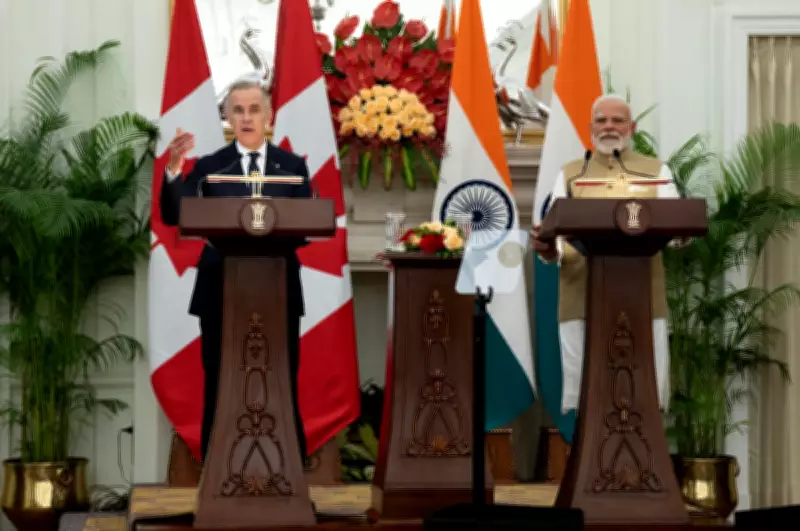
Canadian Prime Minister Mark Carney is facing escalating demands to clarify his stance on whether Indian interference remains a threat to Canada, following a high-profile meeting with Indian Prime Minister Narendra Modi in New Delhi. The encounter, which took place on March 2, 2026, was primarily centered on trade discussions, but it has reignited concerns over allegations that Modi's government orchestrated the killing of a Canadian citizen.
Trade Focus Amidst Tensions
During his four-day visit to India, Carney emphasized a reset in bilateral relations, declaring, "We are one family," as he aimed to strengthen ties with the world's most populous nation. The trip yielded significant economic agreements, including a landmark $2.6 billion uranium deal and multiple memorandums of understanding. Carney expressed ambitions to finalize a free-trade agreement with India, the world's fifth-largest economy, by the end of the year, with hopes of boosting two-way trade to C$70 billion by 2030.
Modi commended Carney's efforts to revive the stalled relationship, and both leaders announced plans for a future meeting in Canada after Modi accepted an invitation to visit. However, the trade-focused agenda was overshadowed by unresolved security issues.

Allegations of Interference and Repression
Carney's office released a statement noting that he "underscored that Canada will continue to take measures to combat" transnational repression during his talks with Modi, though no specific details were provided. This comes amid ongoing scrutiny of India's alleged role in the 2023 assassination of Sikh activist Hardeep Singh Nijjar. Reports suggest that an official at India's Vancouver consulate, believed to be an intelligence officer, assisted in supplying information on Nijjar.
In June, Canada's spy agency labeled Nijjar's murder as a "significant escalation in India's repression efforts," part of a broader campaign by Delhi to threaten dissidents abroad. As recently as last week, a prominent Sikh activist received police warnings about credible threats against his family, which he attributes to Indian sources.
Political and Diplomatic Reactions
The pressure on Carney intensified after a senior Canadian official stated last week that the government was "confident" India's campaign of threats and violence had ceased, implying that the trip would not have proceeded otherwise. In response, Canadian Foreign Affairs Minister Anita Anand distanced herself from these remarks, telling reporters in New Delhi, "the words of the senior official are not words that I personally would use."
Indian envoy to Ottawa, Dinesh Patnaik, has consistently denied any foreign interference by India in Canada. Meanwhile, Liberal MP Ruby Sahota highlighted the ongoing security concerns, stating that "any suggestion these threats have been resolved does not reflect the current security reality facing Canada."
Carney's office cancelled a planned press conference in New Delhi, citing lengthy meetings and a tight travel schedule to Australia, leaving questions from reporters unanswered. His approach of "principled pragmatism" acknowledges that "not every partner will share all our values," but critics argue that this stance may overlook pressing security issues.
As Canada and India navigate this complex relationship, the focus remains on balancing economic cooperation with addressing allegations of interference and ensuring the safety of Canadian citizens.