The 2026 Venice Biennale has been engulfed in turmoil from the start. Countries withdrew, artists were dismissed, exhibitions cancelled, and funding pulled. Petitions and protests erupted months before any artwork was hung. The jury resigned days before the opening, followed by Iran and the European Commission. During the preview, protests against Israel and Russia occurred, artists went on strike, and artworks were replaced with Palestinian flags. The entire event has been a massive mess of conflicting politics, personal tragedy, and unresolvable ideological differences. Adding to the chaos, curator Koyo Kouoh passed away last year, unable to see her vision through. In many ways, the 2026 Biennale never stood a chance.
A Theme of Rest in a Crisis-Ridden World
Kouoh's concept for her Biennale was to set aside the ire of overtly political art and focus on quiet contemplation and healing. Titled In Minor Keys, the exhibition centers on 'spiritual and physical rest' in 'oases' of art, emphasizing 'low notes' and 'deep listening.' However, given the world's collapse—wars erupting, far-right movements flourishing, environmental degradation, and AI threats—the call to relax feels wildly inappropriate. It is a difficult pill to swallow.
A five-person curatorial team stepped in after Kouoh's death, and the result shows. The exhibition feels curated by committee. The central shows in the Giardini and Arsenale are a vast, near-incomprehensible mix of disparate, poorly explained art. The focus on artists from the Global South lacks context, though this is not new (Okwui Enwezor executed it brilliantly in 2015). Visitors move from room to room, struggling to understand connections between works. The vague curatorial theme allows anything to be grouped together, regardless of coherence.

War, conflict, the rise of fascism, and technology are barely present. Politics is almost entirely absent, as if the outside world does not exist. The exhibition features multiple slide projector installations, numerous rocks and stones, and at least three serene forest videos. It is a tedious mix of the anachronistic, irrelevant, and dull. The Giardini greets visitors with ceramics, textiles, and paintings—pots, weavings, natural dyes, starscape screenprints, abstracted landscapes, and still lifes. It is all gentle and safe, making the Biennale feel like an art fair.
Highlights Amidst the Mess
Despite the overall failure, some artworks hold value. Seyni Awa Camara's stunning animal-human hybrid pots occupy one of the opening spaces—multi-limbed, towering terracotta mythical beings. Peruvian artist Celia Vásquez Yui's gathering of glazed creatures transforms a gallery into a jungle slice. Among endless abstractions, Mohammed Z Rahman's tiny matchbox images of shells, flowers, condoms, and skulls depict queer heartbreak. Tammy Nguyen's huge canvases expose links between the Cold War and Vietnam. Wardha Shabbir blows up Pakistani miniature painting to maximal scale, resulting in gorgeous floral works. The Nairobi Contemporary Art Institute's room is excellent: Josephine Alacu's pointillist gothic nightmare, C Driciru's parade of grotesque green figures, and Charles Mukiibi's fistfight scene. These eerie, tortured, aggressive paintings stand out. However, the Giardini remains over-hung, chaotic, and aimless. The Arsenale works better, with bigger, weirder pieces.
Notable Works in the Arsenale
Guadalupe Maravilla's giant trashy thrones address his experience with cancer and immigration. Theo Eshetu spins an olive tree in the gallery as a meditation on death; the tree will slowly wilt and die. Kaloki Nyamai's handmade canvases show aftermaths of violence and trauma. Dawn DeDeaux uses meteorites and shattered glass to confront Hurricane Katrina's pain. Alfredo Jaar's blindingly bright red corridor leads to a cube of rare-earth minerals, a display of exploitative greed. However, material diversity is lacking—too much terracotta, dye, textiles, and beads blur together. Even with a good curatorial idea, execution is poor.

National Pavilions: Fun and Provocation
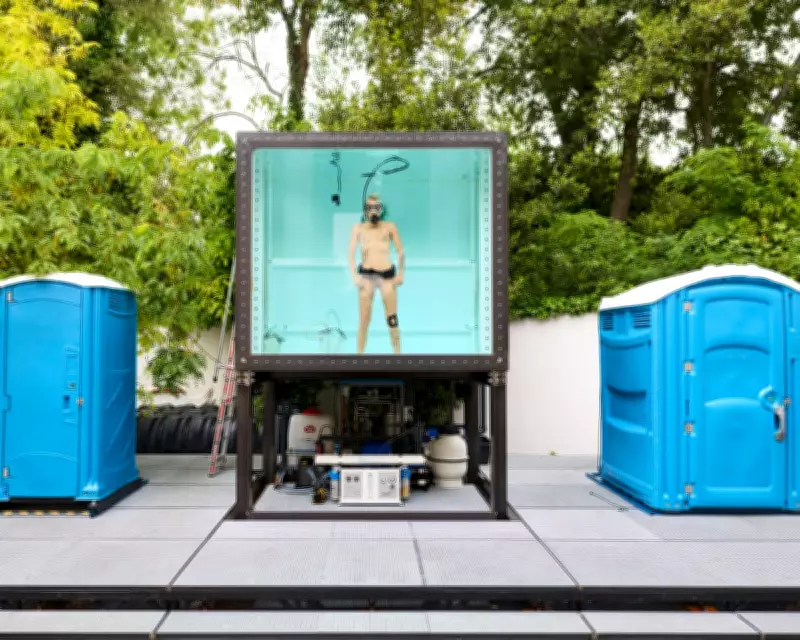
The national pavilions are less aggravating than the main show. Some are even fun, which is unusual for contemporary art. Denmark's pavilion is a hi-tech sperm bank; Luxembourg's features a singing turd; Japan's forces visitors to care for fake babies. Malta presents a life-size chocolate Russell Crowe. Belgium's pavilion resembles a hyper-serious art school version of the Blue Man Group, with bozos screaming and hitting drums—ludicrous, silly, and quite funny. Andreas Angelidakis turns Plato's Cave into a nightclub/kink dungeon for Greece, with deflated phallic columns critiquing the commercialization of Greek culture. Florentina Holzinger's Austria pavilion draws queues for its confrontational, sewage-drenched performance. She rings a bell with her naked body, nude women climb a metal mast, and a performer does doughnuts on a jetski. A woman in a scuba mask is submerged in a tank connected to portaloos; visitors can urinate, and the filtered urine feeds the tank. She swims in processed piss for hours. Next door, a sewage system sprays raw effluent into a locked room, covering windows in brown fluid. It is brilliantly obscene and vile, addressing climate change, rising sea levels, and hidden support systems on the brink of collapse.
Other Powerful Pavilions
Slovenia's pavilion has fallen to ruin, with piles of cinder blocks and rubble. Nonument Group commemorates a mosque built in the Slovenian Alps in 1917, a moving monument to loss and militarization. It is one of the few works tackling war and its legacy. The Vatican's off-site pavilion in the Carmelite Brotherhood gardens offers sonic calm. Musicians like Devonte Hynes, Terry Riley, Meredith Monk, and Brian Eno created music inspired by Hildegard of Bingen. Visitors walk through lavender and verbena, listening through headphones, entering a meditative state. During a thunderstorm, the experience becomes profound—a brief escape from war and conflict. The Israeli pavilion is a water feature, the Russian pavilion resembles a bad florist, and the American pavilion is boring hotel lobby art. The controversy surrounding these pavilions fizzled out.
Unofficial Exhibitions: True Artistic Bravery
The political cowardice of the main exhibition is starkly contrasted by unofficial works around Venice. Belarus Free Theatre's presentation exposes totalitarianism with a wheat field and a crucifix of CCTV cameras. Gabrielle Goliath's installation, originally intended for the South African pavilion but cancelled by the culture minister for being 'too divisive,' is housed in a church. Her video features singers sustaining notes of mourning for women lost to colonial and sexual violence, creating a stunning lament. At Fondazione Prada, Richard Prince and Arthur Jafa's show explores American appropriation—punk thievery, racial hatred, and sexual exploitation. Lorna Simpson's retrospective at Pinault Collection features images of race riots and bullet holes. Lawrence Abu Hamdan's film at Fondazione Inbetween Art Film confronts sonic weapons used against students in Belgrade. Maya Watanabe's film shows a mammoth carcass emerging from Siberian permafrost, a portrait of ecological disaster.
Tech and Minimalism
While tech is absent from the main show, it is present elsewhere. Eva and Franco Mattes cleverly tackle AI and cat memes at Palazzo Franchetti. Holly Herndon and Mat Dryhurst's co-curated show at Palazzo Diedo dives into 'protocol art' with AI networks and machine learning. Lydia Ourahmane's show at Nicoletta Fiorucci Foundation features the smell of simmering stock, moulds for Venetian sculptures, and beaded curtains—reconstituted materials of Venice, exploring belonging. It is ultra-minimalist and moving. This review barely scratches the surface. Georg Baselitz's haunting final works on San Giorgio, Jenny Saville, and Sanya Kantarovsky shows are omitted. Thousands of artworks, countless exhibitions, and billions of ideas overwhelm. The only recourse is to seek connection, to find something that triggers heart or brain. What triggers one may differ, but if it is to be found anywhere, it is in the alleys and palazzos of Venice and its vast, messy Biennale.