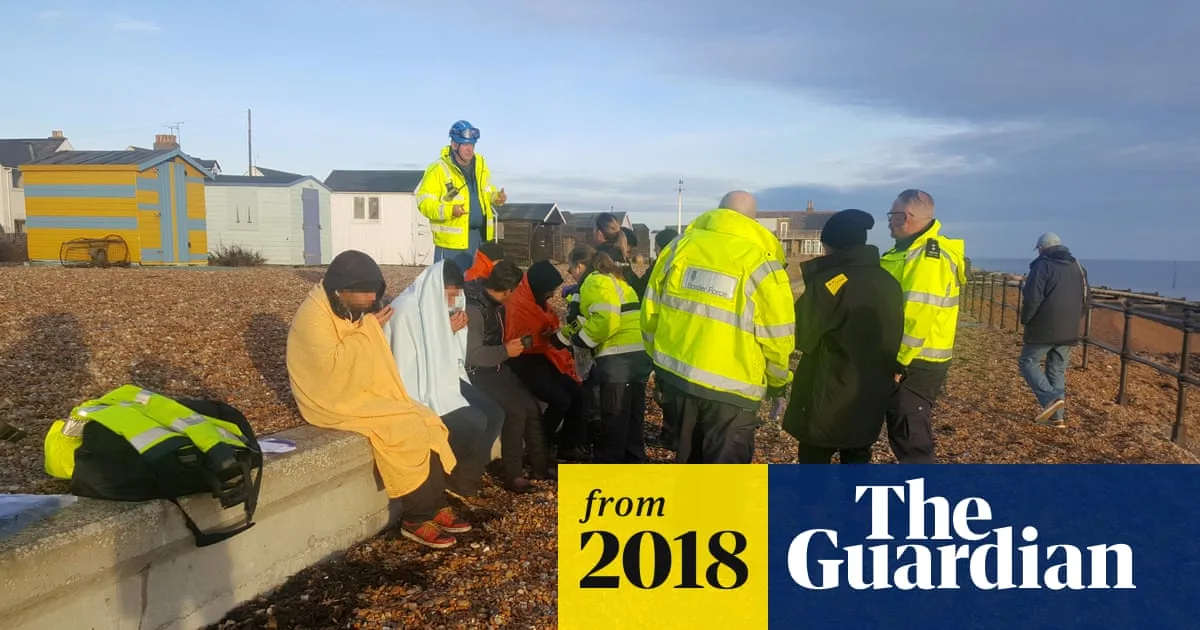
On the outskirts of the French port city of Calais lies a secluded forest where Iranian migrants conceal themselves within a tented encampment, biding their time for an opportunity to cross the English Channel on small, overcrowded boats bound for Britain. During a visit to this camp of approximately 400 individuals in early autumn last year, a 28-year-old migrant named Amir, hailing from an Iranian city near the Caspian Sea, revealed the straightforward process of securing trafficker assistance. 'It is easy to find a trafficker to help us,' Amir explained. 'We go to the canal near the Calais town hall to talk to the right men, or they come here to find us.'
Successful Crossings and Growing Camps
Shortly after this encounter, Amir successfully reached Dover and was subsequently relocated to a migrants' hotel. He represented one of 4,400 Iranians who illicitly traversed the Channel from France to Kent aboard trafficking gang vessels in the previous year. However, the squalid camp Amir departed is anticipated to expand significantly in the near future. Both the entire European Union bloc and Britain are preparing for a dramatic surge of Iranian refugees as the conflict initiated by US President Donald Trump to enforce regime change in Iran continues into its second week without a clear resolution in sight.
New Arrivals and Historical Parallels
Recent reports indicate that additional Iranian migrants have arrived on the French coast, determined to reach British shores. Dozens of individuals are said to have travelled via Turkey in vans to a camp in Dunkirk, appearing as the vanguard of a new influx from Iran into Europe. For decades, observers have witnessed mass migration across the continent, often with trepidation regarding its consequences for host nations. In 2015, following German Chancellor Angela Merkel's decision to open her country's borders to those fleeing the Syrian civil war, the initial wave of Syrian refugees entered Germany. Four young Syrian men, aspiring to become BMW engineers, expressed despair in a coffee bar conversation, noting that only a third of their fellow travellers who reached Europe were genuinely from Syria.
The migration chaos that ensued has permanently altered Europe's demographic landscape. As the Syrian quartet accurately predicted, countless individuals from nations unaffected by war responded to Merkel's controversial invitation, with 1.3 million newcomers entering Germany within the first year alone. Within weeks of that Berlin meeting, Pakistanis who had abandoned stable employment loading luggage on forklift trucks at Karachi airport were settling in a provincial German town, successfully demanding an asylum house for themselves and their families. Similarly, Roma people from the Balkans seized the chance for improved livelihoods, begging on Parisian streets and residing in derelict vehicles in suburban areas. 'We have a right to be in Europe, like anyone else,' the amiable matriarch of one family asserted.
Unprecedented Scale and Security Concerns
The migrant throngs arriving in 2015 were largely uncontrolled, creating a free-for-all scenario. Yet the aftermath of the Iran conflict may prove even more consequential. Many Iranians are fleeing towards the Turkish border, initiating what the EU asylum agency recently warned could become a migration influx 'of unprecedented magnitude'. The agency cautions that if merely ten percent of Iran's 90 million citizens head towards Europe and Britain, border systems could be overwhelmed, rendering the 2015 crisis—now widely viewed as Merkel's folly—a mere historical blip.
Most are aware that Merkel's welcome facilitated the entry of unsavoury opportunists into Europe and Britain, aided by inadequate border controls, resulting in terror atrocities and cultural clashes that have scarred the continent over the past decade. A new migration wave comprising millions of Iranians may yield worse consequences than previously witnessed. The question remains: who will arrive on European shores this time?
Personal Stories and Regime Oppression
Numerous Iranians in Britain have escaped the brutal and unyielding mullah regime. One individual arrived via a Channel boat after being imprisoned in Tehran's notorious Evin prison for wearing a US T-shirt in public. Another, an English teacher, was incarcerated merely for conversing with a platonic female friend in his car. A third, a photography student, fled to Britain due to his sexual orientation—homosexuality being a crime often punishable by death in the theocratic state. He crossed into Turkey covertly after being pursued by the infamous Islamic Revolutionary Guards Corps (IRGC), the central pillar sustaining the Iranian regime.
The IRGC has maintained an iron grip over the Iranian population since the 1979 revolution overthrew the Shah. Despite recent airstrikes, it operates a ruthless paramilitary wing, a nationwide propaganda unit, 150,000 ground troops, 20,000 naval personnel, and aerospace and nuclear enrichment divisions. Its ranks include thousands of scientists, academics, economists, and industrialists. The IRGC's secret police oversee an extensive network of neighbourhood spies, surpassing the efficiency of the old East German Stasi, reporting on infractions such as women revealing hair from compulsory hijabs, alcohol consumption, student unrest, and political opposition meetings.
Global Reach and Domestic Threats
Iran's founding constitution endowed the IRGC with 'an ideological mission' to extend 'jihad in God's ways throughout the world', instructing the Corps to spread its influence not only into neighbouring nations but also into Western countries, including Britain. Nearly half a century later, the IRGC's presence is felt on British streets, and the current crisis may precipitate further infiltration. Iranian migrant friends in London decline invitations for Persian meals, claiming that many national restaurants in West London are operated by Revolutionary Guard supporters. Distressed calls from weeping Iranians in Liverpool describe narrow escapes from being struck by cars while crossing roads, attributing these incidents to Revolutionary Guard operatives 'here among us'.
Last month, the IRGC was designated a terrorist organisation across the European Union, following its existing proscription in the US. The Tony Blair Institute has long advocated for its outlawing in the UK. While some individual henchmen have been sanctioned, the current Labour Government maintains that a total ban is inappropriate for a 'foreign state organisation'. Recently, Foreign Secretary Yvette Cooper continued to resist proscription despite Liberal Democrat leader Ed Davey's demands for action. Davey's party, planning an emergency Parliamentary bill to ban the IRGC, asserts the group 'has long been the architect of brutal domestic repression, as well as a threat to UK security and the safety of Iranian and Jewish communities across Britain'.
Intelligence Warnings and Hopeful Aspirations
MI5, Britain's internal intelligence service, has disclosed that the IRGC and its proxies are responsible for 20 'potentially lethal' terror plots, sectarian violence, and intimidation of Iranian regime opponents within the UK. As the conflict commenced last weekend, an Iranian migrant friend residing in the Midlands expressed hopeful anticipation: 'We want to go home to a new Persia which is not run by the ayatollahs. We are excited, we are hopeful. Soon, I will take you to meet my family, to show you a free Iran, the most beautiful country in the world.' However, subsequent WhatsApp messages conveyed deepening gloom as news of an expected migration upsurge to Europe emerged. 'I am praying the Revolutionary Guard will not be among those who slip in on the boats,' he stated, adding, 'They must not have any more places here in Britain.' As a new refugee crisis intensifies in the Middle East, these cautionary words may indeed prove prophetic.