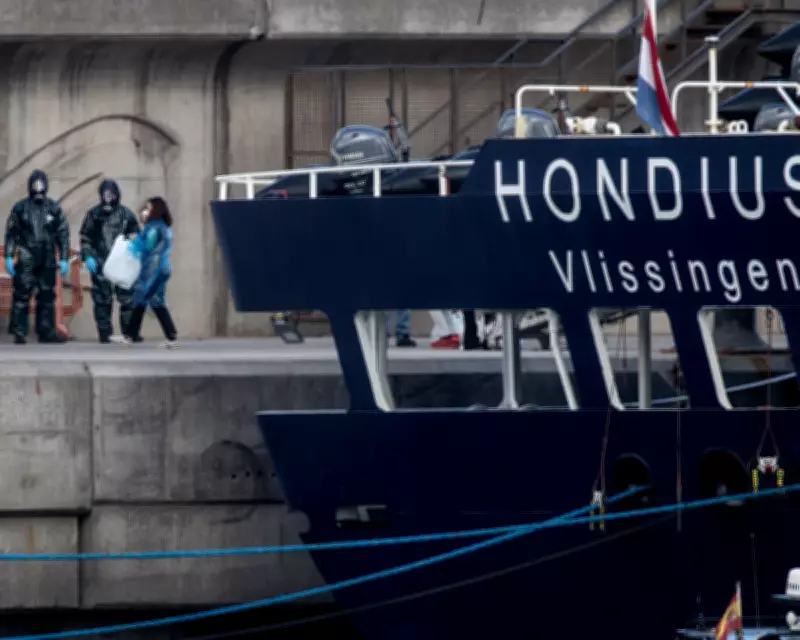
A French woman who tested positive for hantavirus after being evacuated from a cruise ship reported symptoms to doctors onboard but was told it was probably just anxiety, the Spanish health minister has said.
Javier Padilla Bernaldez stated that the woman, traveling on the MV Hondius at the center of a deadly hantavirus outbreak, had been suffering flu-like symptoms. However, they appeared to be improving, and she did not have a fever. The World Health Organization later described her condition as "very critical."
Evacuation and Quarantine
The MV Hondius departed the Canary Island of Tenerife on Monday evening after 120 people from 23 nations were repatriated over 48 hours. Spanish authorities described the operation as "complex" and "unprecedented." On Tuesday night, the last two evacuation planes carrying passengers and crew landed in the Netherlands.

Twenty-six crew members and two health workers remained on the ship as it headed to Rotterdam for disinfection. The vessel also carries the body of a German passenger who died during the voyage.
Medical Oversight
Despite three deaths and eight confirmed cases, doctors from the European Centre for Disease Prevention and Control and the Spanish foreign health service assessed the French woman and dismissed her symptoms as anxiety or stress, Padilla said.
"They were not thinking these symptoms were compatible with hantavirus. Why? Because what she was telling them was an episode of coughing some days ago that had disappeared, and what she was having at that moment was kind of like stress or anxiety or nervousness. So it was not catalogued as hantavirus," Padilla explained.
Speaking as the ship left Tenerife, WHO Director-General Dr. Tedros Adhanom Ghebreyesus thanked Spain for its assistance and noted that the French passenger was now in a "very critical" condition. "Imagine if she stayed longer on the ship," he said.
Response and Testing
The French woman was among five French passengers who disembarked in Tenerife on Sunday before being flown to a hospital in Paris. French Health Minister Stephanie Rist said the woman began feeling very unwell on Sunday night, and "tests came back positive." Her symptoms worsened overnight, and she is being treated in a specialized infectious diseases unit in Paris.
Personnel in full-body protective gear began escorting travelers from ship to shore on Sunday. The WHO and Spanish government had earlier reassured the public that all 149 passengers and crew were asymptomatic. Padilla defended the approach, noting that some cases may have mild symptoms, and all passengers were advised to isolate for 45 days from last exposure, agreed as May 6.
In Spain, evacuees were taken to a military hospital, while 22 British people, one German, and one Japanese person were taken to Arrowe Park Hospital in Merseyside for quarantine and testing. UK health officials said clinical assessments were "well underway," with the group staying three days before continuing isolation at home for 42 days or in other accommodation.
International Coordination
Each of the 23 countries involved is responsible for deciding their own measures. Padilla said the situation with France demonstrated good practice in public health management, as quarantine was already in place. He noted that the woman's condition deteriorated between the ship and the plane, with fever appearing after takeoff.
An American passenger flown to Nebraska also tested positive but had no symptoms. The US health department reported one positive case for the Andes strain, the only hantavirus strain transmissible between humans, and another with mild symptoms. Both the WHO and Spanish government said the positive was not strong enough to be conclusive and did not count it in official figures.
Padilla explained that onboard testing was impossible due to the lack of rapid PCR tests for hantavirus. Samples would have needed to be flown to Madrid, taking 24 hours, which would have been impossible due to forecast high winds from Monday evening, described as "hell" on Tuesday.
Ship's Departure and Outbreak Origin
High winds forced the ship to dock Monday afternoon for safety, despite Spanish government insistence that it would not, after Canary Islands President Fernando Clavijo argued that docking increased the risk of rats spreading hantavirus to land.

Of the two planes landing in the Netherlands on Tuesday, one carried six former guests from Australia, New Zealand, and a British person living in Australia, who will quarantine near the airport before repatriation. The other carried 19 crew members, a British doctor, and two epidemiologists.
The outbreak's cause is unknown but is thought to have spread person-to-person, brought onboard after a birdwatching trip in Argentina by a Dutch couple who became the first fatalities. A spokesperson for Clavijo said the president did not think enough precautions were taken but hoped "everything ends fine for the passengers and operators."
No vaccines or specific treatments exist for hantavirus, which is endemic in Argentina. Health officials have said the global public health risk is low and have downplayed comparisons with the Covid-19 pandemic. Authorities in several countries are tracking passengers who left the ship and their contacts.