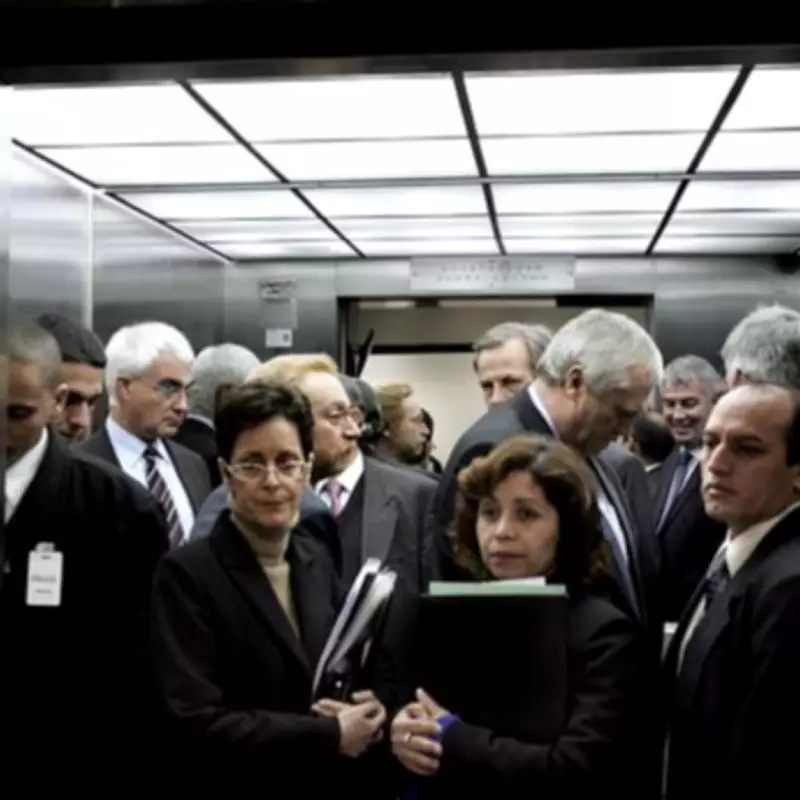
A new study suggests that lifts in Britain may be unsafe due to rising obesity rates, as capacity limits have not been updated for decades. Experts warn that people risk getting stuck in lifts and that obese individuals face stigma when lifts become too full.
Outdated Assumptions
Researchers from University College London (UCL) assessed lift weight signs across Europe and found they have not been revised to reflect the increased weight of the average citizen since the turn of the century. Historic standards assumed an average weight of just under 12 stone (75kg), which was the average weight of a UK man in the mid-1970s. However, the average UK man now weighs 86kg, and the average woman 73kg.
Safety Concerns
Author Nick Finer, clinical professor of medicine at UCL, said: "The failure of lift manufacturers to adapt to rising levels of obesity and body size means that lift capacities are overestimated, leading to increased journey times and potential safety compromises." He noted that some lifts have safety cut-outs when weight limits are exceeded, but not all do. "I have already had people tell me they know individuals who have been stuck in lifts because the total weight was exceeded, even with fewer people than the stated maximum," he added.

Lift manufacturers are required to display maximum weight allowance and passenger capacity, which is calculated by dividing the maximum load by the average passenger weight. The study looked at lift safety in the UK, France, Germany, Italy, Spain, Austria, and Finland. It showed that weight capacity limits increased broadly in line with average body weight between 1972 and 2002, rising from about 62kg to 75kg per person. But since then, companies have continued using the same limit, despite the obesity epidemic.
Proposed Changes
Prof Finer said US scientists proposed raising the standard to 80kg in the 2020s, but it was not widely adopted. He explained that manufacturers now calculate the floor space a person occupies, assuming an oval shape rather than a circle. "They have completely failed to recognise that if obesity is increasing, so is the amount of room you take up," he said.
Three in 10 UK adults are obese, about 16 million people. Experts say this is an example of how communal environments have not been adapted for plus-sized citizens. Prof Finer noted that train and plane seats and doorways are also poorly sized for larger individuals. "I just think we need, sadly, to super-size many of the things in life," he added.
Industry and Expert Reactions
Some airlines, including Southwest in the US, now require plus-sized passengers to book two seats if they cannot fit comfortably. Air France offers a discount on the second seat for such passengers. Registered nutritionist Louise Payne said: "People living with obesity face daily barriers that most of society never has to think about. This is not just about comfort; it's about dignity, accessibility, and inclusion." Jane DeVille-Almond, president of the British Obesity Society, added: "We need to accept that society is unlikely to revert to sizes from 50 years ago and start developing facilities for the 21st century."