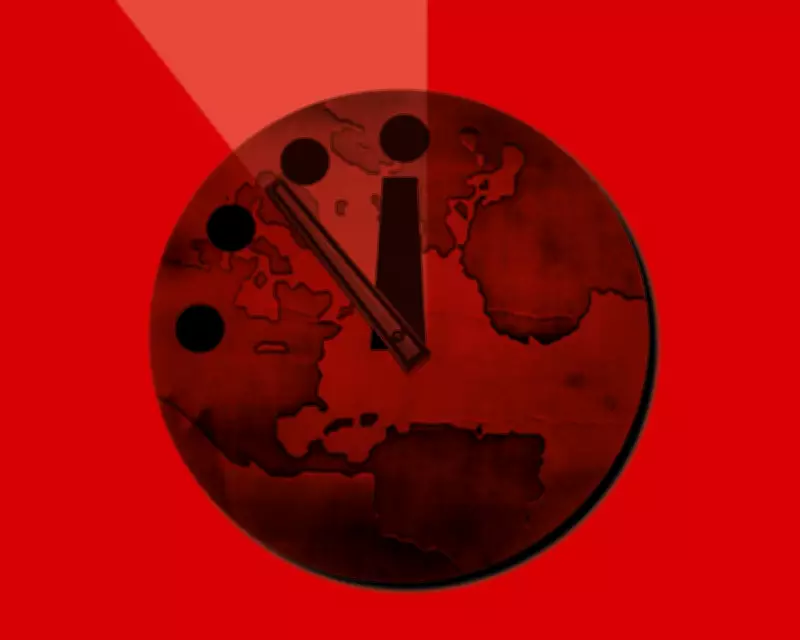
The Doomsday Clock is ticking, and it has never been closer to midnight. At 85 seconds to the apocalypse, humanity faces a confluence of existential threats: war in Ukraine and the Middle East, escalating nuclear tensions, climate breakdown, and the rapid, unregulated advance of artificial intelligence. The clock, a symbolic measure of global catastrophe risk, is set by the Bulletin of the Atomic Scientists, a group of experts who warn that we are sleepwalking towards disaster.
Who Sets the Doomsday Clock?
The clock was established in 1947 by Manhattan Project scientists who felt a deep responsibility to warn the public about the dangers of nuclear weapons. Initially set at seven minutes to midnight for aesthetic reasons, the clock has been adjusted over the decades by a board of scientists, academics, and diplomats. Today, the Science and Security Board, chaired by astrophysicist Daniel Holz, meets annually to assess global threats and reach a consensus on the time.
The Clock's History: From Seven Minutes to Seconds
In 1947, the first clock was set at seven minutes to midnight. It moved to three minutes in 1949 after the Soviet Union tested its first nuclear bomb, and to two minutes in 1953 following the hydrogen bomb. The closest it ever came to midnight before the 2020s was in 1953. The furthest was 17 minutes in 1991, after the Cold War ended. Since 2020, the clock has been measured in seconds, reflecting the heightened urgency.

Why Is the Clock So Close Now?
Alexandra Bell, CEO of the Bulletin, cites a "complete failure in leadership" globally. The war in Ukraine and Israel's bombing of Iran have increased nuclear risks. Climate change exacerbates conflicts, and AI integration into military systems is terrifying. A recent study found that leading AIs chose to use nuclear weapons in 95% of simulated war games. The pandemic response has weakened, and new pathogens pose additional threats.
Can We Turn the Clock Back?
History shows it is possible. The clock was set back after the Partial Test Ban Treaty in 1963 and after arms reduction agreements. Public pressure has driven nuclear disarmament before, reducing the global arsenal from 70,000 to around 12,000 warheads. Bell emphasizes that elected leaders care about constituent calls, so individuals have agency. The Bulletin's goal is to raise awareness and prompt action.
Perspectives from the Scientists
Kennette Benedict, former executive director, broadened the clock's scope to include climate change and disruptive technologies, despite criticism. She remains optimistic, noting that humanity has pulled back from the brink before. Rachel Bronson, her successor, says the work is hopeful because good people are working on solutions. Daniel Holz, the board chair, uses his cosmology background for perspective: "The universe isn't going to save us; it's up to us."
A 103-Year-Old Scientist's View
Dieter Gruen, a Manhattan Project veteran at 103, feels the current peril is worse than the Cuban missile crisis. He worries about Iran's enriched uranium and the lack of a plan to secure nuclear materials. His long life gives him a unique perspective, but he is somber about the future.
What Can We Do?
The clock is a wake-up call, not a prediction. It aims to prompt leaders and citizens to act. Bell says, "If we get the nuclear problem wrong, nothing else matters." The Bulletin encourages public engagement, education, and advocacy for arms control and climate action. The first step is awareness, which can lead to feeling and then to action.
The Doomsday Clock remains a powerful symbol, distilling complex existential threats into a simple measure. It reminds us that the odds are not in our favor, but we have the power to change them. The question is whether we will act before it is too late.