Labour is set to lose control of 50 local authorities at next month's elections in the face of a Reform UK and Green Party surge, an AI-powered model has shown.
Reform UK and Green Party Predictions
In an update to its local elections model ahead of the 7 May contests, data insight firm Bombe projected Reform will win the most council seats overall. Nigel Farage's party are forecast to perform particularly well in working-class towns in Norfolk, Suffolk, Essex and the North of England. They will also enjoy success in some urban wards, including pockets of the Manchester area, Newcastle and across the Midlands, according to the research.
Meanwhile, the Greens are predicted to win outright control - or become the largest party - in a number of inner London boroughs. These include Lambeth, Lewisham, Hackney, Southwark and Greenwich while, outside the capital, Zack Polanski's party is also expected to perform well in Manchester, Oxford and Cambridge.

Overall Council Control Projections
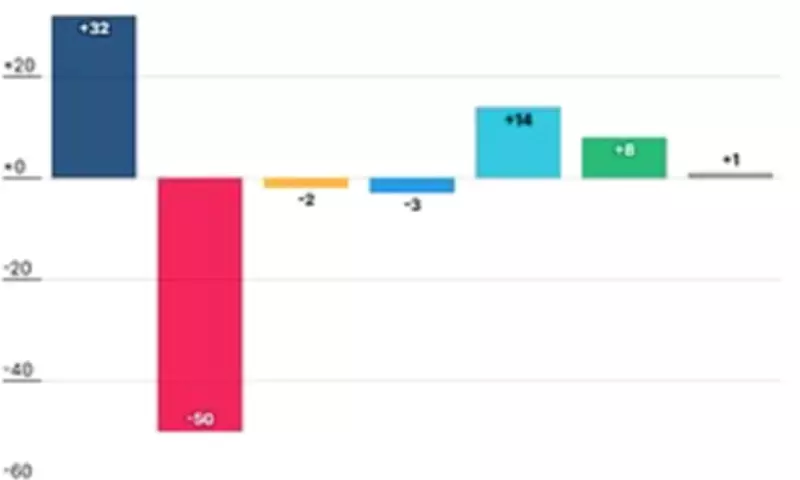
Overall, according to the latest Bombe model, Reform will gain control of 14 councils, while the Greens will gain control of eight. The Liberal Democrats are predicted to lose two councils and the Tories will lose three, while there could be a huge increase in the number of councils left under no overall control.
Reform are projected to gain around 1,380 council seats across England, with the Greens gaining an extra 700 councillors. Labour are forecast to lose 1,400 seats, with the Tories losing just over 200, and the Lib Dems shedding 160 councillors.
Knife-Edge Wards and Methodology
The research also suggested a significant number of wards are sitting on a knife-edge ahead of the 7 May vote. Bombe found the margins across a significant number of wards is 'extremely fine', with some areas set to be won and lost on just handfuls of votes. The firm said that even very small shifts - such as in turnout - could change outcomes in a meaningful number of seats.
Its updated model incorporates individual candidate data, county council geography and boundary changes, while it uses ward-level voting behaviour between 2022 and 2026. The model uses Gradient Boosted Regression Prediction (GBRP) and is validated against real-world results. It correctly called 17 of the 20 most recent by-elections at 85 per cent accuracy.
CEO Comments
Mike Joslin, co-founder and CEO of Bombe, said: 'Our pioneering machine learning technology is now able to predict individual candidates in a way other companies have not attempted. It accounts for historic incumbency, local candidate profile and thousands of other factors drawn from real-world behaviour across the last four years.'
'The sheer number of boroughs under no overall control tells you everything about how tight this election will be. There will be wards won and lost on handfuls of votes. The Green advance in inner London is a significant political story. We are predicting them to win in inner-city communities like Lambeth, Hackney and Lewisham, where Labour have held power for decades - former heartland territory. That is a fundamental shift.'