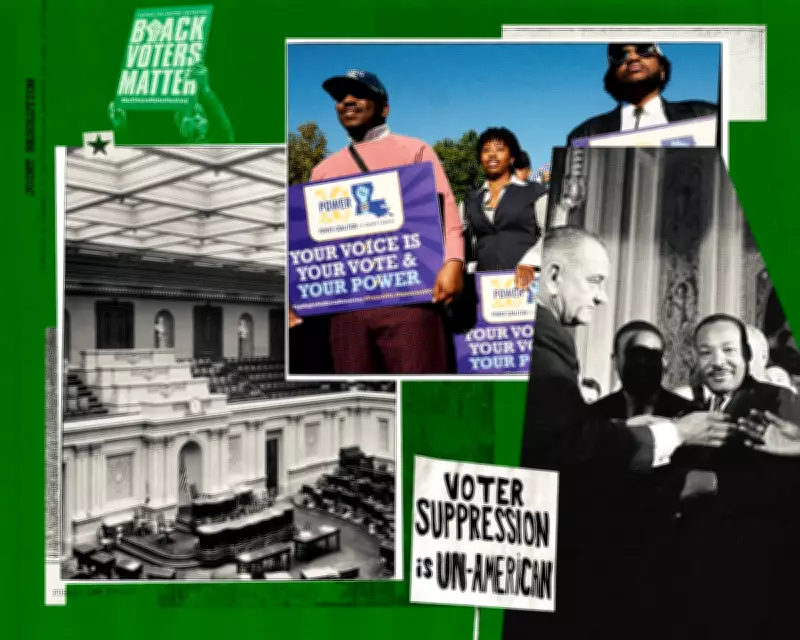
Following the US Supreme Court's decision to effectively dismantle a key provision of the Voting Rights Act, voting rights advocates and Democratic lawmakers have intensified their push for state-level voting rights acts to safeguard voters.
Supreme Court Ruling and Its Impact
The Supreme Court's ruling in Louisiana v. Callais struck down Section 2 of the Voting Rights Act, which had been instrumental in ensuring fair treatment for minority voters during redistricting. This decision weakens the ability of Black voters to elect their preferred representatives and triggers a new wave of redistricting challenges in an election year.
State-Level Responses
Currently, nine blue and purple states have enacted their own voting rights acts, providing protections against voter suppression, vote dilution, and intimidation, along with pre-clearance requirements for voting changes. Eleven other states, including several in the South, have introduced similar bills.

However, state voting rights acts cannot fully replace the federal law, especially in Republican-dominated Southern states where they face the greatest opposition. Election law experts warn that the Callais decision may inspire legal challenges to state acts, though proponents remain confident in their legal foundation.
Advocates' Perspectives
Janai Nelson, president of the NAACP Legal Defense Fund, emphasized the urgency of passing state voting rights acts as an alternative to the weakened federal law. “We were just stripped of one of the most potent and transformative tools that this country has ever known,” she said, calling for additional measures.
Adam Lioz, senior policy counsel at the Legal Defense Fund, noted that state acts provide a pathway for affirming voting rights and building momentum for federal action. Even in challenging environments, these proposals offer a positive vision contrasting with restrictive voting laws in red states.
Legal Challenges and Uncertainties
Rick Hasen, an election law expert at UCLA, predicted new legal challenges to state voting rights acts based on the Callais ruling. The conservative majority opinion by Justice Samuel Alito signaled potential concerns about race-conscious legislation. A New York town's amicus brief in the case argued that its state voting rights act raises constitutional issues beyond those of the federal law.
Despite uncertainties, state courts have upheld voting rights acts where challenged. Aseem Mulji of the Campaign Legal Center urged states not to “throw in the towel” but to creatively protect voters through various means, including race-neutral approaches.
Looking Ahead
State voting rights acts, such as California's 2002 law and Maryland's recently enacted statute, represent a crucial tool for protecting minority voting power. While the Callais decision is a significant setback, advocates remain determined to advance these measures, viewing them as a foundation for future progress.