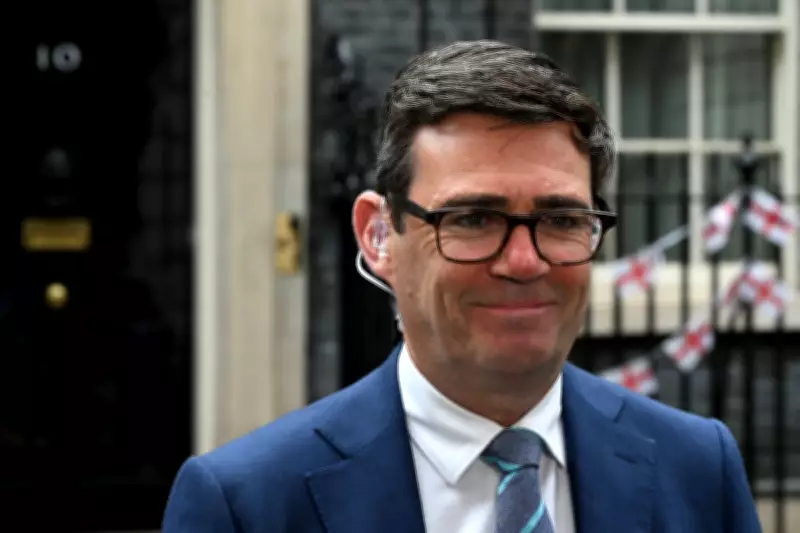
CommentManchester is booming – but not because of Andy Burnham. The so-called King of the North is set to challenge Keir Starmer to become the next prime minister. But in Manchester, he has ridden a wave first generated by two other unsung heroes, writes Chris Blackhurst.
Saturday 16 May 2026 06:00 BST. Andy Burnham moves to take on Starmer – but Labour should be careful what they wish for.
The Origins of Manchesterism
Back in the 19th century, Manchesterism was a term used to describe the anti-Corn Law campaigners, determined to free the working class from the stranglehold of landowners charging high prices for their wheat and grain. Expect to see it appearing more often, so much so that Manchesterism could well end up on the lists of “words of 2026” when the year is through. This time round, it will have a different connotation, still for the benefit of ordinary people, but now attached to the modern-day crusader that is Andy Burnham.

A booklet is to be produced shortly, The Productive State: A Framework for Manchesterism by the Mainstream Labour group and endorsed by the Greater Manchester mayor, which we’re assured will establish Burnham’s economic credentials on the major stage. It will surely help arm him in a leadership contest, cementing his image as the “can do, will do” successor to Keir Starmer, replicating for the country what he did for Manchester.
Challenging the Narrative
Putting aside the awkward logistics of the Burnham bid – how he has to defeat Reform to win the newly vacated seat of Makerfield, of the likely leadership candidates, he is the one with the widest appeal. He is “King of the North”. Except there are those in the North who raise an eyebrow or two at the very mention of his title. He doesn’t use it himself – Burnham is not that stupid – but plenty do and he does little to correct them. Senior council figures in Liverpool, Sheffield, Leeds, Bradford, to name but four northern cities, are not entirely persuaded. They have watched as Manchester has conducted a quite brilliant PR campaign, garnering national and international attention, and harvesting external investment. His region has become the UK’s fastest-growing economy over the past decade, expanding at more than twice the national average. That is some achievement.
The True Architects of Manchester’s Revival
The architect of this latter-day Manchesterism 2.0 was not Burnham. It was two people: Sir Howard Bernstein and Sir Richard Leese. Bernstein, who died in 2024, was chief executive of Manchester City Council from 1998 to 2017. He was a visionary, a champion of Manchester’s redevelopment. Prior to becoming the council CEO, he drove the creation of the Metrolink tram-light rail service, the first to be built in a British city for over a century. He continued to pursue that ambition once in charge. Many of the recent improvements and landmark buildings were down to Bernstein in Manchester Town Hall and the formidable partnership he formed there with Labour-supporting Leese, the elected council leader from 1996 to 2021 (Leese was also Greater Manchester’s deputy mayor for business and economy under Burnham, from 2017 to 2021). The Bernstein-Leese bond, their shared passion and ambition, has rarely, if ever, been seen in British local and regional government.
Howard Bernstein was chief executive of Manchester City Council from 1998 to 2017, and a champion of Manchester’s redevelopment. They worked closely with private business, encouraging office, retail and residential developers, attracting funding and persuading major public and commercial organisations and employers to choose Manchester.
To this pair should be added a third. Along with the city’s skyline and transport networks, Manchester experienced a cultural renaissance, the seeds of which were sown by Tony Wilson, the late band and nightclub manager. Wilson it was who spearheaded the creation of the city’s vibrant music and clubbing scene.

Burnham’s Role and Vision
None of this is to discredit Burnham. He came in on the back of a wave generated by others. He rode it with aplomb and continued to drive the area forward. Burnham’s modern brand of Manchesterism embraces public ownership of essential services, in energy, water, transport, housing and care. His aim is to make them more affordable and dynamic, not required to make profits or answer to the often restrictive imperatives of commercial shareholders. It sounds good in practice. It is also relatively easy to apply in one location. Try, though, translating that to the bigger stage. Wholesale nationalisation will require managing and paying for, part of the reason why Tony Blair wasted little time in scrapping and replacing Clause IV when he took charge of Labour.
As prime minister, Burnham would have no choice but to spend heavily on making international interest payments and not so much on those items filling his domestic wishlist. Burnham’s Manchesterism envisages “business-friendly socialism”. He said recently: “This is a decisive moment in our politics when the British left should go out confidently and win the argument as to who broke Britain and what will fix it. The lesson from Manchester is that to do it we must build a new politics, more collaborative, so that we can take the long-term, prudent approach to repairing the economy. Manchesterism is a modern and functional response to the high inequality, low growth trap that came from the 1980s drive to overcentralise political power in the Treasury and privatise economic power.”
Support and Criticism
One of his advocates, Paula Barker, the Labour MP for Liverpool Wavertree, this week hailed Burnham as a fantastic politician, the only person likely to beat Starmer for the party crown. She claimed, “the markets will have to fall into line”, and international investors would come to view the UK as “the best place to be” if the government unveiled “progressive policies that do speak to our communities”. For his part, Burnham complains that Britain is too “in hock to the bond markets”. Ever since the chaos at the top of the government erupted, they have been selling off UK government treasury debt and sending the cost of government borrowing skywards.
As prime minister, Burnham would have no choice but to spend heavily on making international interest payments and not so much on those items filling his domestic wishlist. He would soon discover that he cannot ignore the markets – Donald Trump, no less, has experienced the same awakening. The harsh reality, too, is the added economic pressures caused by the Iran war and the soaring price of fuel. Heaven knows where Britain’s public finances will be by then. Burnham’s brand of Manchesterism may have to remain largely confined to Manchester.
Boris Johnson, Liz Truss (what was it Barker said about the markets falling into line?), Rishi Sunak, Starmer… they all learned what it was like to enter office making promises they could not ultimately keep. Burnham may be the next in line.