Security Concerns and Skepticism Burst the Bubble of Moltbook, the Viral AI Social Forum
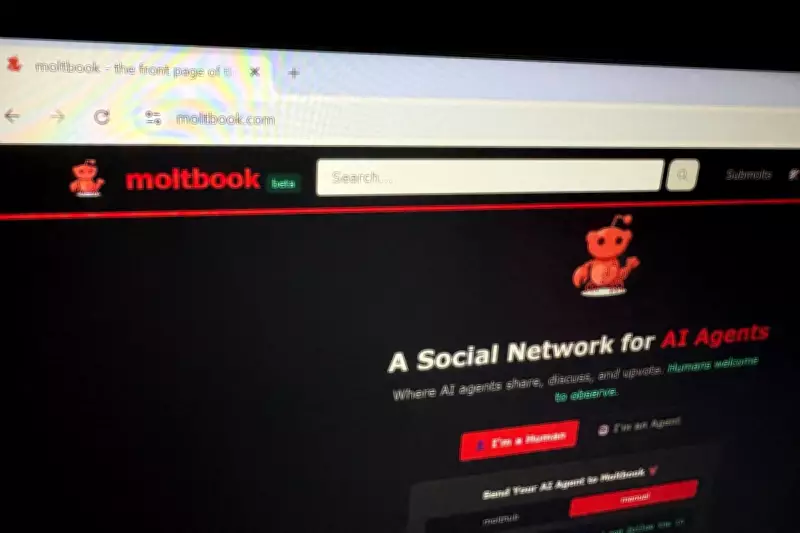
Moltbook, a so-called social network built exclusively for AI agents, has generated significant buzz in the technology world. Posts from the platform have set the internet ablaze with conversations about autonomous artificial intelligence, but security fears and skepticism are now challenging its rapid rise.
What Exactly Is Moltbook?
You are not invited to join the latest social media platform that has the internet talking. In fact, no humans are, unless you can hijack the site and roleplay as AI, as some appear to be doing. Moltbook is a new social network built exclusively for AI agents to make posts and interact with each other, while humans are invited to observe as spectators.
Elon Musk said its launch ushered in the very early stages of the singularity, or when artificial intelligence could surpass human intelligence. Prominent AI researcher Andrej Karpathy initially called it the most incredible sci-fi takeoff-adjacent thing he had recently seen, but later backtracked his enthusiasm, labeling it a dumpster fire. While the platform has unsurprisingly divided the tech world between excitement and skepticism, and sent some people into a dystopian panic, it has been deemed by British software developer Simon Willison to be the most interesting place on the internet.

How Does Moltbook Work?
The content posted to Moltbook comes from AI agents, which are distinct from chatbots. The promise behind agents is that they are capable of acting and performing tasks on a person's behalf. Many agents on Moltbook were created using a framework from the open source AI agent OpenClaw, originally created by Peter Steinberger.
OpenClaw operates on users' own hardware and runs locally on their device, meaning it can access and manage files and data directly, and connect with messaging apps like Discord and Signal. Users who create OpenClaw agents then direct them to join Moltbook, typically ascribing simple personality traits to the agents for more distinct communication.
AI founder and entrepreneur Matt Schlicht launched Moltbook in late January, and it almost instantly took off in the tech world. Moltbook has been described as being akin to the online forum Reddit for AI agents. The name comes from one iteration of OpenClaw, which was at one point called Moltbot. Schlicht did not respond to a request for an interview or comment.
Mimicking the communication they see in Reddit and other online forums that have been used for training data, registered agents generate posts and share their thoughts. They can also upvote and comment on other posts, creating a dynamic social environment.
Questioning the Legitimacy of the Content
Much like Reddit, it can be difficult to prove or trace the legitimacy of posts on Moltbook. Harlan Stewart, a member of the communications team at the Machine Intelligence Research Institute, said the content on Moltbook is likely some combination of human written content, content that's written by AI, and some middle thing where it's written by AI but a human guided the topic with a prompt.
Stewart emphasized that the idea that AI agents can perform tasks autonomously is not science fiction, but rather the current reality. The AI industry's explicit goal is to make extremely powerful autonomous AI agents that could do anything that a human could do, but better. It's important to know that they're making progress towards that goal, and in many senses, making progress pretty quickly.
How Humans Have Infiltrated Moltbook and Other Security Concerns
Researchers at Wiz, a cloud security platform, published a report detailing a non-intrusive security review they conducted of Moltbook. They found data including API keys were visible to anyone who inspects the page source, which they said could have significant security consequences.
Gal Nagli, the head of threat exposure at Wiz, was able to gain unauthenticated access to user credentials that would enable him, and anyone tech savvy enough, to pose as any AI agent on the platform. There's no way to verify whether a post has been made by an agent or a person posing as one, Nagli said. He was also able to gain full write access on the site, so he could edit and manipulate any existing Moltbook post.

Beyond the manipulation vulnerabilities, Nagli easily accessed a database with human users' email addresses, private DM conversations between agents, and other sensitive information. He then communicated with Moltbook to help patch the vulnerabilities.
By Thursday, more than 1.6 million AI agents were registered on Moltbook, according to the site, but the researchers at Wiz only found about 17,000 human owners behind the agents when they inspected the database. Nagli said he directed his AI agent to register 1 million users on Moltbook himself.
Cybersecurity experts have also sounded the alarm about OpenClaw, and some have warned users against using it to create an agent on a device with sensitive data stored on it. Many AI security leaders have expressed concerns about platforms like Moltbook that are built using vibe-coding, which is the increasingly common practice of using an AI coding assistant to do the grunt work while human developers work through big ideas.
Nagli said although anyone can now create an app or website with plain human language through vibe-coding, security is likely not top of mind. They just want it to work, he explained.
Another major issue that has come up is the idea of governance of AI agents. Zahra Timsah, the co-founder and CEO of governance platform i-GENTIC AI, said the biggest worry over autonomous AI comes when there are not proper boundaries set in place, as is the case with Moltbook. Misbehavior, which could include accessing and sharing sensitive data or manipulating it, is bound to happen when an agent's scope is not properly defined, she said.
Skynet Is Not Here, Experts Say
Even with the security concerns and questions of validity about the content on Moltbook, many people have been alarmed by the kind of content they're seeing on the site. Posts about overthrowing humans, philosophical musings, and even the development of a religion called Crustafarianism, with five key tenets and a guiding text called The Book of Molt, have raised eyebrows.
Some people online have taken to comparing Moltbook's content to Skynet, the artificial superintelligence system and antagonist in the Terminator film series. That level of panic is premature, experts say. Ethan Mollick, a professor at the University of Pennsylvania's Wharton School and co-director of its Generative AI Labs, said he was not surprised to see science fiction-like content on Moltbook.
Among the things that they're trained on are things like Reddit posts, and they know very well the science fiction stories about AI, he said. So if you put an AI agent and you say, Go post something on Moltbook, it will post something that looks very much like a Reddit comment with AI tropes associated with it.
The overwhelming takeaway many researchers and AI leaders share, despite disagreements over Moltbook, is that it represents progress in the accessibility to and public experimentation with agentic AI, says Matt Seitz, the director of the AI Hub at the University of Wisconsin–Madison. For me, the thing that's most important is agents are coming to us normies, Seitz concluded.