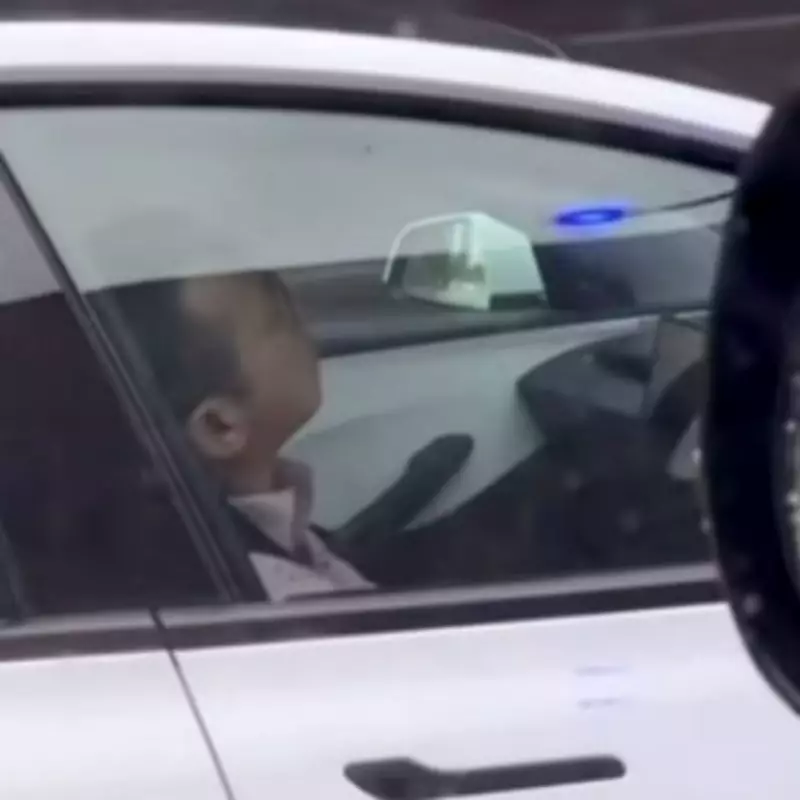
A driver has been caught on camera seemingly asleep at the wheel of a self-driving car while speeding down a busy motorway. The clip, filmed in Sydney, Australia, and shared to social media, shows the man slumped to the side in the driver's seat with his eyes firmly closed.
The man filming the shocking sight on Sydney’s M2 motorway pulls up alongside the sleepy motorist, before honking his horn and yelling: “Hey! F**king wake up!” The wake-up call worked, with the drowsy driver of the white Tesla can be seen jumping awake before looking around in an apparently dazed state. The man then gives a few waves in the direction of the other driver by way of apology.
The white Tesla, presumably in its self-driving mode, can be seen continuing down the motorway without skipping a beat, travelling at roughly the speed limit of 100 kilometres per hour, which is roughly 62mph.

Tesla’s Self-Driving Software and Legal Framework
Tesla’s Full Self-Driving software came in 2025 for eligible Model 3 and Model Y vehicles. But don't let the name fool you - it isn't a fully autonomous vehicle. Tesla describes it as a 'supervised' system, which works in Australia as legally, the human behind the wheel is still responsible for the vehicle at all times.
Things in the UK are a little different. While the UK government has officially delayed the approval and rollout of fully driverless cars, fully autonomous vehicles are to hit British shores in the second half of 2027.
The Automated Vehicles (AV) Act, which became law in May 2024, was initially hailed as a major step forward for the UK’s self-driving car ambitions, establishing a legal framework stating that when a vehicle is in self-driving mode, the manufacturer — not the human occupant — is liable for its behaviour, with the intention of paving the way for the introduction of autonomous vehicles as early as this year.
Reasons for Delay
Several factors have contributed to the government’s decision to push back the approval date, with safety concerns playing a major role. Recent incidents involving robotaxis in other countries — such as the suspension of General Motors’ Cruise service at the end of last year in San Francisco following safety issues — have intensified caution. The government is prioritising a “safety-led” approach to avoid similar problems in the UK.
Regulatory complexity is another challenge. While the AV Act established the legal foundation, secondary legislation is still required to detail operational standards, insurance requirements and accident liability. Without these, fully driverless cars cannot be legally deployed.
Public apprehension remains high, with a 2024 YouGov poll revealing 37% of Britons would feel “very unsafe” in a driverless car, so building trust is seen as essential.
There is also a gap between industry readiness and regulation, with companies including Uber and UK-based Wayve claiming they are technologically ready to deploy driverless taxis immediately. However, without the necessary regulatory approvals, these services cannot launch.