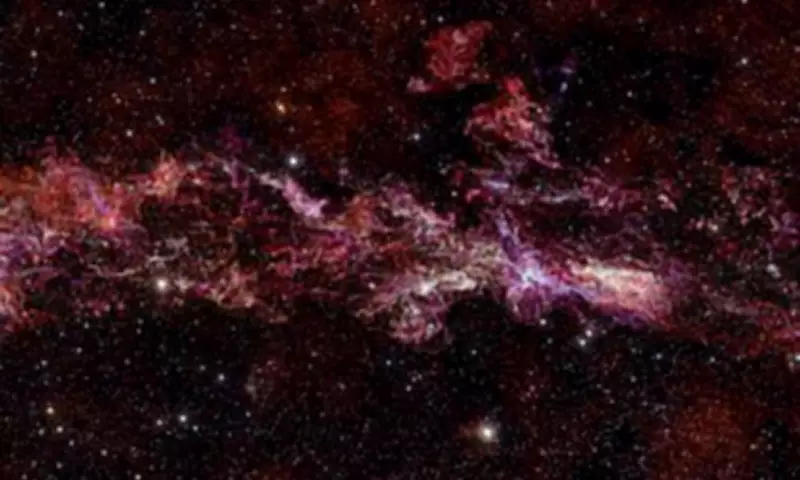
ALMA Telescope Captures Unprecedented View of Milky Way's Chemical Heart
The largest image ever recorded by the Atacama Large Millimeter/submillimeter Array (ALMA) telescope in Chile has unveiled the previously hidden chemical landscape at the very core of the Milky Way galaxy. This monumental image, spanning an impressive 650 light-years, focuses on the Central Molecular Zone (CMZ), one of the most extreme and dynamic environments found anywhere in our galactic neighbourhood.
An Extreme Galactic Environment Revealed
Located approximately 28,000 light-years from Earth in the direction of the Sagittarius constellation, the Central Molecular Zone represents a vast reservoir of swirling cosmic matter and stellar formations. Remarkably, this crowded region contains nearly 80 percent of the entire galaxy's dense gas, making it a crucial area for astronomical study. Dubbed the ALMA CMZ Exploratory Survey (ACES), this comprehensive image provides scientists with an unprecedented window into the complex physical and chemical processes occurring within this galactic nucleus.
The research team discovered an astonishing array of different molecules, ranging from simpler chemical compounds like silicon monoxide to more complex organic molecules including methanol, acetone, and ethanol. Dr. Ashley Barnes, co-author from the European Southern Observatory, explained to the Daily Mail: "One of the most exciting aspects is the rich chemistry we detect. We see dozens of different molecules, including some complex organic molecules that contain carbon, the same element that forms the basis of life on Earth."

Stitching Together a Cosmic Masterpiece
Although this region remains shrouded in cosmic dust that obscures visible light observations, the ALMA telescope possesses the unique capability to image the CMZ's cold gas—the fundamental raw material from which new stars are born. By meticulously stitching together a mosaic containing dozens of individual images, researchers have successfully created an extraordinarily detailed view of this elusive galactic region. From Earth's perspective, the resulting composite image would cover an area of sky equivalent to three full Moons positioned side-by-side.
The very heart of our galaxy contains the supermassive black hole known as Sagittarius A*, which boasts a mass approximately four million times greater than that of our sun. The intense gravitational pull and radiation produced by this colossal black hole create dense, turbulent conditions that cannot be found anywhere else in the Milky Way. These extreme conditions enable the CMZ to produce molecules that are both larger and more complex than those typically found in gas clouds nearer to Earth.
Potential Building Blocks for Life
The researchers hypothesize that some of these complex molecules could potentially serve as progenitors for amino acids—the fundamental building blocks of proteins that exist in all known forms of life. Dr. Barnes elaborated: "From ACES, we are learning more about how the ingredients for planets, and potentially life itself, can arise in the universe." Beyond revealing chemical compositions, tracking molecular movements helps astronomers understand the dynamic processes unfolding within the galactic core itself.
"These molecules form under particular conditions of temperature and pressure, so by mapping them we can understand what the environment is really like," Dr. Barnes emphasized. Mapping these "molecular tracers" allows the ACES survey to reveal gas flows, turbulence patterns, and chemical distributions from the massive scale of the galactic core down to individual gas clumps where future stars may eventually form.
Filaments, Clouds, and Stellar Nurseries
The image reveals a vast cosmic web of long, thread-like filaments of gas stretching across hundreds of light-years. Researchers also identified dense clouds where new stars are actively forming, alongside enormous cavities and bubbles carved out by powerful stellar explosions. Dr. Barnes described: "It shows a region that is constantly being reshaped by gravity and by the life cycles of massive stars, and their interactions with exotic things like black holes."

These filaments represent a particularly exciting discovery, as they appear to function similarly to cosmic rivers of gas, funneling material into the densest clouds where stars can grow and develop. Co-author Dr. Daniel Walker, an astronomer from the University of Manchester, told the Daily Mail: "These structures were previously observed in individual regions, but ACES shows they are widespread. Their origin is still uncertain, but they may trace magnetic fields, large-scale gas flows, or previously unrecognised dynamical processes."
A Laboratory for Understanding Our Origins
What makes this image profoundly significant for astronomers is the realization that conditions within the Central Molecular Zone could illuminate how our solar system—and others like it—originally formed billions of years ago. Principal investigator Professor Steven Longmore of Liverpool John Moores University explained: "It is the best laboratory we have to understand how our sun and solar system formed. This is because, when our solar system formed 4.5 billion years ago, conditions in the universe were much more extreme than those we find near Earth today."
Professor Longmore further clarified: "The CMZ is the nearest region to Earth with conditions similar to those in the early Universe. As the CMZ is so close, we can observe the stars and planets currently forming there in exquisite detail and therefore understand our own origins better." The ALMA CMZ Exploratory Survey thus represents not merely a technical achievement in astronomical imaging, but a fundamental advancement in our comprehension of cosmic chemistry, star formation processes, and the potential origins of life throughout the universe.