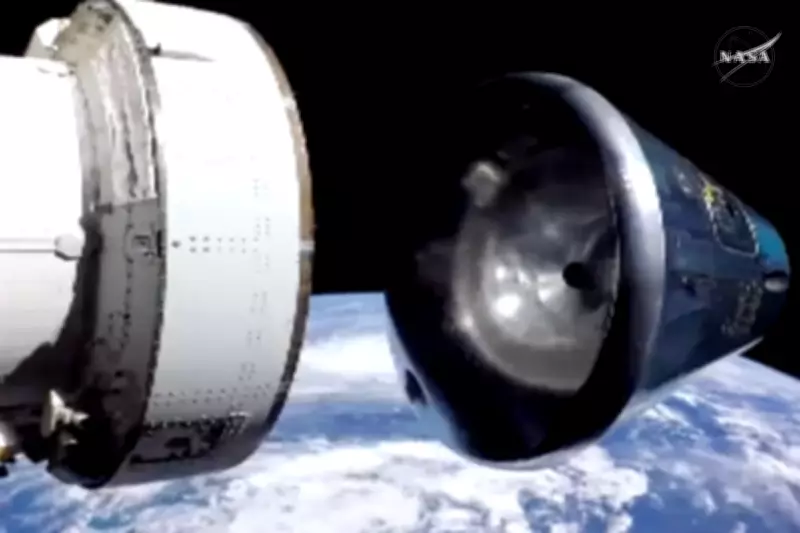
In a monumental achievement for space exploration, NASA astronauts have safely returned to Earth following their historic lunar flyby mission, marking the first crewed journey to the Moon in more than five decades. The Artemis II crew splashed down off the coast of San Diego, California, at 1:07 AM UK time, concluding an epic voyage that sets a critical stepping stone toward future Moon landings and eventual Mars missions.
Record-Breaking Re-Entry and Recovery
During the intense re-entry phase, the Orion capsule hurtled into Earth's atmosphere at approximately 24,000 miles per hour, equivalent to 32 times the speed of sound. This high-velocity descent subjected the spacecraft's heat shield to extreme temperatures, soaring as high as 2,760 degrees Celsius, in a crucial test of its durability. Engineers had previously adjusted the descent trajectory based on lessons from a test flight to mitigate risks of the module burning up.
The re-entry caused a communication blackout with the crew for several minutes, a tense period resolved only after parachutes deployed, slowing the capsule's fall to a gentle 17 miles per hour before it hit the Pacific waters. Standing by for recovery were the naval ship USS John P Murtha and a fleet of military aircraft, which assisted in retrieving the crew one by one in an operation expected to take about an hour.

Unprecedented Deep-Space Journey
Launched from Cape Canaveral on April 1, 2026, the Artemis II mission carried three American astronauts and one Canadian deeper into space than any human has ventured before. The crew traveled an astounding 252,756 miles from Earth, surpassing the previous distance record of 248,655 miles held by the Apollo 13 crew for 56 years. Their journey took them around the far side of the Moon, a region normally hidden from view, where they experienced a 40-minute communication blackout, completely cut off from Earth.
During this blackout, the team seized the opportunity to capture breathtaking images of the Moon and Earth, including a total solar eclipse, adding to the mission's scientific and visual legacy. The flight was tracked with assistance from the Goonhilly Earth Station in Cornwall, highlighting international collaboration in space endeavors.
Historical Context and Future Ambitions
This mission represents NASA's first crewed lunar flight since the Apollo 17 mission in 1972, reigniting ambitions for sustained human presence beyond Earth. The agency aims to return astronauts to the lunar surface by 2028, a timeline set to precede China's planned Moon landing around 2030, underscoring the competitive and strategic nature of modern space exploration.
The successful splashdown not only validates the Orion spacecraft's capabilities but also boosts confidence in NASA's broader Artemis program, which seeks to establish a sustainable human presence on the Moon and serve as a precursor for future Mars missions. As space agencies worldwide ramp up their lunar efforts, this mission stands as a testament to human ingenuity and the relentless pursuit of discovery in the cosmos.