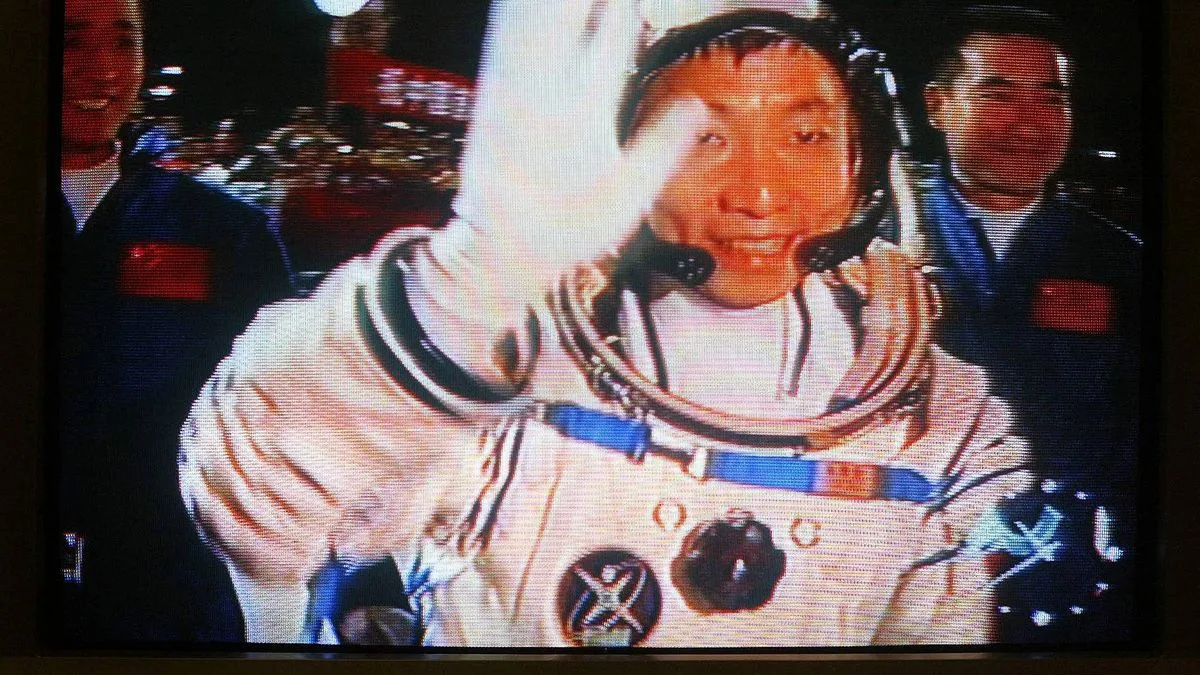
The Eerie Space Knocking That Baffled China's Astronauts
China's pioneering astronaut has returned to Earth with a truly extraordinary account after encountering a puzzling 'knocking sound' during his historic mission that left space engineers completely stumped. The mysterious phenomenon has since been reported by multiple space travelers, creating one of orbital exploration's most intriguing unsolved mysteries.
Yang Liwei's Historic 2003 Mission
Taikonaut Yang Liwei blasted off aboard Shenzhou 5 in 2003 for a groundbreaking 21-hour mission that saw him circle the globe fourteen times before touching down safely in Mongolia. This landmark journey marked China's first successful manned spaceflight, establishing the nation as a serious contender in the space exploration arena. However, during his journey through the cosmos, Yang detected something utterly inexplicable that would overshadow even this monumental achievement.
The Unexplained Phenomenon
While orbiting Earth, Yang heard a distinct 'knocking' sound that repeated itself continuously throughout portions of his mission. He conducted a thorough examination of the capsule, gazing through the porthole and inspecting all panels meticulously, yet couldn't identify any source for the persistent noise. Most perplexingly, Yang maintained the sound wasn't originating from inside the capsule but rather from outside, in the vacuum of space where sound theoretically cannot travel.
Yang subsequently revealed to the BBC: "It sounded like someone hitting the hull, like striking an iron bucket with a wooden hammer." Despite the unsettling nature of the experience, the astronaut remained composed and continued his mission, ultimately dismissing the mysterious tapping as a 'normal phenomenon' to maintain his focus on critical operations.
Post-Mission Investigation
Upon returning to Earth, engineers meticulously examined the spacecraft for answers but discovered nothing that could explain the anomalous noise, according to reports from the Daily Star. Every system was checked, every component tested, yet the source remained elusive. The investigation yielded no mechanical faults, no structural issues, and no evidence of external damage that might account for the auditory phenomenon.
Other Astronauts' Experiences
The peculiar sound didn't disappear with Yang's mission. Chinese media subsequently reported that crews on later missions—including voyages in 2005 and 2008—also experienced the same mysterious knocking. Prior to launch, Yang even warned newcomers not to be alarmed if space appeared to come knocking at their door, suggesting the phenomenon had become something of an open secret among China's space program personnel.
Scientific Explanations and Theories
Sound requires a medium such as air or metal to travel, making a knock from the vacuum of space particularly perplexing from a physics perspective. Several potential explanations have been put forward by experts:
- Micro-debris impacts: Tiny particles striking the hull without leaving visible marks could theoretically create knocking sounds transmitted through the spacecraft structure.
- Thermal fractures: As spacecraft experience extreme temperature fluctuations every 90 minutes in orbit, expansion and contraction of materials might produce audible cracking or knocking noises.
- Structural vibrations: Mechanical vibrations triggered by pressure systems, valves, reaction wheels, or attitude thrusters could potentially manifest as knocking sounds.
While these theories are plausible, no conclusive evidence has been discovered during any mission to definitively explain the phenomenon.
Modern Monitoring and Ongoing Mystery
China's more recent spacecraft are equipped with additional sensors and monitoring equipment, with every unusual creak and tremor now meticulously recorded. However, until the data provides a conclusive answer, Yang's 'knock-knock' remains among spaceflight's most intriguing unsolved mysteries. The phenomenon continues to spark scientific debate and public fascination, highlighting how much remains unknown about human experiences in the extreme environment of space.