Scientists have made a groundbreaking discovery by uncovering the origin of three mysterious signals emanating from the centre of the Milky Way. For years, astronomers have been perplexed by strange spikes of energy blaring out from the heart of our galaxy, but researchers now propose that a specific type of dark matter, known as 'excited dark matter', is responsible.
The Enigma of Dark Matter
Dark matter is an elusive substance that constitutes approximately a quarter of the universe, yet it cannot be observed through conventional means. Since it does not interact with normal matter, even the most powerful telescopes cannot detect it directly. However, scientists believe this mysterious substance may indirectly produce the baffling behaviour observed in the turbulent core of our galaxy.
Insights from Lead Researcher
Lead author Dr Shyam Balaji, of King's College London, explains: 'When we examine well-known astrophysical events, such as star explosions, they fail to fully account for mysteries like the specific energy and shape we've detected from the Milky Way's centre. Now, we've demonstrated how an excited dark matter model could explain at least two, and possibly three, of these unexplained signals simultaneously.'

The heart of the Milky Way is an exceptionally chaotic and violent environment, where immense forces pull and crush dense gas clouds into fast-moving stars. At its core lies the supermassive black hole Sagittarius A*, with a mass about four million times that of the sun. While telescopes can observe radiation released by the intense gravity and heat, scientists have struggled to explain all observed phenomena.
Unexplained Gamma-Ray Spike
For instance, a sharp spike in gamma-ray radiation at a specific wavelength, known as the 511-keV emission line, does not align with established models of normal matter function. In a new paper published in The Astrophysical Journal Letters, scientists have shown that these signals could be caused by excited dark matter.
Dr Balaji elaborates: 'Excited dark matter involves particles briefly jumping into a higher-energy state upon collision, then releasing that energy by producing an electron and its antimatter partner, a positron, when they return to their normal state.'
Detecting Signals from Space
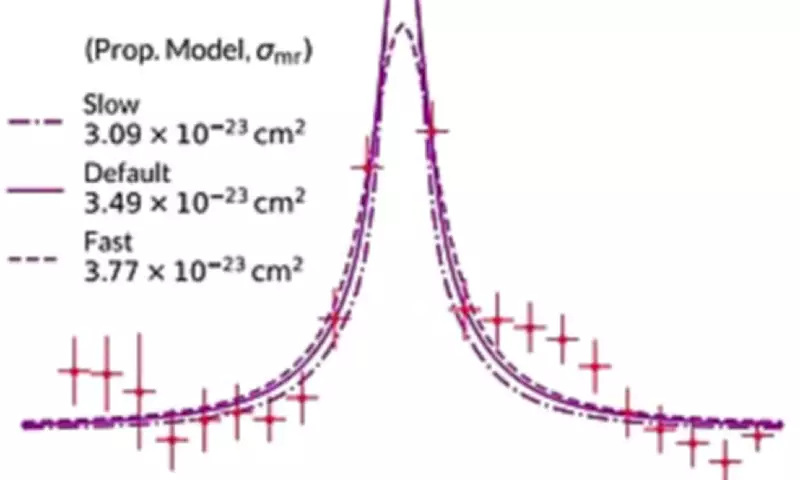
These positrons generate signals detectable by deep-space telescopes, such as the European Space Agency's INTEGRAL mission, positioned outside Earth's radiation belts at an altitude of 37,000 miles. By comparing INTEGRAL data with a model of positron movement through space, researchers found that collisions between positrons from excited dark matter could produce a gamma-ray spike matching the 511-keV emission line.
Further Mysteries Unraveled
The scientists did not stop there; they discovered that their excited dark matter model could also explain additional strange signals. Specifically, it may account for very high-energy light from the galactic centre, known as the 2 MeV gamma-ray continuum. Dr Balaji notes: 'This signal requires positrons with very specific energies, which excited dark matter naturally produces, unlike conventional sources like supernovae or cosmic rays.'
Moreover, the model could potentially explain unusually high ionisation levels in a gas clump within the Central Molecular Zone, a region 28,000 light-years from Earth containing nearly 80% of the galaxy's dense gas. Cosmic rays have not adequately explained this heavy ionisation, suggesting excited dark matter's strange behaviour as a plausible answer.
Future Research Directions
Co-author Damon Cleaver, a PhD student at King's College London, states: 'If one mechanism can account for multiple long-standing unexplained observations, it provides a clearer direction for future research. With next-generation space missions, we may finally test whether dark matter is behind some of the Milky Way's most persistent mysteries and learn more about this enigmatic substance.'

Understanding Dark Matter
Dark matter is a hypothetical substance believed to make up roughly 27% of the universe, acting as the gravitational 'glue' that holds galaxies together. It remains invisible due to its lack of light reflection and has never been directly observed, but its gravitational effects on known matter confirm its existence. Only about 5% of the observable universe consists of familiar matter like atoms and subatomic particles.