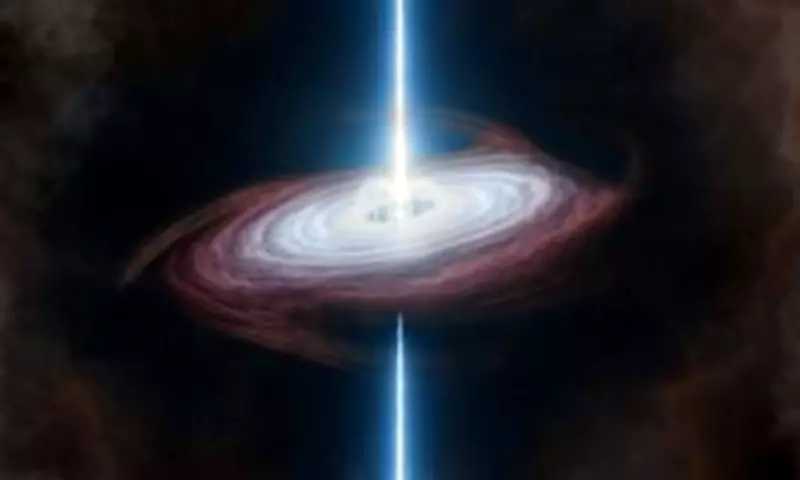
For the first time in astronomical history, researchers have directly observed the violent birth of one of the cosmos's most extreme phenomena—a magnetar. This newly formed object contains the staggering mass of half a million Earths compressed into an unimaginably dense sphere measuring a mere 12 miles across.
The Nature of Magnetars
Magnetars represent a rare and extraordinary subclass of neutron stars. These celestial bodies originate from the collapsed cores of massive stars following cataclysmic supernova explosions. Like all neutron stars, they consist predominantly of tightly packed neutrons, resulting in incredible density.
What distinguishes magnetars from other neutron stars is their possession of the most powerful magnetic fields known to exist in the universe. To provide perspective, Earth's magnetic field registers at approximately one Gauss, while a common refrigerator magnet measures about 100 Gauss. In stark contrast, magnetars exhibit magnetic fields of around a million billion Gauss, making them truly unparalleled in their ferocity.

The Groundbreaking Observation
The scientific breakthrough emerged from an extensive monitoring campaign targeting a superluminous supernova designated SN 2024afav. Astronomers tracked this event for over 200 days, noting unusual behavior as it faded. Unlike typical supernovae, whose light diminishes steadily after peaking, SN 2024afav displayed distinctive flickering and produced small, repetitive light pulses during its decline.
Researchers theorized that this anomalous pattern resulted from debris forming a swirling gas disc that fell back into a nascent magnetar. Crucially, the disc's axis of rotation appeared tilted due to the profound effects of general relativity, as detailed in their study published in the prestigious journal Nature.
Einstein's Relativity in Action
According to Einstein's theory of general relativity, the pulsating light observed was a direct consequence of a massive, spinning object distorting the fabric of space-time around it—precisely the signature of a forming magnetar. This represents one of the clearest astrophysical demonstrations of relativistic effects in such a context.
The collected data provides compelling proof that scientists witnessed the actual formation of a magnetar as the core of the superluminous supernova collapsed inward upon itself. This observation offers unprecedented insights into the mechanisms driving these cosmic powerhouses.
Expert Commentary
Alex Filippenko, a distinguished professor of astronomy at the University of California, Berkeley and co-author of the study, hailed the findings as "definitive evidence" of a magnetar's birth. He emphasized the significance of observing general relativity's influence in a supernova environment.
"To see a clear effect of Einstein's general theory of relativity is always exciting," Filippenko told The Times. "But seeing it for the first time in a supernova is especially rewarding."
This landmark discovery not only confirms long-standing theoretical predictions about magnetar formation but also opens new avenues for understanding the extreme physics governing neutron stars and supernovae. It underscores the ongoing importance of observational astronomy in unraveling the universe's most enigmatic processes.