Martian Microbes Could Have Hitched Ride to Earth on Asteroid Debris, Study Suggests
While aliens in science fiction often travel between planets on advanced spaceships, real-life extraterrestrials might use a far more rudimentary mode of transport. According to new research, microscopic organisms could have journeyed through space by hitching a lift on rocky debris ejected during asteroid impacts.
The Lithopanspermia Hypothesis Revisited
The idea that life might spread across the solar system or even the universe via rocks is known as the lithopanspermia hypothesis. This concept has been debated for over a century, but many scientists have dismissed it due to the extreme conditions life would need to endure. Senior author Professor Kalita Ramesh explained to the Daily Mail: 'It's an idea that's more than a century old, but we've discounted it for years because the conditions that the life would have to survive were so extreme.'
Life would have to withstand not only the freezing cold and intense radiation of space but also the enormous forces generated by an asteroid impact. These impacts release energy comparable to nuclear weapons, making survival seem improbable.

Groundbreaking Experiments with Hardy Bacteria
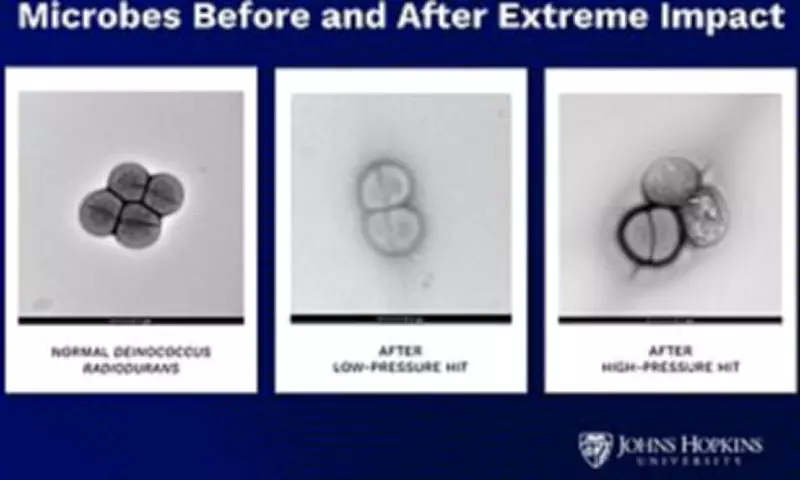
Researchers from Johns Hopkins University conducted experiments to test this hypothesis, focusing on a type of bacteria that closely resembles what might exist on Mars. They selected Deinococcus radiodurans, a desert bacterium found in the high deserts of Chile, renowned for its ability to survive inhospitable, space-like conditions.
Professor Ramesh noted: 'The surface of Mars is very cold, very dry, and exposed to much more radiation than the surface of Earth. Deinococcus radiodurans is able to handle high radiation, extreme cold, and desiccation, making it a good model for a potential Martian bacterium.'
To simulate an asteroid impact, the scientists sandwiched samples of this tough bacteria between two metal plates and fired a projectile at them at speeds of 300 miles per hour (482 km/h). This created pressures up to 2.4 gigapascals, which is 24 times greater than the pressure at the deepest point in the ocean, the Mariana Trench.
Surprising Survival Rates
The results were astonishing. At 1.4 gigapascals of pressure, 100% of the bacteria survived without any signs of damage. Even at 2.4 gigapascals, 60% of the bacteria endured, showing only minor ruptures in their membranes and some internal damage. Lead author Dr Lily Zhao told the Daily Mail: 'We found that life is more likely to survive an asteroid impact, so it's definitely still a real possibility that life on Earth could have come from Mars. Maybe we're Martians!'
In fact, the steel structure holding the plates together failed before all the bacteria could be killed, highlighting their resilience. Asteroid impacts can produce pressures up to five gigapascals, but this study demonstrates that tough bacteria could survive the initial blast.
Implications for the Origins of Life
This research makes the lithopanspermia theory far more plausible than previously thought, with significant consequences for our understanding of life's origins in the solar system. It suggests that if life existed on Mars, it could have traveled to other planets or moons over billions of years.
Professor Ramesh elaborated: 'The existence of life on one planet now means that life could have moved to other planets or moons over the aeons. For example, Martian life – if it ever existed – could potentially have found its way to the Martian moon Phobos, where it could survive buried beneath the surface.'
Scientists already know that rocks from Mars have reached Earth after asteroid strikes, such as a large piece that was auctioned last year. This new study adds weight to the possibility that bacteria hitched a ride on similar asteroids, potentially seeding life on our planet.
Mars: A Brief Overview
Mars is the fourth planet from the sun, characterized as a dusty, cold desert world with a very thin atmosphere. Despite its harsh conditions, it features seasons, polar ice caps, canyons, and extinct volcanoes, with evidence of past geological activity. It is one of the most explored planets in the solar system, with rovers sent to investigate its surface.

- Orbital period: 687 days
- Surface area: 55.91 million mi²
- Distance from Sun: 145 million miles
- Gravity: 3.721 m/s²
- Radius: 2,106 miles
- Moons: Phobos, Deimos
This research opens new avenues for astrobiology, suggesting that we should broaden our search for extraterrestrial life to include not just planets but also their moons and the debris that travels between them.