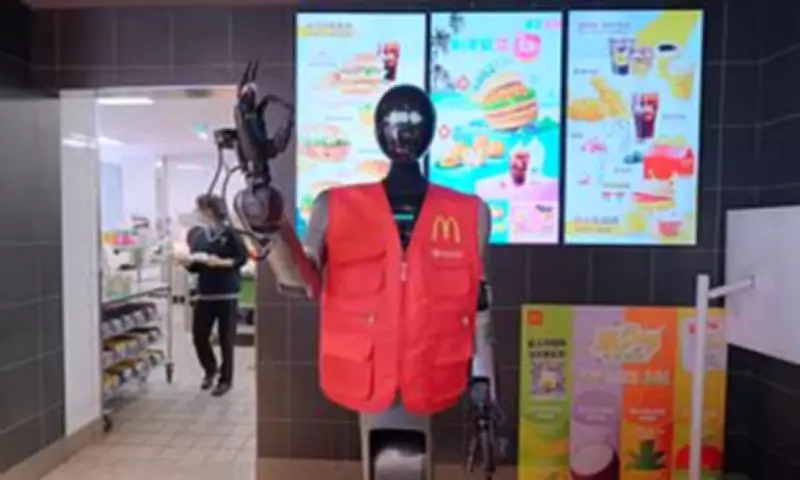
In a striking glimpse into the future of dining, a McDonald's restaurant in Shanghai has deployed humanoid robots to serve meals and entertain customers, with the machines even donning the iconic red and yellow uniforms of the fast-food giant. Supplied by Chinese robotics firm Keenon Robotics, this trial showcases how automation could soon handle routine tasks in the food service industry, blending technology with traditional hospitality.
Robots in Uniform: A New Face for Fast Food
Videos circulating online reveal diners interacting with cyborgs stationed behind counters, dressed in the famous McDonald's attire. One humanoid, wearing a black uniform labeled 'chef', warmly greets patrons as they enter, while others make the brand's signature 'M' sign and showcase dance moves to engage visitors. Children have been seen chasing robot assistants disguised as cute animals, which deliver food and clean floors, adding a playful element to the dining experience.
Keenon Robotics promoted the initiative online, stating, 'Watch the robot squad suit up and enjoy the McDonald's party! Our humanoid series are leading the squad and hitting the streets.' The company emphasized that this demonstration highlights how service automation is becoming a seamless part of global dining, aiming to bring more smiles to every mealtime through technological innovation.

Interactive Features and Customer Engagement
In one notable interaction, a robot touches its thumb and index finger together to form an 'okay' sign for a customer, showcasing its ability to mimic human gestures. Additionally, a smaller, cube-shaped cleaning bot features a touchscreen and is designed to appear as if it's wearing a tie, blending functionality with a whimsical aesthetic. These elements underscore the trial's focus on enhancing customer interaction through robotics.
Clarification from McDonald's Executives
Jon Banner, the executive vice president of McDonald's, clarified on social media that the robots were part of a temporary greeting for the grand opening of the Shanghai Science and Technology Museum restaurant. He explained, 'The robots were requested by the museum to draw attention. Mission accomplished!' Banner added that the machines were not involved in any service or operational functions, indicating this was more of a promotional stunt than a functional integration.
Despite being a short-lived trial lasting only about five days, the deployment has sparked discussions about the potential for wider rollout. One observer on X noted, 'Shanghai is the test market. If the unit economics work, the rollout does not stay in China.' Another commenter hailed it as the 'real future', suggesting that with humanoid robots greeting customers and delivery bots handling food, automating kitchens could lead to McDonald's stores operating with minimal staff.
Technical Specifications of Keenon Robotics Models
Keenon Robotics' 'Dinerbot T10' is equipped with 3D vision for safer obstacle avoidance in complex environments. It includes open-access trays for easy food pickup and a six-wheel shock-absorbing chassis to prevent spillage during sudden stops. The screen can be programmed to display various animal faces, such as a cat, bunny, or deer, and offers a selection of voices to enhance engagement.
Meanwhile, the 'Kleenbot C40' features a triple-brush system for separating dry and wet spillages, designed to handle crowds and irregular obstacles efficiently. It can pick up items like hair, paper scraps, dust, coffee, and juice. While Keenon's website does not list prices, these models retail online for approximately £11,500 to £16,000. Their recently released 'XMAN-R1' humanoid, specifically designed for human interaction, carries a price tag of around $100,000.
Public Reaction and Future Implications
While many are excited about the automation prospects, some have expressed concerns, warning that such robots might be 'destroyed' if introduced in other regions due to cultural or economic resistance. The trial comes amid broader trends in robotics, as highlighted by recent incidents like a dancing robot going berserk at a Haidilao hotpot restaurant in California, which saw staff struggling to control it during a malfunction.

This McDonald's trial in Shanghai serves as a pivotal example of how technology is reshaping the food service landscape. As automation advances, it prompts important conversations about efficiency, customer experience, and the future of employment in the industry. Whether these robots become a staple in fast food or remain a novelty, their deployment marks a significant step toward integrating robotics into everyday dining scenarios.