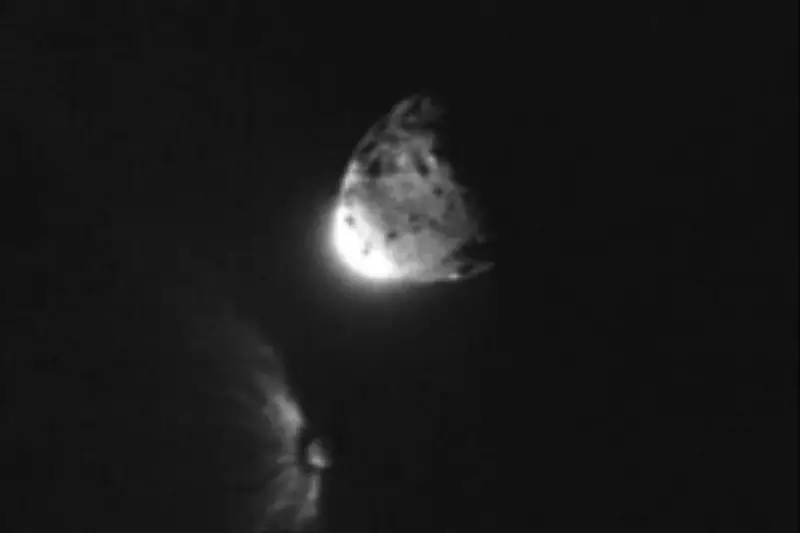
In a landmark achievement for planetary defence, NASA has successfully altered the orbit of an asteroid through a deliberate spacecraft collision, scientists confirmed on Friday. This historic test represents the first time humanity has intentionally changed the trajectory of a celestial body orbiting the sun.
A Deliberate Deflection for Future Protection
The Double Asteroid Redirection Test (DART) spacecraft, launched in 2021 as part of the world's first planetary defence exercise, deliberately plowed into the asteroid Dimorphos in September 2022. Dimorphos orbits a larger companion asteroid called Didymos as both travel around the sun together. While this particular asteroid pair never posed any threat to Earth, the successful orbital alteration demonstrates crucial technology that could one day protect our planet from potentially hazardous space rocks.
Measurable Changes with Significant Implications
An international research team reported in Science Advances that the impact successfully trimmed the asteroids' solar orbit. The orbital adjustments, while seemingly minor, represent a monumental breakthrough. The collision reduced the duo's travel time around the sun by 0.15 seconds and shortened their 300-million-mile orbit by 720 meters over a two-year period.

"Even though this seems small, a tiny deflection can add up over decades and make the difference between a potentially hazardous asteroid hitting or missing the Earth in the future," explained lead author Rahil Makadia of the University of Illinois Urbana-Champaign in an email statement.
Makadia emphasized the strategic importance of early intervention: "For any save-the-planet tests, the key isn't delivering a huge shove at the last minute. The key is delivering a tiny shove many years in advance."
The Physics of Planetary Protection
The research revealed fascinating details about the impact's mechanics. Scientists determined that all the boulders and debris flung from Dimorphos during the collision provided as much momentum to the asteroid as the spacecraft itself—effectively doubling the push. Last summer, a separate U.S.-Italian team estimated that approximately 35 million pounds of rock and dust were ejected during the impact.
Why This Asteroid Pair Was Chosen
Steven Chesley of NASA's Jet Propulsion Laboratory, who participated in the study, explained why this particular rubble-packed asteroid system was selected for the mission. "While it is just a single experiment, it is nonetheless an important data point that will be relevant to any future asteroid deflection missions," Chesley stated via email.
The crucial factor was safety—even with the altered course, Earth remains completely out of harm's way from these asteroids for the foreseeable future. Dimorphos measures 525 feet in diameter, while its faster-spinning companion Didymos spans 2,560 feet across and possesses approximately 200 times more mass according to the latest study.
Looking Ahead to Further Discoveries
Scientists anticipate learning even more about the impact's aftermath when the European Space Agency's Hera spacecraft reaches the asteroid system in November. Unlike the destructive approach of DART, Hera will conduct months of detailed surveys without striking the asteroids. The mission will deploy a pair of small experimental probes that will attempt to land on the asteroid surfaces.
This successful test marks what researchers describe as "a notable step forward in our ability to prevent future asteroid impacts on Earth." As planetary defence technology advances, humanity moves closer to developing reliable systems for protecting our planet from cosmic threats that have shaped Earth's history through previous extinction events.