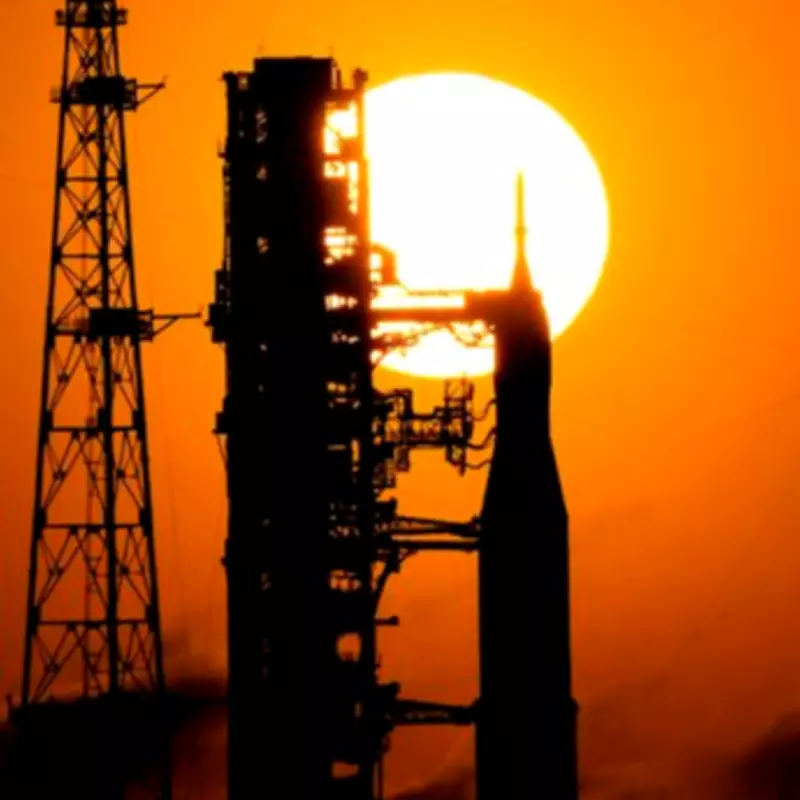
NASA's Artemis 2 Moon Mission Nears Historic Launch
The monumental Artemis 2 Moon rocket has been repositioned at the Kennedy Space Centre launchpad, with NASA targeting a launch as early as April 1. This mission marks the first crewed flight to the Moon since 1972, a pivotal moment in space exploration history.
Artemis 2 Rocket Specifications and Design
Standing an impressive 98 meters tall and weighing approximately 2.6 million kilograms when fully fuelled, the Space Launch System (SLS) rocket is a technological marvel. It features two massive solid rocket boosters and four powerful engines that will propel the spacecraft toward lunar orbit.
The enormous orange core stage functions as a colossal fuel tank, containing over three million litres of liquid hydrogen and liquid oxygen essential for escaping Earth's atmosphere. Atop this structure rests the Orion spacecraft, which will serve as the astronauts' home during their ten-day expedition.

Life Inside the Orion Crew Capsule
The Orion crew module presents a remarkably compact living space, measuring just 5 meters wide by 3 meters high—approximately the dimensions of a medium wheelbase Ford Transit van. Within this confined area of about 10 cubic meters, four astronauts will eat, sleep, exercise, work, and attend to personal needs throughout their journey.
This mission represents the second flight of the SLS, following the uncrewed Artemis 1 test in 2022 that validated Orion's systems and heat shield. While Orion draws inspiration from the Apollo modules, it incorporates significant modern enhancements including an expanded diameter and advanced thermal protection.
During launch, the astronauts will occupy four specially designed seats that can be stowed once in orbit to maximize available space. In the weightless environment, crew members can utilize the entire capsule volume, with control panels mounted on what would normally be the ceiling and equipment stored in floor lockers.
Essential amenities include a flywheel exercise machine for daily cardiovascular workouts and a zero-gravity toilet—a luxury not available to Apollo astronauts fifty years ago, though privacy remains minimal. The capsule also features a water dispenser for hydration and food rehydration, with each astronaut having selected their preferred meals for the mission.
Artemis 2 Mission Timeline and Objectives
NASA has identified a launch window spanning April 1 to April 6, with the mission duration expected to be approximately ten days depending on celestial alignment. The launch phase represents one of the most critical and hazardous segments, requiring flawless execution as the SLS ascends from Cape Canaveral, Florida.
A Launch Abort System positioned at the rocket's apex can rapidly propel the crew to safety should any anomalies occur during initial ascent. Following successful launch, the astronauts will enter a high Earth orbit approximately 45,000 miles above the planet to conduct comprehensive systems checks, including evaluation of the onboard sanitation facilities.
After jettisoning the solid rocket boosters and core stage, approximately three hours into the flight, the Interim Cryogenic Propulsion Stage will separate. This moment allows the crew to assume manual control of Orion for the first time and represents the final opportunity for an uncomplicated return to Earth.
Assuming all systems function optimally, the astronauts will initiate the trans-lunar injection burn that sets their course toward the Moon. During transit, they will conduct scientific experiments and practice utilizing their radiation shelter as a precaution against potential solar storms.
Upon reaching lunar proximity, the spacecraft will orbit the Moon's far side at distances ranging from 6,500 to 9,500 kilometers from the surface. The crew will have approximately three hours to observe lunar terrain through Orion's windows before experiencing a communications blackout lasting 30 to 50 minutes as they pass behind the Moon.
The return journey requires an additional four days, culminating in atmospheric re-entry where temperatures will soar to approximately 2,700 degrees Celsius—half the temperature of the Sun's surface. A sequence of parachutes will deploy to ensure a controlled splashdown in the Pacific Ocean near California, where recovery teams await.

Meet the Artemis 2 Astronaut Crew
The four-person crew aims to increase the total number of humans who have traveled around the Moon from 24 to 28. Mission Commander Reid Wiseman, age 50, brings substantial experience with six months already spent in space over his 16-year astronaut career.
Jeremy Hansen, also 50, serves as mission specialist and represents the Canadian Space Agency. A former fighter pilot, this mission will mark his inaugural spaceflight. Victor Glover, age 49, will apply his expertise as a former test pilot to spacecraft operations, while mission specialist Christina Koch, 47, possesses the crew's most extensive space experience with one cumulative year spent beyond Earth's atmosphere.
The astronauts have undergone intensive training together, including periods living in confined quarters to simulate mission conditions. Each crew member has selected personal items to accompany them: Glover carries a Bible and family heirlooms; Koch brings handwritten notes from loved ones; Hansen includes moon pendants belonging to his wife and daughters; and Wiseman has chosen blank paper and a pencil to document his thoughts during the lunar flyby.
Artemis 2 represents a crucial milestone in NASA's broader lunar exploration program, which ultimately aims to establish a sustainable human presence on the Moon's surface through subsequent missions and potential base construction.