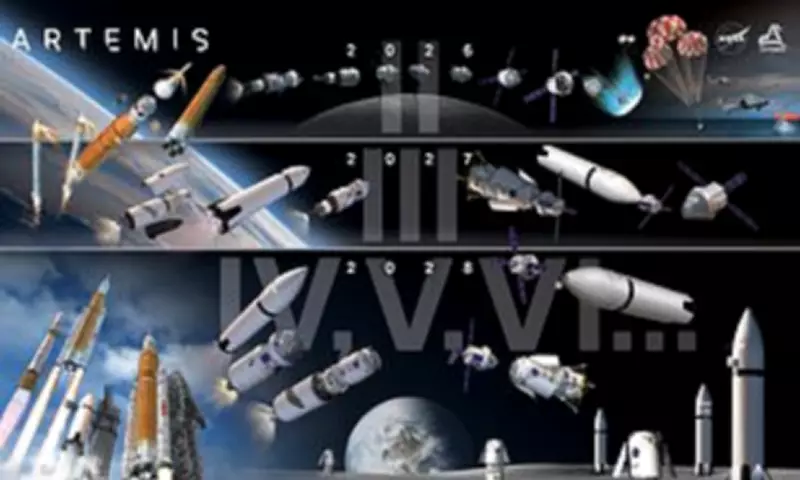
NASA Announces Major Artemis Mission Delays, Pushing Lunar Landing to 2028
NASA has unveiled a radical restructuring of its Artemis moon missions, resulting in another significant delay to the planned lunar landing. On Friday, the US space agency detailed an ambitious new strategy that involves a series of incremental flights to build capability gradually. While NASA frames this as an 'increase in cadence,' the practical outcome is that Artemis III will no longer achieve a moon landing in 2027 as previously scheduled.
Revised Mission Timeline and Public Backlash
Under the updated plan, Artemis III in 2027 will now focus on low-Earth orbit activities, including docking practice with the lunar lander and testing new space suit designs. The first crewed moon landing is rescheduled for 2028 with Artemis IV, potentially followed by a second landing that same year with Artemis V. NASA aims to establish a permanent lunar presence by 2030 through annual missions thereafter.
Online, furious space fans have flocked to social media platforms to express their outrage over the seemingly endless delays. On X, formerly Twitter, one irate commenter wrote: 'Just admit it. We’re never going back. Ever.' Another added: 'Not going to mince words here, I have near zero confidence.' Critics have highlighted NASA's track record of overruns and technical setbacks, with one user bluntly stating: 'Over cost, over schedule. too little, too late.'

Technical Challenges and Leadership Response
The delay follows a series of technical mishaps, including a recent blockage discovered in the helium system of the Space Launch System (SLS) rocket after a successful wet dress rehearsal for Artemis II. This issue forced NASA to roll the SLS back to the hangar for repairs, pushing the launch date to April at the earliest. Persistent problems, such as leaks of super-cooled hydrogen fuel, have compounded frustrations.
NASA Administrator Jared Isaacman defended the new approach, citing the need to standardize operations and increase flight rates safely. In a statement, he said: 'NASA must standardize its approach, increase flight rate safely, and execute on the President’s national space policy. Standardizing vehicle configuration, increasing flight rate and progressing through objectives in a logical, phased approach, is how we achieved the near-impossible in 1969 and it is how we will do it again.'
Expert Criticism and SpaceX Concerns
However, the plan has faced scepticism from industry experts. Former NASA Administrator Lori Garver criticised it on X, calling it 'magical thinking' and expressing concern over the focus on spin over substance. Additionally, doubts have been raised about the reliance on SpaceX's Starship rocket, which has had only two successful test flights out of eleven and has yet to reach Earth orbit. NASA has hinted at opening the Artemis III contract to other providers if delays persist, with one commenter questioning: 'You don’t really believe Starship will ever get to the moon do you?'
Artemis II Mission Details
Looking ahead, Artemis II is scheduled for launch in April 2026, aiming to complete a lunar flyby with its crew—Reid Wiseman, Victor Glover, Christina Koch, and Jeremy Hansen. The mission will cover 620,000 miles over 10 days at an estimated total cost of $44 billion. Key stages include:
- Launch from Kennedy Space Centre Launch Pad 39B
- Manoeuvres to raise orbit using the Cryogenic Propulsion Stage
- Trans-lunar injection and a four-day journey to the moon
- Lunar flyby at an altitude of 5,523 miles above the surface
- Return to Earth and splashdown in the Pacific Ocean
NASA Associate Administrator Amit Kshatriya emphasized the step-by-step build-up of capability, stating: 'We are looking back to the wisdom of the folks that designed Apollo. The entire sequence of Artemis flights needs to represent a step-by-step build-up of capability, with each step bringing us closer to our ability to perform the landing missions.' Despite the optimism, the ongoing delays and public criticism underscore the challenges facing NASA's lunar ambitions.