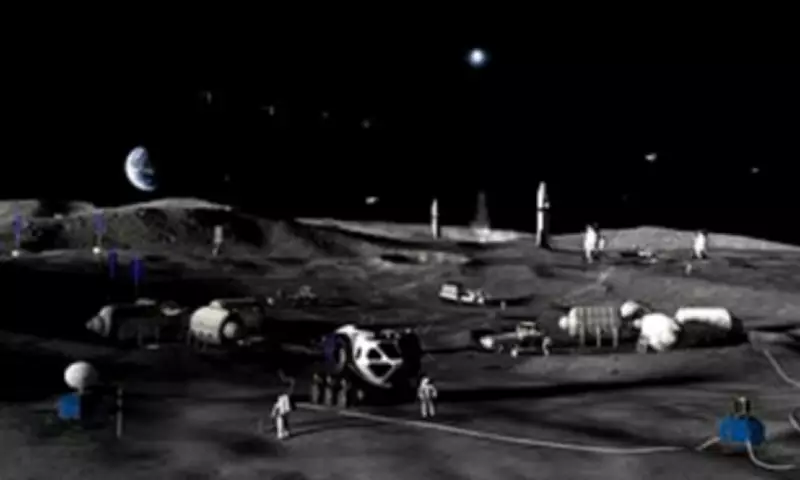
NASA has unveiled ambitious plans to construct a $20 billion permanent base on the moon, marking a significant strategic shift under new chief Jared Isaacman. The agency aims to establish a long-duration human presence at the lunar south pole over the next seven years through dozens of missions.
Strategic Focus on Lunar Sustainability
Jared Isaacman, who joined NASA in December, announced a refocusing of priorities towards building a lunar habitat that enables sustained human activity. He emphasised that this move represents the next step towards achieving the near-impossible and ensuring American leadership in space.
"There will be an evolutionary path to building humanity's first permanent surface outpost beyond Earth, and we will take the world along with us," Mr Isaacman stated during a conference at NASA headquarters in Washington. He added, "This time the goal is not flags and footprints. This time the goal is to stay."

Phased Construction Approach
NASA outlined a three-phase plan for constructing the moon base. The first phase involves transitioning from infrequent missions to a repeatable approach that increases the tempo of lunar activity. Phase two will focus on developing semi-habitable infrastructure, including rovers and transportation systems.
Phase three will deliver the heavier infrastructure necessary for a continuous human foothold on the moon. This includes multi-purpose habitats developed by the Italian Space Agency and lunar utility vehicles provided by the Canadian Space Agency.
Key Infrastructure Components
The habitation module, designed by the Italian Space Agency, measures three metres wide and six metres long with a mass of approximately 15 tonnes. It features wheels for mobility across the lunar surface and is completely self-sufficient, providing power and heat for inhabitants.
Currently designed to support two astronauts for seven to 30 days, or a larger crew for short emergency periods, the module includes five main substations controlling atmosphere, temperature, humidity, and water and waste management systems.
NASA's plans also incorporate a pressurised rover from the Japan Aerospace Exploration Agency, serving as a mobile laboratory with robotics, cameras, sensors, and scientific instruments to extend exploration capabilities beyond current moonwalks.
International Collaboration and Competition
Mr Isaacman highlighted the international dimension of the project, noting collaboration with agencies from Italy, Canada, and Japan. However, he also acknowledged the competitive race against China to establish a permanent lunar base, stating, "The clock is running in this great-power competition, and success or failure will be measured in months, not years."
Shift from Lunar Gateway
To concentrate resources on the moon base, NASA will suspend plans for the Lunar Gateway orbital space station. Mr Isaacman explained that pausing Gateway in its current form allows for redirecting efforts towards infrastructure enabling sustained surface operations at the strategic south lunar pole.
Artemis Program Adjustments
This announcement follows recent reshuffling of NASA's Artemis program, which has faced multiple delays. The agency maintains its goal of returning Americans to the moon's surface by 2028 but is adjusting its flight lineup to include a test mission before the eventual lunar landing to enhance launch readiness.
Artemis 2, now targeting early April, will involve the first lunar flyby in over half a century, covering 620,000 miles over ten days with an estimated total cost of $44 billion.
Mr Isaacman concluded, "Building a base will seem pale in comparison to what we will be capable of accomplishing in the years ahead," underscoring NASA's long-term vision for lunar exploration and future missions to Mars.