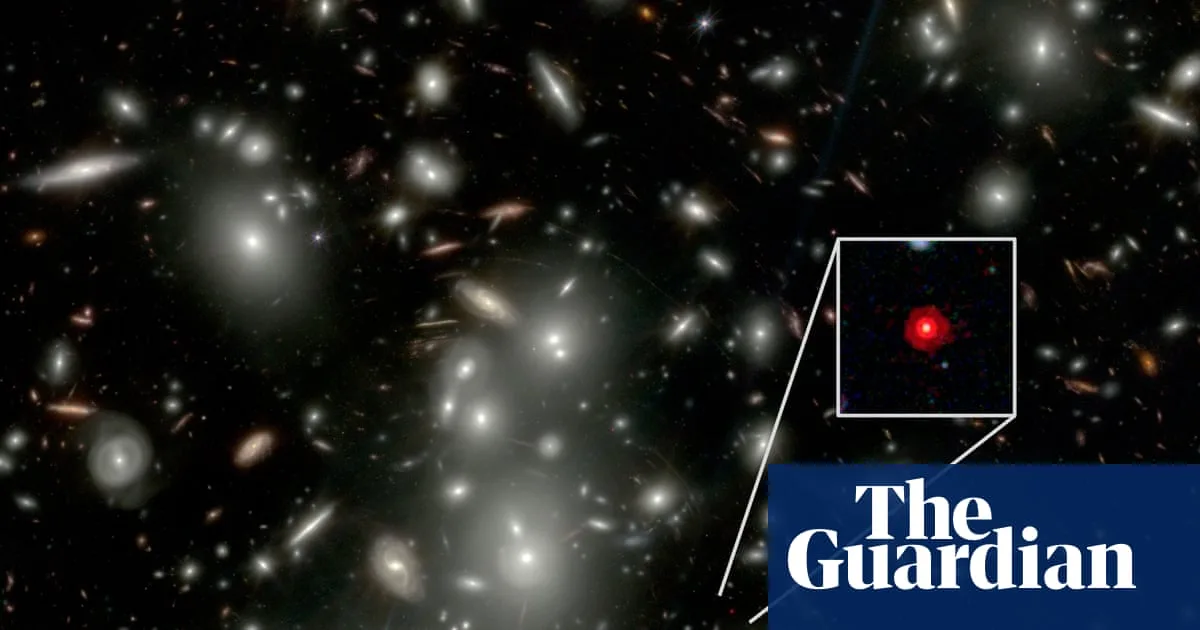
The James Webb Space Telescope has spotted an ancient black hole that may have formed in the first fraction of a second after the Big Bang, challenging existing theories of cosmic evolution. The object, designated QSO1, is a 'little red dot' dating back more than 13 billion years, when the universe was just 700 million years old.
Observations reveal a supermassive black hole with a mass of 50 million suns, surrounded by a sparse halo of gas and dust that is less than half that mass. This 'nearly naked' configuration contradicts the standard model, where black holes are typically a thousand times less massive than their host galaxies.
Professor Roberto Maiolino of the University of Cambridge, part of the research team, said: 'This black hole has formed without being preceded by a galaxy around it. This is really challenging for the theories.' The surrounding material is chemically pristine, composed almost entirely of hydrogen and helium, with no heavy elements from stars, suggesting minimal star formation nearby.

If confirmed as a primordial black hole—a theoretical class first proposed by Stephen Hawking in the 1970s—the discovery would represent a 'paradigm change' in cosmology. Primordial black holes are thought to have formed from dense, hot regions collapsing directly after the Big Bang, acting as seeds for galaxies.
Professor Andrew Pontzen of Durham University, not involved in the study, noted that while the evidence is indirect, future gravitational wave detectors could settle the debate within a decade. The findings have been posted on the preprint server Arxiv.