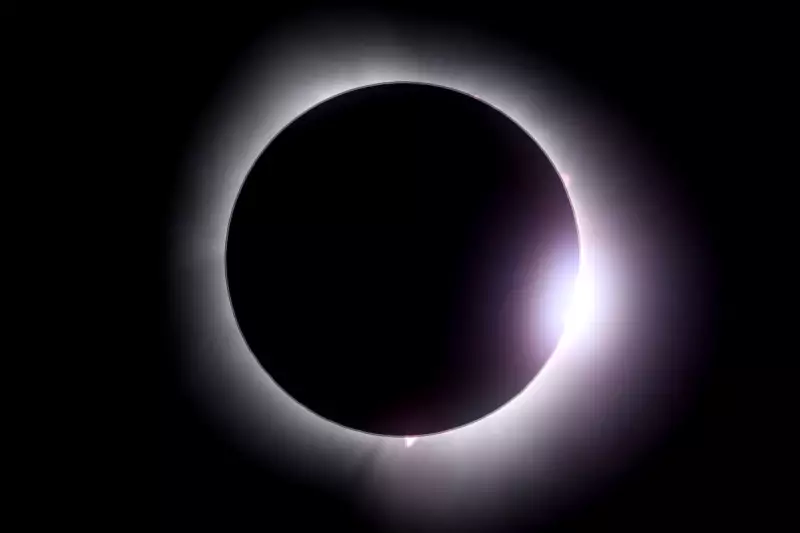
The world has witnessed its inaugural solar eclipse of the year, yet this celestial event unfolded in one of the most isolated regions on Earth, making it a spectacle largely reserved for Antarctic wildlife and a handful of intrepid scientists.
Total Eclipse Over the Frozen Continent
A total solar eclipse occurs when the Moon aligns precisely between the Earth and the Sun, casting a shadow that dramatically obscures our star and plunges the landscape into an eerie twilight. This particular eclipse traced a path directly over Antarctica, ensuring that the full experience of totality was accessible almost exclusively to the continent's resident penguin populations.
Remote Research Station in the Path
The path of totality did, however, extend over the Concordia Research Station, renowned as the most remote scientific outpost on the planet. This provided a unique opportunity for researchers stationed there to observe the phenomenon firsthand, albeit in extreme conditions far from populated areas.

The Annular 'Ring of Fire' Phenomenon
Interestingly, this eclipse was classified as annular rather than purely total. An annular eclipse arises when the Moon, Sun, and Earth align in such a way that the Moon appears slightly smaller in the sky relative to the Sun. Consequently, it fails to completely block the solar disk, resulting in a brilliant ring of sunlight encircling the dark lunar silhouette, often described as a 'ring of fire'.
This effect is attributable to the Moon's elliptical orbit, which causes its distance from Earth to vary. At its farthest point, the Moon's apparent size diminishes sufficiently that it cannot fully obscure the Sun, leading to this distinctive and less dramatic lighting alteration compared to a total eclipse.
Future Eclipses on the Horizon
The next solar eclipse is scheduled for 12 August, and it will once again favour cold, sparsely inhabited locales such as Greenland and Iceland. Nonetheless, totality will also be observable in Spain, Russia, and a limited section of Portugal. Additionally, a partial eclipse will be visible across select regions of Europe, Africa, and North America.
For those eager for another astronomical event, a total lunar eclipse will occur much sooner, on 3 March. This eclipse will be fully visible across Asia, Australia, the Pacific Islands, and the Americas, offering a more accessible viewing opportunity for populations in these areas.