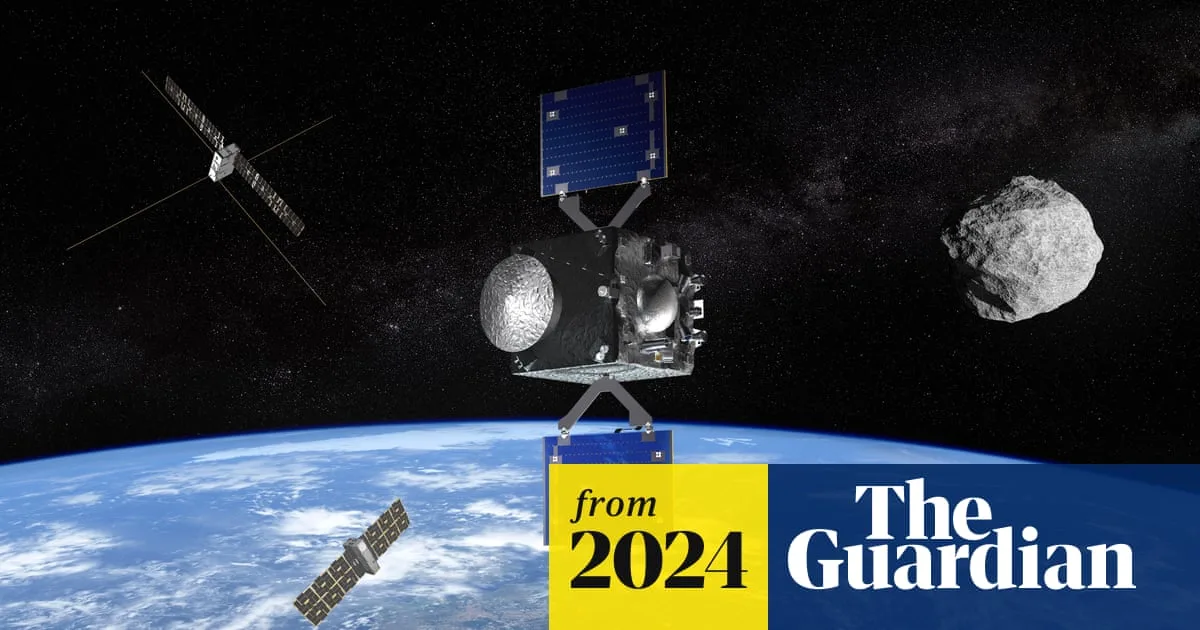
The European Space Agency (ESA) has announced funding for preparatory work on the Rapid Apophis Mission for Security and Safety (Ramses), which aims to study the asteroid 99942 Apophis as it passes closer to Earth than GPS and TV satellites in 2029. The asteroid, larger than the Eiffel Tower, will skim within 20,000 miles (32,000 km) of Earth on Friday 13 April 2029, about one-tenth of the distance to the Moon.
Dr Holger Krag, head of ESA's space safety programme office, described the flyby as 'absolutely unique', noting that no asteroid is expected to come as close for a few thousand years. 'If the sky is clear, you should be able to see it with your naked eye,' he said. Apophis will pass closer than geostationary satellites used for TV broadcasting, navigation and weather forecasting, and Earth's gravity will interact with the asteroid, potentially reshaping it and causing landslides on its surface.
The Ramses spacecraft will gather data on Apophis's size, shape, mass, spin, composition, internal structure and orbit. The mission aims to improve planetary defence by characterising asteroids in case deflection becomes necessary. 'Our goal in planetary defence is not to do science on asteroids, but it's to characterise them in a way that one day we can deflect them when they become dangerous,' Krag said.

Professor Monica Grady of the Open University warned of the potential threat from Earth-crossing asteroids like Apophis, noting that a large impact could cause a catastrophe that 'will destroy humanity'. After its discovery in 2004, Apophis raised concerns about a possible collision, but NASA has ruled out an impact in 2029 and 2036, and experts say it will not hit Earth for at least the next 100 years.
Space agencies are nevertheless investigating deflection methods, such as NASA's Dart mission, which successfully crashed a spacecraft into the asteroid Dimorphos. ESA's Hera mission, due to launch this year, will study the aftermath. Krag emphasised the importance of understanding an asteroid's properties before attempting deflection, as 'the composition of it matters, the spin rate matters, the mass matters'. Ramses offers a chance to practise rapid reconnaissance.
Professor Alan Fitzsimmons of Queen's University Belfast, a member of the Ramses science advisory team, said the data could help extend predictions of potential collisions with Apophis for hundreds of years. The final decision on whether Ramses will proceed is expected by the end of next year, but the new funding allows the team to purchase initial hardware. Potential instruments include an Asteroid Framing Camera and a seismometer to monitor activity during the flyby.