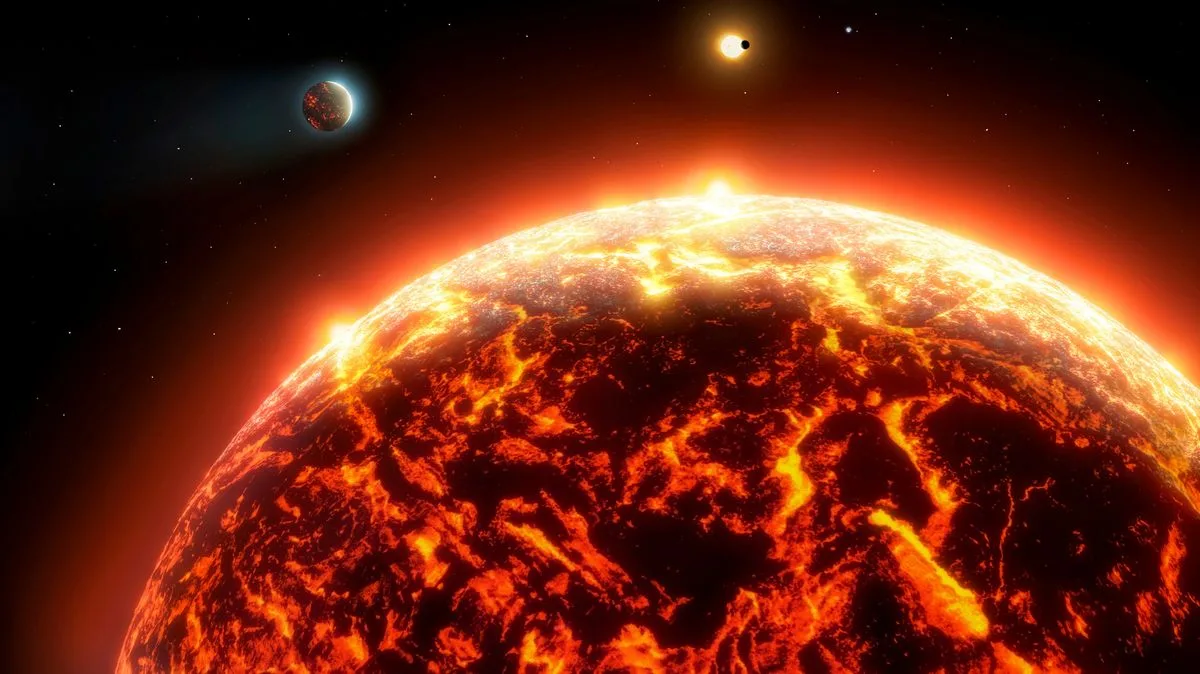
Scientists Discover Bizarre 'Super Earth' with Seas of Lava Where Sun Never Sets
A mysterious 'super Earth' located 560 light-years away, which had left scientists baffled due to its rare atmosphere, is now believed to feature vast oceans of teeming molten rock. This spectacular planet, known as TOI-561 b, has captivated astronomers with its extreme conditions and unexpected characteristics.
The Puzzling Planet with an 'Impossible' Atmosphere
The ancient planet TOI-561 b has puzzled experts since its discovery, as it possesses an "impossible" rich atmosphere despite surface temperatures soaring to a scorching 1,800 degrees Celsius. Recent studies suggest this anomaly is due to massive oceans of liquid, molten rock that interact dynamically with the surrounding gases. Located in the outer reaches of the Milky Way, this finding challenges previous scientific theories that hot planets cannot retain atmospheres.
Readings from the James Webb Space Telescope now indicate that the atmosphere of TOI-561 b could contain water, oxygen, and carbon dioxide, adding to its intrigue. As an 'ultra-short-period planet' with a rapid orbit, a calendar year on TOI-561 b lasts just under 11 hours, as it orbits incredibly close to its star—roughly 1/40th the distance of Mercury from our Sun.
Eternal Daylight and Ancient Origins
One side of TOI-561 b is locked in eternal daylight, creating a stark contrast between its illuminated and dark hemispheres. However, the presence of an atmosphere means that heat is circulated, warming the dark side and contributing to the planet's unique thermal dynamics. The star it orbits is approximately 10 billion years old, about twice the age of our Sun, indicating that rocky planets were forming early in the universe's history.
This discovery not only upends conventional wisdom about ultra-short-period planets but also provides insights into planetary formation in the early cosmos. Nicole Wallack, a Postdoctoral Fellow at Carnegie Science in Washington DC, explained to Science Daily: "Based on what we know about other systems, astronomers would have predicted that a planet like this is too small and hot to retain its own atmosphere for long after formation. But our observations suggest it is surrounded by a relatively thick blanket of gas, upending conventional wisdom."
Discovery and Ongoing Research
TOI-561 b was initially discovered by NASA's TESS (Transiting Exoplanet Survey Satellite) and announced in early 2021. Further inspection has been carried out by scientists using data from the James Webb Space Telescope, a $10 billion (£7.5 billion) instrument launched in 2021. Currently located about one million miles from Earth, where it orbits the Sun, the telescope is a joint project between NASA, the European Space Agency, and the Canadian Space Agency.
Describing the planet as a "wet lava ball," study co-author Tim Lichtenberg from the University of Groningen in the Netherlands noted: "We think there is an equilibrium between the magma ocean and the atmosphere. At the same time that gases are coming out of the planet to feed the atmosphere, the magma ocean is sucking them back into the interior." This dynamic process helps explain how TOI-561 b maintains its atmosphere despite extreme heat.
The James Webb Telescope has been instrumental in studying the universe's earliest known galaxies, some over 13.5 billion years old, and distant exoplanets like TOI-561 b. This research continues to push the boundaries of our understanding of planetary science and the conditions that can sustain atmospheric layers in hostile environments.