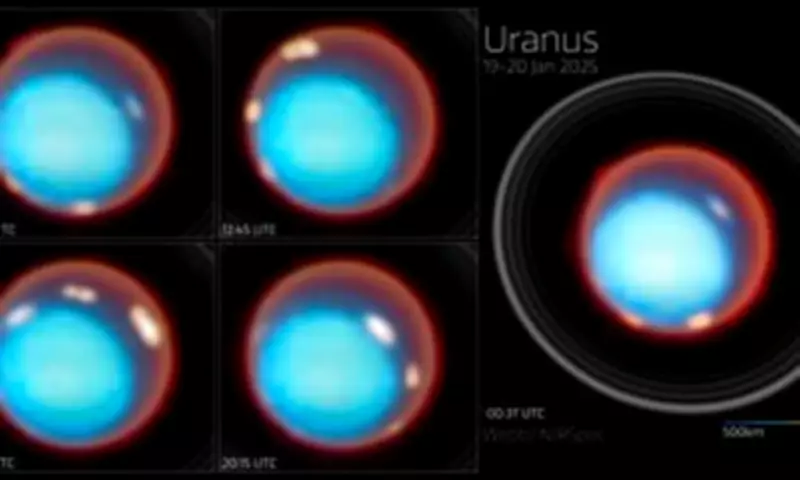
In a groundbreaking astronomical achievement, researchers have unveiled the first three-dimensional map of Uranus's upper atmosphere, providing unprecedented insights into one of our solar system's most enigmatic planets. This remarkable feat was accomplished using NASA's state-of-the-art James Webb Space Telescope, which observed the ice giant for nearly an entire rotation cycle.
Unprecedented Atmospheric Mapping
The international scientific team, spearheaded by Paola Tiranti from Northumbria University, meticulously mapped temperature variations and ion density within the electrically-charged atmospheric layer situated approximately 3,100 miles above Uranus's cloud tops. This comprehensive mapping effort has yielded the most detailed visualization to date of where the planet's spectacular auroras originate and how they release energy to create their distinctive luminous displays.
Revealing Auroral Complexities
The observations revealed two distinct bright auroral bands positioned near Uranus's magnetic poles, which exhibit a pronounced lopsided configuration and are tilted by nearly sixty degrees from the planet's rotational axis. This unusual magnetic field orientation causes the auroras to sweep across the planetary surface in intricate, complex patterns that differ dramatically from those observed on Earth.

'This represents the inaugural opportunity to examine Uranus's upper atmospheric structure in three dimensions,' explained Ms Tiranti. 'Thanks to Webb's extraordinary sensitivity, we can now trace how energy propagates upward through the planetary atmosphere and even discern the influence of its asymmetrical magnetic field.'
Temperature and Density Discoveries
The James Webb Space Telescope data identified not only the two prominent auroral bands but also a distinctive zone of diminished emission and reduced ion density situated between them. Researchers hypothesize this feature may correlate with how Uranus's magnetic field channels charged particles, drawing parallels to similar phenomena observed at Jupiter.
The comprehensive measurements demonstrated that atmospheric temperatures peak between 1,864 and 2,485 miles above the cloud tops, while ion densities reach their maximum concentration approximately 621 miles above the same reference point. Perhaps most significantly, the analysis confirmed that Uranus's upper atmosphere continues to cool, extending a temperature decline trend first detected in the early 1990s.
Cooling Atmospheric Trends
The research team documented an average atmospheric temperature of around 426 kelvins, equivalent to approximately 150 degrees Celsius lower than values previously recorded by ground-based telescopes and earlier spacecraft observations. Understanding why Uranus's atmosphere continues to cool could provide vital insights into how ice giant planets throughout the universe regulate their atmospheric thermal conditions.
'By revealing Uranus's vertical atmospheric structure with such exceptional detail, Webb is fundamentally advancing our comprehension of energy balance mechanisms within ice giant planets,' Ms Tiranti emphasized. 'This represents a crucial milestone toward characterizing giant planets beyond our own Solar System.'
Uranus's Unique Characteristics
Positioned more than one billion miles from Earth, Uranus remains one of the least explored planets within our solar system. This remoteness explains why scientists continue to make surprising discoveries about the gas giant. Just last year, researchers identified a previously unknown moon in Uranus's orbit, estimated to be approximately six miles in diameter, bringing the total known number of Uranian moons to twenty-nine.
'No other planetary system contains as many small inner moons as Uranus, and their complex interactions with the ring system suggest a chaotic evolutionary history that blurs traditional distinctions between ring systems and moon systems,' noted Matthew Tiscareno of the SETI Institute in Mountain View, California, who participated in the research collaboration.

Magnetic Field Anomalies
Uranus presents extraordinary magnetic characteristics that distinguish it from Earth. Unlike our planet's magnetic field, which aligns nearly parallel with its rotational axis, Uranus's magnetic field tilts sixty degrees from its axis while the planet itself rotates on its side. This configuration causes the magnetic field to 'tumble' asymmetrically relative to solar wind, creating magnetospheric behaviors vastly different from terrestrial phenomena.
When Uranus's magnetosphere opens, it permits solar wind penetration, but when it closes, it forms a protective shield against these charged particles. Researchers suspect solar wind reconnection occurs upstream of the magnetosphere at varying latitudes, causing magnetic flux closure in different atmospheric regions.
The newly published findings in Geophysical Research Letters represent an international collaborative effort involving the European Space Agency and Canadian Space Agency alongside NASA, marking a significant advancement in our understanding of distant planetary systems.