

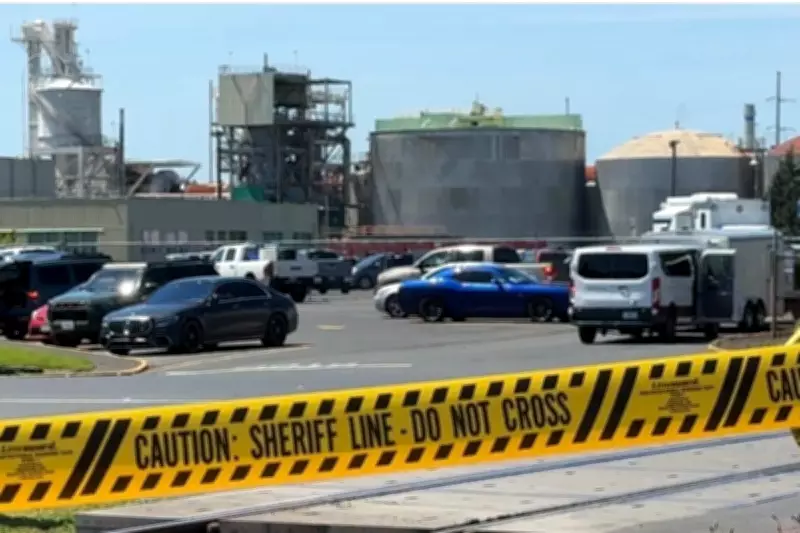
A catastrophic chemical tank failure at a paper mill in Longview, Washington, has left 11 people dead and shaken a community deeply rooted in the timber and paper industries. The tank, containing over 500,000 gallons of a caustic mixture used to break down wood for paper production, ruptured Tuesday morning at the Nippon Dynawave Packaging Co. facility, unleashing a flood of chemicals powerful enough to overturn pickup trucks and damage nearby buildings.
A Community in Mourning
Washington state Sen. Jeff Wilson, who has lived in Longview for 56 years and previously worked at the mill as an environmental cleanup contractor, described the personal toll. From his living room, he can see the plant where the accident occurred. When he heard sirens, he immediately called his son, who works at the larger industrial site. “I personally have been inside that tank and near that tank many times,” Wilson said. “The casualties are our friends and neighbors.”
The disaster is one of the deadliest U.S. workplace accidents in recent decades, striking at the heart of a town where families have worked in mills for generations. Longview was founded by timber baron Robert A. Long to support the first mills, and over its century-long history, the community’s identity has become intertwined with the lumber and paper industries.

Economic and Emotional Impact
Beyond immediate grief, residents worry about the plant’s future. The mill provides crucial jobs in an industry that has dwindled in the region. Nippon Paper Group, the Tokyo-based parent company, said it is assessing the accident’s financial impact. U.S. Rep. Marie Gluesenkamp Perez, whose district includes Longview, noted that at vigils, workers expressed pride in their jobs and fear of losing them.
Cindy Stiebritz, a volunteer at an antiques store, emphasized the mill’s central role: “If you’re a waitress, a grocery store worker, a teacher—every walk of life here knows somebody from these mills. Those mills are the backbone of this town. You feel like you’ve lost part of your family.” Her husband’s parents met while working at Long’s lumber company.
Longview’s industrial zone along the Columbia River is a visible part of daily life, with many residents seeing the facilities or smelling the sulfuric odor of pulp and paper production. The city’s downtown features R. A. Long Square, a central landmark where vigils were held.
Investigation Underway
Authorities are investigating the cause of the tank collapse. The facility, dating to 1953 and employing about 1,000 people, produces materials for tissues, printing paper, cups, plates, cartons, and other goods. Fundraisers for victims’ families reveal the human cost: a grandfather always willing to help, two brothers including a sole provider for his partner and three children, and a husband leaving behind two children and a pregnant wife.
Brianna Pesio, a server at Mill City Grill, said her father has worked at the plant for over 30 years. She described the terror when her brother couldn’t reach him Tuesday morning. “I just didn’t know if I lost my dad,” she said. She drove to his house and pounded on the door until he woke up—he had just finished a shift at 5 a.m. Her husband also works in a paper mill.
At Country Folks Deli, longtime server Gayle Leavitt noted her in-laws worked at the mill for decades. “That’s how this town has survived,” she said.
Pride and Resilience
Officials highlighted the pride residents take in the mills and the importance of well-paying jobs in a region hit by the timber industry’s decline. State Rep. Jim Walsh said at a news conference, “This is a place where real people make real things. This is not the virtual world. Real industry always carries risks, but it’s our job to manage that risk.”
Stiebritz hopes the cause is found “so it never happens again. If anything comes out of it, I hope lives can be saved.” Tearing up, she thought of the children who lost parents. “This town is family. It’s one big family. But we’ll make it through. We’re strong. We’ve got a lot of love.”






