

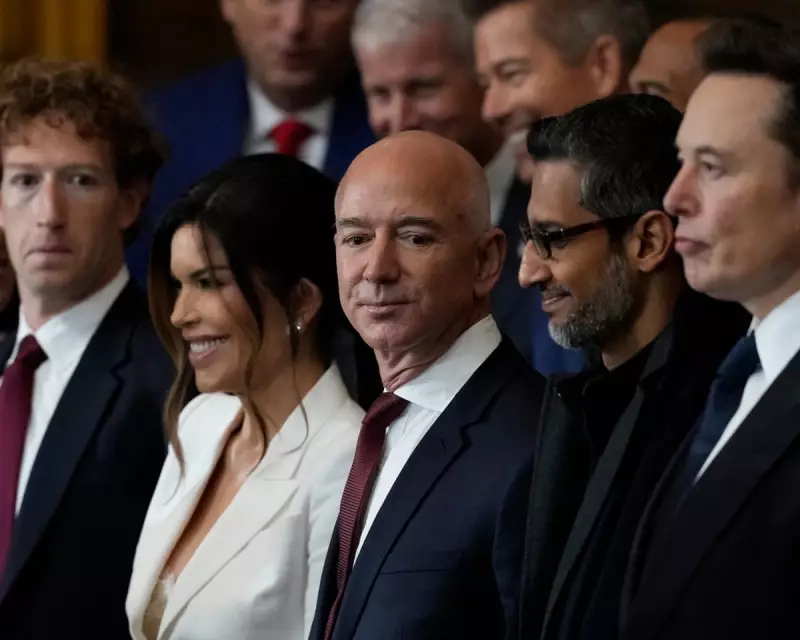
A stark photograph from Donald Trump's 2025 presidential inauguration in Washington captured more than just a political moment. It symbolised a profound and dangerous shift in global power. The image featured tech and business titans Mark Zuckerberg, Sundar Pichai, Elon Musk, Jeff Bezos, and Lauren Sánchez Bezos in attendance, a visual testament to the coalescing influence of the ultra-wealthy within the highest echelons of political power.
The Staggering Scale of Global Inequality
This gathering of billionaires underscores a central political crisis of our time: the extreme and growing concentration of wealth. According to the World Inequality Report (WIR) 2026, a mere 56,000 individuals – just 0.001% of the global population – now control three times more wealth than the poorest 50% of humanity combined. This disparity is not a distant phenomenon; it afflicts nations directly. In the UK, for instance, 50 families possess more wealth than the bottom half of the British population.
The velocity of this wealth accumulation is breathtaking. Oxfam data from 2024 shows the fortunes of the world's 2,769 billionaires swelled by $2 trillion in a single year. To contextualise, the total global spend on international aid was projected to be under $186bn – less than a tenth of that annual increase. While governments plead poverty, UK billionaires have, on average, seen their wealth explode by over 1,000% since 1990, primarily through property, inheritance, and financial assets, effectively growing richer at the expense of society.

How Extreme Wealth Corrodes Democracy and the Planet
The consequences of this imbalance extend into every policy arena, from climate action to democratic integrity. The WIR reveals that the richest 1% are responsible for 41% of greenhouse gas emissions from private capital ownership – nearly double the share of the bottom 90%. Their lavish consumption alone generates as much pollution as the poorest two-thirds of humanity.
This inequality is also the engine behind political polarisation and the rise of figures like Trump and Nigel Farage. Decades of research by academics Kate Pickett and Richard Wilkinson correlate high inequality with worse public health, higher crime, lower educational attainment, and severe status anxiety. It fosters a predatory 'Epstein class' ethos that views others as 'non-player characters', a term used by Elon Musk, and sees empathy as a civilisational weakness.
The Great Divide: Public Will vs. Political Inaction
Here lies the fundamental rupture in modern politics. Polling by the Pew Research Center across 36 nations found that 84% of people see economic inequality as a major issue, with 86% blaming the political influence of the rich. In the UK, a YouGov poll showed 75% of the public supports a wealth tax on fortunes above £10 million, with only 13% opposed.
Yet, the political class overwhelmingly sides with the ultra-wealthy. The manifestos of major parties, even those historically of the left, show no serious ambition to 'make billionaires history'. When pressed, ministers offer two feeble excuses. First, they claim a wealth tax wouldn't raise much revenue, ignoring its primary benefits: restoring fairness and dismantling the undue power of the rich. The WIR shows effective tax rates fall sharply for billionaires, eroding public trust.
The second excuse is the threat of the rich fleeing abroad. The responses are simple: evidence is lacking; their departure might be beneficial; and the solution is international cooperation. Tellingly, when 125 nations backed a global measure to curb tax avoidance, Keir Starmer's UK government was one of only nine to oppose it. The conclusion is inescapable: governments don't tax the ultra-wealthy because they choose not to.

This bias is reinforced by a media landscape largely owned by the same wealthy interests, which stokes divisive culture wars to distract from the true source of societal dysfunction. The battle for a fairer, greener, and more democratic world begins with one clear demand: political parties must choose whether they represent the vast majority or the tiny, ultra-wealthy minority. They cannot do both.





