

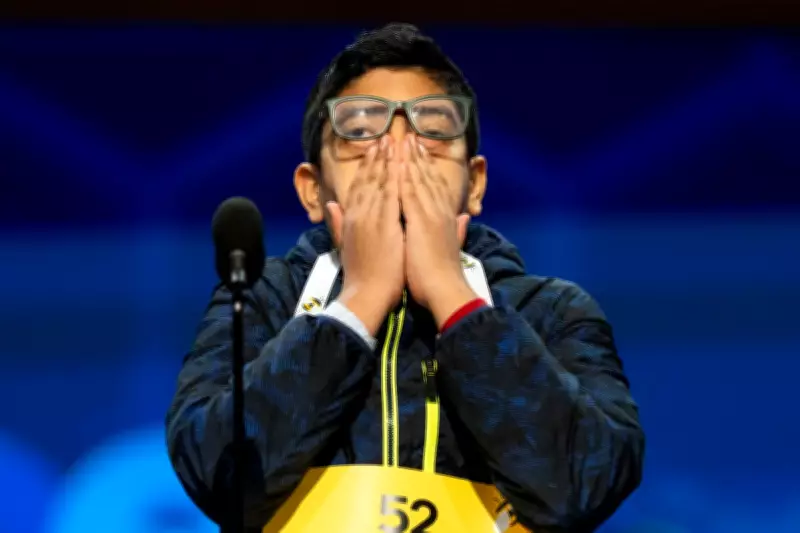
The Scripps National Spelling Bee semifinals are underway, and a long-standing debate among competitors has resurfaced: Is success driven by a deep understanding of language patterns or sheer memorization of words?
Two Paths to the Podium
Shrey Parikh, 14, of Rancho Cucamonga, California, represents the modern, comprehensive approach. After finishing third in 2024, he now works with three coaches, uses paid word lists, and studies Greek and Latin roots, language patterns, and every spelling bee-worthy word he can find. He also competes year-round in online bees against top spellers. His method has proven effective, earning him a spot among the 54 semifinalists vying for a place in Thursday's finals.
In contrast, Sarv Dharavane, 12, of Dunwoody, Georgia, takes an old-school approach. He has no coach, does not participate in online bees, and relies solely on Merriam-Webster's Unabridged dictionary. "The book is my coach," Sarv said. His strategy helped him finish third in 2025, and he sees no reason to change. "I used to read the dictionary and set aside difficult words to study later," he explained. "I've always been able to remember pretty well, and I can read through long lists without getting tired."

The Mastery vs. Memorization Debate
Sam Evans, who coached the past two champions, believes both approaches are valid. "At the end of finals, most of the words aren't going to have a really clean-cut language pattern or rule," he said. "So I think memorization is really important. Sometimes it gets a bad reputation, but you have to do it."
Dev Shah, the 2023 champion, advocates for an artistic approach centered on mastering roots and language patterns. "The skill of guessing is everything," he wrote after his victory. He acknowledged that memorization is important for quirky words but believes conceptual understanding helps under pressure.
Sohum Sukhatankar, a former champion who coaches Shrey, emphasizes efficiency. "When you're at the highest level, you have to be prepared for hundreds of thousands of words," he said. "You want to do as little memorization as possible to avoid the chance that you just forget it."
Learning from Setbacks
Shrey's journey has not been without obstacles. Last year, he was eliminated from his school bee after blanking on the word "calipers" while ill. "I was really devastated," he recalled. It took months before he regained motivation. He now uses an AI-assisted platform called Onyma, launched by Sukhatankar and Evans, as well as SpellPundit, an online resource used by every champion since 2019.
Despite his extensive preparation, Shrey acknowledges that competition brings pressure. "I feel like it creates more pressure to perform," he said. Nonetheless, he remains committed to mastering every possible word, knowing that at the microphone, he may still have to guess.
As the semifinals unfold, the contrasting strategies of Shrey and Sarv highlight a fundamental question in spelling: Which path leads to the trophy? For now, both remain in contention, each proving that there is more than one way to succeed.






