

Three Deaths on a Chinese Trawler Expose Shocking Labour Abuses in Global Fishing
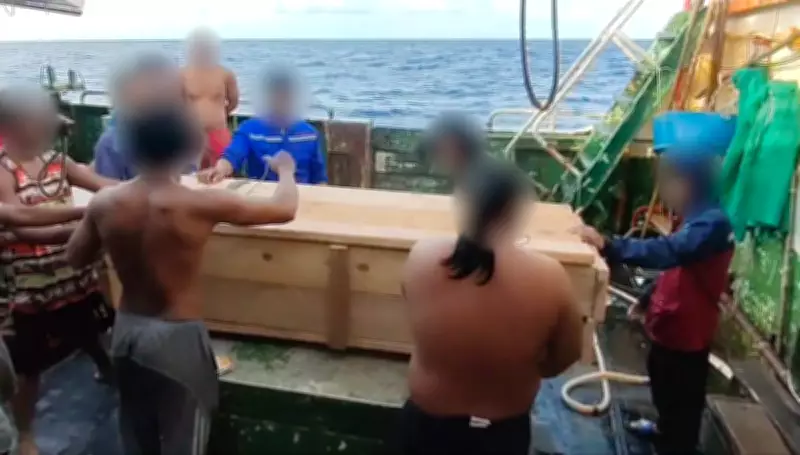
When Isko, a Filipino fisher aboard the Tia Xiang 5, succumbed to illness, his fellow crew members were forced to construct a makeshift coffin from wooden pallets. This harrowing incident is part of a broader pattern of neglect and exploitation uncovered through damning testimony from workers on the Chinese tuna-fishing vessel, which supplies fish to the UK and European Union.
A Voyage Marked by Suffering and Neglect
Abdul, a 36-year-old Indonesian fisher from West Java, recounts the tragic events that unfolded during his first stint on the longline tuna fishing vessel in the Indian Ocean. In February 2025, just four months into the voyage, Abdul fell ill with symptoms including swollen, bruised legs and debilitating weakness. Despite his condition, he was labelled "weak" and accused of "overreacting" by other crew members, compelling him to continue working gruelling 16-hour days for a meagre monthly wage of 4.6 million Indonesian rupiah (approximately £198).
As the months passed, additional crew members on the Tia Xiang 5, owned by the state-owned Shandong Zhonglu Oceanic Fisheries, began exhibiting similar alarming symptoms: painful limb swelling, severe weakness, and shortness of breath. According to Abdul, they received no proper medical care or respite from their exhausting schedules. The fishers were provided with substandard nourishment, fed "bait" fish that was not fresh and "tasted bad," alongside few vegetables. They also grew suspicious of the drinking water, which was distilled from seawater but turned "too salty" when the machine malfunctioned and appeared "yellow" or "dirty."

Deaths and Desperation Onboard
The situation deteriorated rapidly when Isko, described as "brave" for challenging the captain and declaring himself unfit for work, faced punishment. He was ostracised, forced to sleep on deck with only a tarpaulin for protection against rain and scorching sun, and denied access to his sleeping quarters for four days, as confirmed by Joko, a 34-year-old friend of Abdul's. Despite pleas from sick crew members, the captain refused to return to port or allow Isko to return home. Isko died four days later.
In total, three fishers—including another Filipino and an Indonesian—perished during that voyage from undiagnosed illnesses. The symptoms align with beriberi, a vitamin deficiency illness often seen in migrant fishers due to insufficiently nutritious diets, according to the Environmental Justice Foundation (EJF). A harrowing video obtained by EJF shows a dead man, identified as Isko, lying in a corridor while crew members continue fishing nearby. After Isko's death, fear spread among the sick, and the vessel only returned to Singapore after a third fisher deteriorated, though that fisher died en route.
Aftermath and Calls for Accountability
By the time Abdul disembarked, his leg was swollen "like an elephant's foot," and he was so weak he required a wheelchair at Singapore's airport. Upon reaching Jakarta, he was hospitalised and treated for lymphatic disease, taking two to three months and additional costly treatment to recover. His final salary, after deductions including 6.5 million rupiah for hospital fees, amounted to just 11.9 million rupiah for eight months at sea.
Steve Trent, CEO and founder of EJF, condemned the situation as an "inexcusable case of extreme neglect" and a "violent assault on people's rights." He emphasised that this case is typical of conditions across the Chinese distant water fleet, with hundreds of crew testimonies revealing appalling practices. The fish caught by these crews could enter EU and UK markets, as Shandong Zhonglu Oceanic Fisheries is licensed to supply these regions.

Global Implications and Regulatory Failures
EJF is urging the UK and other countries to endorse a Global Charter for Transparency. A recent report highlighted that critical checks on seafood imports into Britain have dropped to alarmingly low levels post-Brexit. Annually, the UK receives about 1,000 catch certificates from China, equating to roughly 58,000 tonnes of seafood, yet has refused only four consignments since 2012, indicating inadequate screening despite the fleet's history of illegal fishing and labour abuses.
Ben Harkins, a technical specialist at the International Labour Organization (ILO), noted that excessive working hours are a major risk for fishers on longline tuna vessels due to the time-intensive nature of setting and retrieving lines. He stressed the need for a robust legal framework, pointing out that, except for Thailand, the ILO's work in fishing convention is not ratified across Southeast Asia. "There are a lot of constraints for migrant fishers to organise, but experience shows it can drive better wages and conditions," Harkins stated.
Shandong Zhonglu Oceanic Fisheries, along with recruitment companies and the Chinese embassy in the UK, were contacted for comment but have not responded. Abdul, who agreed to use his first name, hopes his testimony will spur improvements in working conditions for migrant workers worldwide.





