

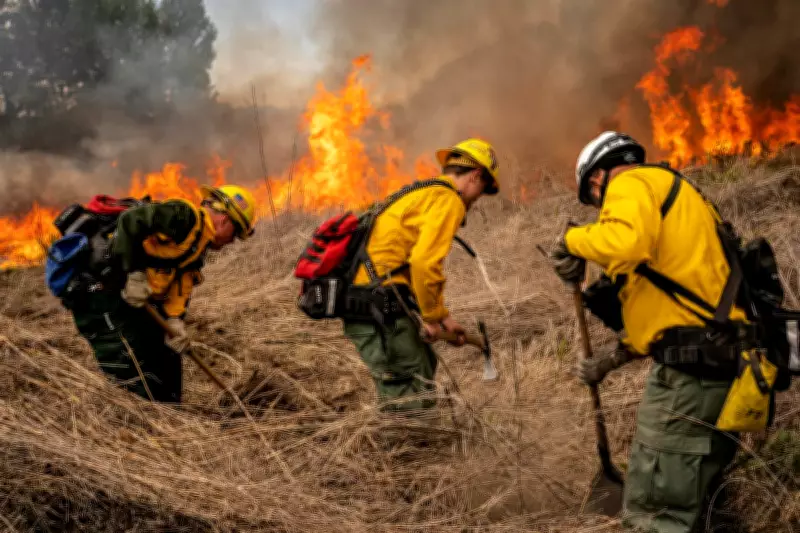
US Volunteer Firefighter Crisis Deepens as Departments Close Amid Shortage
Firefighting officials across the United States are sounding the alarm over a dramatic plunge in volunteer numbers, a situation described as a "public safety crisis" that has already forced the closure of entire departments in several states. This critical shortage threatens the backbone of American fire protection, especially in rural and suburban communities where volunteers have historically provided the majority of emergency response services.
Alarming Decline in Volunteer Numbers
Approximately 65% of all firefighters in the United States are volunteers who serve alongside their regular employment. However, recent data reveals a troubling trend: from 827,000 volunteers nationwide in 2008, the figure has plummeted to just 635,000 in 2023, the most recent year for which statistics are available. This represents a significant reduction in the workforce that communities rely on for fire safety and emergency response.
New York State Faces Critical Shortage
The state of New York has been particularly hard hit by this decline. Fire officials report that volunteer numbers have fallen to their lowest level in four decades, creating what they term a "public safety crisis" across various regions. Ralph Raymond, second vice-president of the Association of Fire Districts of New York and a volunteer firefighter based in Massapequa, emphasized the severity of the situation.

"It's quite serious, to be perfectly honest with you," Raymond stated. He noted that volunteers provide an astonishing 93% of fire protection services throughout New York state. The dwindling numbers have already had tangible consequences, with six fire departments closing in New York communities during 2025 alone.
Impact on Community Safety
The closure of local fire departments directly affects resident safety. Raymond explained that when a department shuts down, residents must wait for fire trucks to arrive from neighboring departments that are often located further away. "They're still going to get the fire protection, but they're not going to get it as quick," he cautioned, highlighting how response times can mean the difference between contained incidents and catastrophic losses.
Historical Context and Modern Challenges
Volunteer firefighters have served as the foundation of US fire protection for centuries, evolving from basic bucket brigades to sophisticated emergency response teams. Until the 1850s, all firefighters were volunteers, with Cincinnati, Ohio establishing the first professional paid department in 1853. Despite this development, volunteers have remained the dominant force, particularly in rural areas, small towns, and villages.
Modern volunteer firefighters begin their shifts at home, requiring weeks of specialized training before being authorized to combat blazes. When emergency calls come in, these dedicated individuals must rush to their local firehouse, gear up, and deploy on fire trucks—all while balancing their regular employment and personal commitments.
Economic Pressures Deter Volunteers
Raymond and other fire officials attribute the volunteer shortage largely to economic factors, particularly the rising cost of living. With many individuals already working multiple jobs to make ends meet, finding additional time to serve as firefighters has become increasingly difficult. In response, New York fire officials are advocating for legislative changes that would allow them to provide "nominal compensation" to volunteers, potentially around $100 per shift.
"It really would mean a lot to the individuals who are poor who are standing by," Raymond explained. "Because it takes that person, that guy or that girl who's volunteering that time, who works two jobs to put food on their table. Now it takes that person and they say: 'Hey, you know what? I don't have to work that second job. I can volunteer my time down at the firehouse.'"

Personal Commitment Amid Crisis
Raymond, a 63-year-old volunteer with four decades of service inspired by his firefighter father, represents the dedication that has sustained this system. He described the profound satisfaction derived from serving one's community. "I love helping people. I love giving back to my community. It's a sense of community pride, when you're out on the truck, and you're actually providing a service to the community, and you're able to help somebody—it's a feeling like no other."
He affirmed his commitment to continue volunteering as long as he remains physically able, embodying the spirit that has defined American volunteer firefighting for generations. However, his personal dedication underscores a broader concern: whether economic realities will allow future generations to follow in his footsteps, or if the volunteer firefighter tradition faces irreversible decline.





