

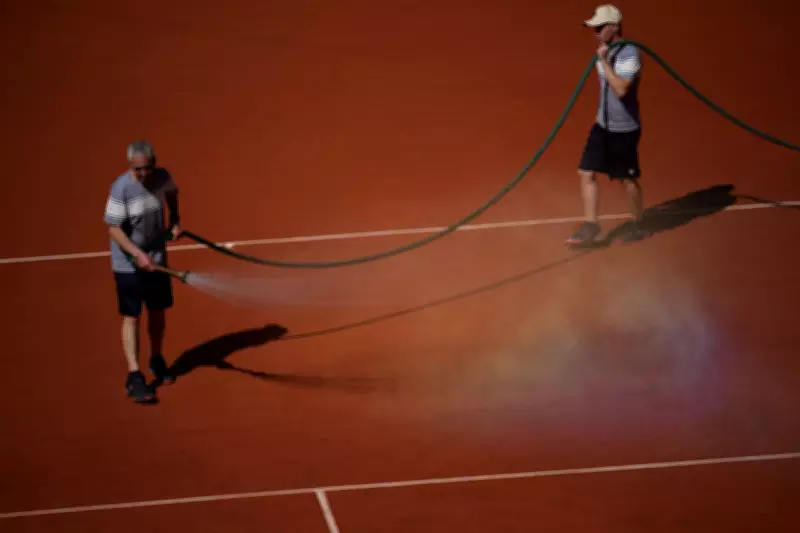
The scorching heat wave gripping Paris during the French Open is not only challenging players but also threatening the clay courts. Temperatures have soared to at least 32 degrees Celsius (90 Fahrenheit) since the tournament began, far above normal for late May, and are forecast to continue. On Tuesday, the temperature at Roland Garros peaked at 35 C (95 F).
Unprecedented Heat
Philippe Vaillant, head of court maintenance at the French Open, described the conditions as unprecedented. "Even the weather services say it themselves: it's unprecedented to have temperatures this high for such a long period at this time of year," he said. Heat waves can quickly alter the clay surface's consistency, affecting bounce and player safety.
Groundskeeping Strategies
Vaillant and his team of 200 groundskeepers have employed extra watering and strategic spreading of calcium chloride to protect the 18 courts on site and 15 additional practice courts. In hot weather, courts dry faster, leading to quicker play. Top-ranked Aryna Sabalenka noted after her first-round victory, "Now it's, like, boiling hot and balls are flying, everything is much faster."

Vaillant explained, "We're forced to water the courts a little more, of course." In the evenings, teams soak the courts to recharge the layers, allowing water to rise through the limestone base. Calcium chloride, a type of salt, is spread in flake form each morning. "It melts on contact with water and helps retain surface moisture," Vaillant said. During matches, courts are watered between each set, a practice not normally done under standard temperatures.
Impact of Heavy Rain
Heavy rains earlier in May helped mitigate the heat wave's effects. "We were able to let the rain do its job," Vaillant said. "It recharged all our water-retaining layers, which means that today, after several days of heat-wave conditions, the courts are still in excellent condition." The courts are playing slightly faster than usual, but not dramatically so.
Court Composition
A Roland Garros clay court consists of five layers totaling about 80 centimeters: large stones, gravel, volcanic-rock residue, limestone, and a thin layer of crushed brick (3 to 5 millimeters thick). "The most important part is the limestone layer underneath," Vaillant said. "This limestone layer must remain moist at all times. If we let it dry out too much, the courts could crack."
Player Safety
Players have been using ice bags to stay cool, but heatstroke is not the only risk. Dry courts become slippery, increasing injury risk. "It can be dangerous. A player could slip and get injured," Vaillant warned. Watering helps maintain traction.
Water Conservation
The groundskeeping team uses slightly more than one cubic meter of water per court daily. Rainwater collected under Court 7 irrigates green spaces, but French regulations currently prevent using it on courts for health reasons. However, a new decree allows rainwater use for sports surfaces, and plans are underway to collect rainwater for court watering.






