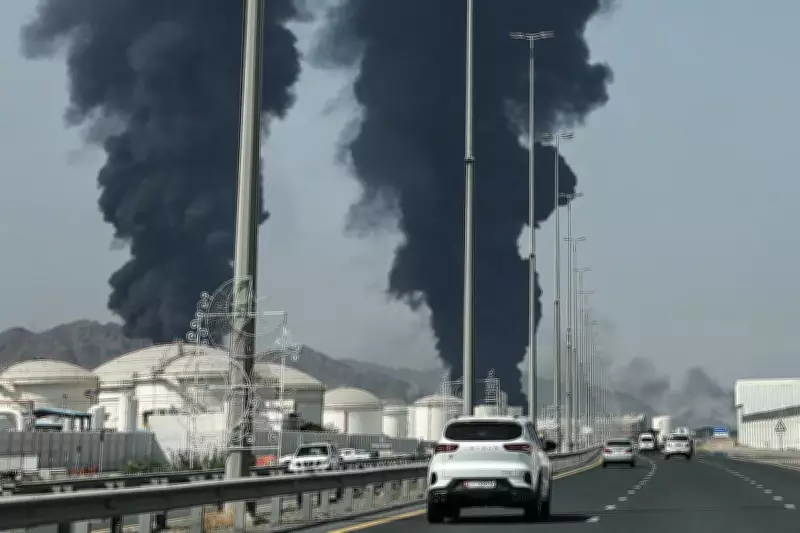
A major United Arab Emirates port, Fujairah, has been struck by a suspected Iranian drone attack, causing significant disruption to oil-loading operations at one of the world's most vital energy hubs. The incident occurred on Saturday, 14 March 2026, following a series of escalating threats from Iran to expand strikes on US allies. This aggression came in direct response to a recent US military operation targeting Iran's Kharg Island, a cornerstone of its oil industry.
Global Significance of Fujairah Port
Fujairah is a linchpin in the global oil and fuel supply chain, functioning as a premier hub for both crude oil exports and marine vessel refuelling. According to data from Kpler, in 2025 alone, Fujairah exported over 1.7 million barrels per day of crude oil and refined fuels. This volume accounts for approximately 1.7 per cent of daily global oil demand, underscoring its substantial market influence.
The port's strategic location on the Gulf of Oman, roughly 70 nautical miles from the Strait of Hormuz, further amplifies its critical role. With the Strait of Hormuz effectively closed due to the ongoing conflict with Iran, the flows through Fujairah have become increasingly indispensable to maintaining global energy supplies.

Marine Fuel Operations and Storage Capacity
In addition to crude exports, Fujairah sold 7.4 million cubic metres of marine fuels in 2025, equivalent to about 7.33 million metric tons. This makes it the world's fourth-largest bunkering port, trailing only Singapore, Rotterdam, and China's Zhoushan. The port boasts an impressive storage capacity of 18 million cubic metres, positioning it among the top global hubs for storing crude oil, refined fuels, and conducting blending operations.
Blending is a crucial process in the oil industry, involving the mixing of various petroleum components to produce finished products like gasoline and bunker fuels that meet specific quality standards. Major international storage firms, including VTTI, Vitol, ADNOC, and Vopak, operate extensively within the Fujairah Oil Industry Zone, which hosts the Middle East's largest commercial storage capacity for refined products.
Importance to the United Arab Emirates
For the UAE, Fujairah port is of paramount national importance. Prior to the outbreak of war, the UAE produced more than 3.4 million barrels per day of crude oil. A key infrastructure asset is the 1.5 million barrel-per-day Abu Dhabi Crude Oil Pipeline, also known as the Habshan–Fujairah Pipeline. This pipeline transports oil from Abu Dhabi's fields directly to Fujairah, enabling the UAE to bypass the increasingly volatile Strait of Hormuz.
The port is the primary loading point for the UAE's Murban crude grade, which is predominantly sold to buyers across Asia. Given that the Strait of Hormuz is largely shut to exports, any significant and prolonged disruption at Fujairah would force OPEC's third-largest crude producer to consider shutting down substantial portions of its production capacity, with severe repercussions for both the national economy and global oil markets.
Escalating Regional Tensions
The drone strike on Fujairah follows provocative claims by former US President Donald Trump, who stated that the US had "totally obliterated every military target in Iran’s crown jewel" on Kharg Island. This US strike on Iran's vital oil hub precipitated the Iranian threats against US allies, culminating in the attack on the UAE's critical port infrastructure. The incident marks a dangerous escalation in regional hostilities, directly threatening one of the world's most crucial energy arteries and introducing new volatility into already strained global crude and fuel markets.