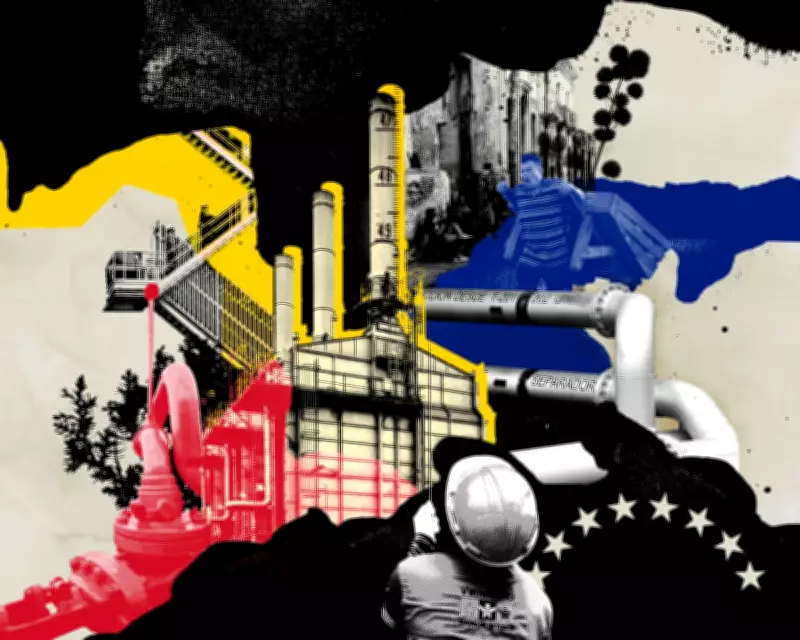
Venezuela's Oil Industry Awaits Revival Amid Reforms and Rust
Recent reforms to Venezuela's hydrocarbons law, which nationalised the oil industry two decades ago, may encourage companies to return. At Campo Boscán, a vast complex in western Venezuela, the drills, pumps, and pipelines that extract crude oil operate amid decay: roads are broken, weeds grow everywhere, and many wells run inside metal cages to prevent theft.
Albenis Merchán, a drilling technician with 35 years of experience, recalls better times as he drives his pickup through the desolate landscape. "We used to receive maintenance and safety training all the time. Supplies and spare parts were never lacking. Many things need to improve here to tap the full potential of this area," he says.
Historical Context and Current Operations
Campo Boscán lies 40km from Maracaibo, the capital of Zulia state, a region that has supplied crude to the global market for over a century. Discovered in 1945 by the Richmond Exploration Company, the field still produces more than 100,000 barrels daily, contributing to Venezuela's total of up to 1 million barrels per day.

Despite the neglect, this remains a privileged field. When the late president Hugo Chávez nationalised the energy industry in 2006, almost all large foreign companies left the country. Chevron stayed, and since 2022 it has controlled this complex alongside the state company PDVSA through a joint venture called Petroboscán, with Chevron holding 40% and PDVSA 60%.
Political and Economic Implications
The partnership is considered a preliminary stage toward a new commercial relationship between the US and Venezuela. After the capture of Nicolás Maduro by Donald Trump's administration, other leading energy companies are considering returning to exploit the world's largest oil reserves.
Amid the worsening climate crisis, South American and Caribbean countries are experiencing an oil boom after discoveries of new deep-water deposits off Guyana, Suriname, and Brazil. On 9 January, at a meeting Trump held with executives from the largest energy companies, Chevron's vice chairman, Mark Nelson, estimated that the company could increase its output in Venezuela from the current 240,000 barrels a day by up to 50% within 18 to 24 months.
Challenges and Opportunities
Yet, even with Trump's intervention and Maduro's capture, oil industry leaders remain hesitant to invest due to political instability and regulatory uncertainty. Facing pressure from the US president, who wants to use Venezuela as an example of how to intervene in Iran, executives at the CeraWeek conference in Texas last month indicated they remain divided.
But Chevron's words have stirred expectations at Campo Boscán, where employees and contractors eagerly await a recovery. "The optimisation department is studying each well. They need to determine the best method to get more out of them," says Merchán.
Legal Reforms and Infrastructure Needs
Before launching this new opening, Venezuela had to resolve a legal obstacle. The government of interim president Delcy Rodríguez has pushed through the national assembly an urgent reform of the hydrocarbons law, restoring the possibility of producing and exporting crude with minimal state participation.
In mid-February, sealing an alliance unthinkable under Maduro, US energy secretary Chris Wright visited another field in eastern Venezuela operated by Chevron and PDVSA alongside Rodríguez. The Trump administration has informed all interested companies that $100bn in investment will be needed to revive the country's productive capacity in the coming years.
Francisco Monaldi, director of the Latin America energy programme at Rice University in Texas, says one priority will be restoring the electricity infrastructure, subject to frequent blackouts after years of underinvestment. "Chevron has had to generate its own electricity to avoid relying on the transmission grid," Monaldi says.

Human Capital and Environmental Concerns
Venezuela also needs specialised talent, as Chávez fired 20,000 PDVSA workers after a general strike in 2003, and many more emigrated in the largest exodus in the western hemisphere. Despite the diaspora, Monaldi believes the hands extracting local crude will be Venezuelan. "Many foreign companies have them on their payrolls and are identifying them. That's happening here, in Houston. Venezuelans have family in their country and will find it easier to adapt," he says.
Those still working inside the country consider a return essential. "Young engineers who arrive don't know anything, and they don't want to learn either," says Merchán, who often visits wells where inexperienced workers ask for his help.
Future Prospects and Obstacles
César Parra, former director of the Zulia oil chamber, is optimistic. He says the region can still export 20bn barrels from its reserves, spread across the shores and beneath Lake Maracaibo, heavily polluted by extraction. Private-sector investment from domestic and foreign companies will be essential, with historical data showing production rises when the private sector takes over operations.
But the most significant obstacle is institutional. Rodríguez, Maduro's former vice-president, is a sanctioned official now overseen by the US, governing with much of the structure that supported the deposed leader. She has shown pragmatism, granting advantageous concessions, yet her government lacks legitimacy, and only the opposition enjoys majority support.
According to surveys after Maduro's capture, this landscape does not satisfy Venezuelans' desire for freedom, nor does it inspire confidence in companies like ExxonMobil, whose chief executive describes Venezuela as "uninvestable". Monaldi adds that uncertainty exists in the US due to potential political changes.
Conclusion: A Glimmer of Hope
According to Opec, Venezuela holds more than 300bn barrels of reserves, with 80% in the Orinoco belt. Zulia state, an exporter for decades, has already extracted most of its wealth and today accounts for just 7% of the national total. Even so, in this part of the country, everyone eagerly awaits reactivation, trusting that its benefits will feed different sectors of the economy.
At Campo Boscán, among neighbouring farms where cows chew dry grass, Merchán looks to the future with high expectations. He and thousands of other Venezuelan workers hope the reopening will align their wages with expenses in a de facto dollarised economy where the population has grown abruptly poorer.
Venezuelan oil once again promises abundance and wellbeing for generations to come. Many people's ambitions far exceed the gradual and difficult response that any turnaround will demand. But in the short term, Venezuela has few other sources of income.
That is why Merchán, and millions of despairing Venezuelans, see this stage as a potential bonanza within their grasp. "There are many wells here that are already drilled and ready to be exploited," he says. "All that's missing is installing the pumps, and they'll start producing right away."