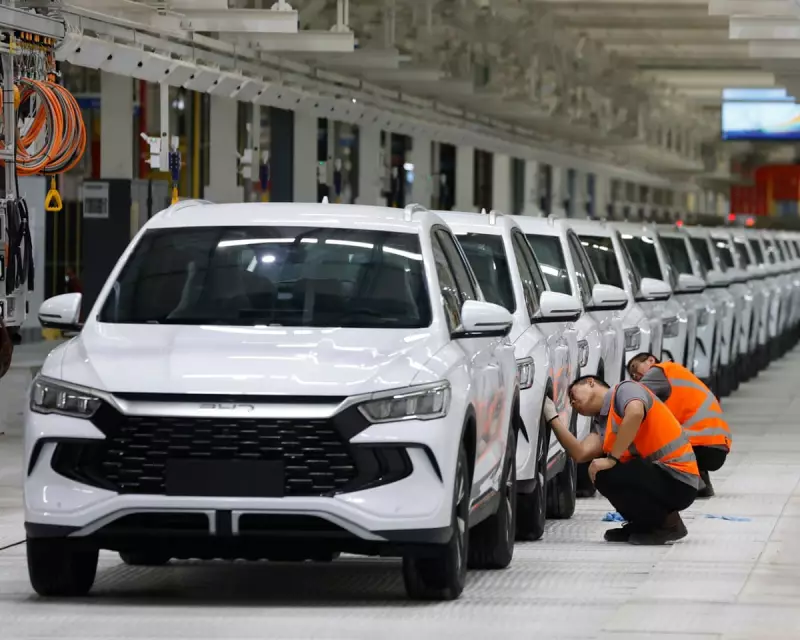
In a landmark shift for the global automotive industry, the Chinese manufacturer BYD has officially overtaken Tesla to become the world's largest seller of electric vehicles. This pivotal change in leadership was confirmed by sales data for the year 2025, marking the end of the US pioneer's long-held dominance.
The Numbers Behind the Power Shift
The figures tell a clear story of diverging trajectories. BYD reported selling a staggering 3.6 million battery-only vehicles in 2025, a monumental increase that solidified its top position. In contrast, Tesla's deliveries for the same period reached approximately 2.8 million units. While this represented growth for Elon Musk's company, it was not enough to keep pace with its Shenzhen-based rival.
This transition has been building for several years. BYD first outsold Tesla in the final quarter of 2023, offering a early signal of the changing competitive landscape. The Chinese firm's success is built on a multi-pronged strategy, offering a wide range of models from affordable city cars to premium sedans and SUVs, all underpinned by its vertically integrated manufacturing of batteries, a critical and costly component.

Political Headwinds and the Looming Tariff Threat
The commercial triumph of BYD is now colliding with significant geopolitical tensions, casting a shadow over its future expansion. Former US President Donald Trump has vowed to impose a 25% tariff on all Chinese vehicle imports if he returns to the White House after the November 2024 election. This proposed policy, which Trump announced on his Truth Social platform in January 2026, is explicitly aimed at protecting the American auto industry from what he frames as a wave of cheap imports.
Such a move would dramatically reshape the economics of selling Chinese EVs in the United States, a market BYD has been cautiously eyeing for expansion. The threat underscores the growing friction between Western governments and China's industrial ascendancy in green technology sectors. For now, BYD's sales strength remains concentrated in its domestic market and other regions like Southeast Asia, Europe, and Latin America.
Implications for the Global Electric Vehicle Race
The ascent of BYD signifies more than just a change at the top of a sales chart. It represents the maturation and formidable scale of China's electric vehicle ecosystem. Analysts point to several key factors in BYD's rise:
- Cost Advantage: Significant control over its supply chain, especially batteries, allows for competitive pricing.
- Product Breadth: A vast lineup caters to diverse consumer segments, unlike Tesla's more focused model range.
- Government Support: Years of state policy and investment in China have cultivated a robust EV manufacturing base.
For Tesla and other Western automakers, the challenge is now unequivocal. They must accelerate innovation and cost-reduction efforts to compete with the value and scale offered by Chinese champions like BYD. The potential for a new era of trade barriers, hinted at by Trump's tariff pledge, adds a layer of political uncertainty that could bifurcate the global market, forcing companies to adopt more regionalised strategies.
The year 2025 will be remembered as the moment the electric vehicle crown passed to China. How Tesla responds, and how Western governments choose to engage with this new competitive reality, will define the next chapter of the automotive industry's electric transformation.