

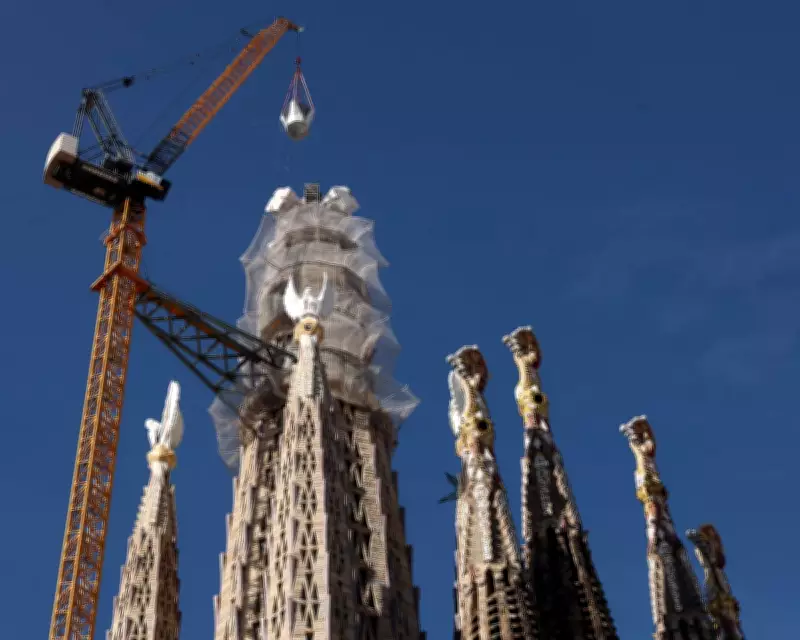
'A Joyful Day': Final Piece of Sagrada Familia's Central Tower Installed
After several days of waiting for windless conditions, construction workers successfully winched the remaining arm of the cross into position on Friday morning, completing the central tower of Barcelona's iconic Sagrada Familia basilica. This monumental achievement brings Antoni Gaudí's visionary church to its maximum final height of 172.5 metres, precisely 144 years after the ambitious project first commenced.
Historic Milestone for Barcelona's Skyline
The upper section of the 17-metre-high, four-sided steel and glass cross was carefully lifted and secured at 11am, finalising the tower dedicated to Jesus Christ. With this installation, the Sagrada Familia now stands as Barcelona's tallest building and the world's tallest church, a testament to the Catalan architect's lifelong devotion. As the Catalan and Vatican flags were ceremoniously raised, Jordi Faulí, the current chief architect for the project, expressed profound emotion, stating, "It's been a joyful day, wonderful for all the people who have made it possible."
Centenary Celebration and Future Work
A special ceremony to mark the completion of the tower—the tallest of eighteen conceived by Gaudí—is scheduled for 10 June, coinciding with the centenary of the architect's death in 1926. This event will occur sixteen years after the church was consecrated by Pope Benedict XVI. Despite this significant milestone, construction is expected to continue for approximately another decade, focusing on the striking south-facing Glory façade. Three renowned artists—Miquel Barceló, Cristina Iglesias, and Javier Marín—have been commissioned to present designs for this final major element.

From Building Site to Architectural Marvel
For generations, the Sagrada Familia has been an integral part of Barcelona's identity, evolving from an open-air building site into a defining feature of the city's skyline, comparable to the Eiffel Tower in Paris or the Empire State Building in New York. For decades, stone masons and carpenters worked amidst tourists, whose visits have largely funded the construction. It is only in the past fifteen years, with the completion of the breathtakingly beautiful interior, that the structure has truly felt like a church rather than a construction zone.
Inside, Gaudí's geometrical designs create an oasis of light, with delicate, tree-like columns tapering to the roof, and the white stone interior illuminated by vibrant colours from stained glass windows. However, the basilica has elicited mixed reactions over the years. George Orwell famously described it as "one of the most hideous buildings in the world" and expressed regret that anarchists did not destroy it when they had the opportunity during the Spanish Civil War.
Overcoming Challenges and Preserving Gaudí's Vision
During the civil war, anarchists did destroy Gaudí's original drawings and plaster models, which were later painstakingly reconstructed. In the late 1970s, New Zealand architect Mark Burry adapted rocket design software to realise Gaudí's intricate geometric plans. Burry has defended the authenticity of the ongoing construction, arguing that Gaudí's geometry is so precise that any deviation would cause the structure to collapse. While some elements, such as the Passion façade by sculptor Josep Maria Subirachs—sometimes called the Darth Vader façade—may seem discordant, the overall work remains unmistakably Gaudí's.
Tourism and Economic Impact
The Sagrada Familia is Barcelona's top tourist attraction, drawing approximately five million visitors annually and generating an income of roughly €150 million (£131 million). About half of this revenue has been reinvested into the construction efforts, ensuring the continuation of Gaudí's legacy. As the city celebrates this historic achievement, the emotional significance of completing the central tower resonates deeply with residents who have lived alongside this unfinished masterpiece for generations.






