

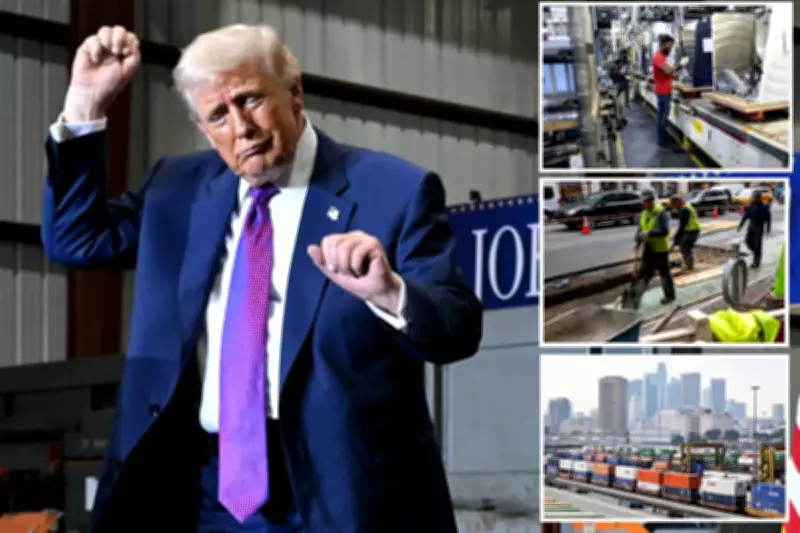
Trump's Manufacturing 'Golden Age' Fails to Materialise as Jobs Decline
President Donald Trump's vision of a "golden age" for American manufacturing, tapping into nostalgic imagery of midcentury industrial might, has failed to materialise according to economic experts and legislative analysis. Instead of the promised renaissance, his administration has overseen significant manufacturing job losses and created widespread uncertainty through volatile tariff policies.
Contradictory Employment Figures
While Trump declared that manufacturing would come "roaring" back to the United States, the reality has been quite different. According to Bureau of Labor Statistics data, although 5,000 manufacturing jobs were added in January 2026, this represents a net loss of 83,000 positions compared to the same period last year. A separate congressional analysis by Democratic lawmakers suggests even more dramatic losses, indicating that over 100,000 manufacturing jobs disappeared during Trump's first year back in office.
"While President Trump promised us a manufacturing boom, the reality of his first year has been a bust," stated Senator Maggie Hassan, the top Democrat on the Senate Joint Economic Committee. "It is critical for both our national security and our economic future that we grow our manufacturing sector. The president has instead spent his first year burdening manufacturers with reckless tariffs, and this loss of jobs is the result."

Historical Context and Recent Trends
American manufacturing employment peaked in 1979 with 19.5 million workers, representing nearly one-quarter of the workforce at that time. Since then, factory jobs have steadily declined, with temporary increases during Trump's first term followed by pandemic-related plunges. President Joe Biden's subsequent economic stimulus measures provided temporary relief, but those gains evaporated by late 2024, and Trump's policies have since erased thousands of remaining positions.
Modern manufacturing construction spending reached its zenith in August 2024 and has been in steady decline since, according to Federal Reserve data. Despite this downward trend, some industry representatives remain hopeful, citing potential benefits from lower interest rates, favourable tax conditions, and investments in artificial intelligence and data centre infrastructure.
Tariff Controversy and Economic Impact
Trump's sweeping tariff agenda, which he described as essential for rebalancing global trade, has faced significant legal and economic challenges. The Supreme Court recently struck down substantial portions of these tariffs, ruling that the president lacked authority to impose them under emergency powers. This decision has left billions of dollars in levies tied up in litigation and created long-term economic uncertainty.
Economist Dean Baker from the Center for Economic and Policy Research explains the tariff dilemma: "The classic story you might tell about tariffs is that they help manufacturing, but they hurt the rest of the economy. When you put tariffs on intermediate goods, which most of our imports actually are, then you make manufacturing more expensive here."
Steel Industry Case Study
The steel sector provides a revealing example of tariff consequences. While some domestic producers like Coosa Steel in Georgia have praised tariffs for creating a "level playing field" against Chinese competition, economists note these protections come at significant cost to consumers and downstream manufacturers. Domestic steel production has actually declined from 97 million tons annually in 2019 to 90 million tons in 2025, despite reduced imports.
Erica York of the Tax Foundation observed: "The protected firm can now profitably sell its higher priced goods because of the tariffs, but it does so at the expense of all the downstream users who now have to pay those higher prices."

Clean Energy and Technology Setbacks
Trump's manufacturing agenda has faced particular criticism regarding clean energy and technology sectors. His administration has cancelled dozens of clean energy projects that were already underway, resulting in thousands of lost jobs. Climate advocacy group Climate Power reports that more than 350 clean energy projects have been cancelled, delayed, or lost funding since Trump's election, affecting approximately 173,000 positions.
In the technology sector, semiconductor manufacturers have shed over 13,000 jobs since April despite Trump's emphasis on domestic chip production as an economic and national security priority. Many of the investments he touts actually stem from legislation passed during the Biden administration.
Data Centre Expansion Concerns
The rapid growth of artificial intelligence data centres presents another complex challenge for manufacturing policy. While the Trump administration supports protecting energy ratepayers from infrastructure costs, it has declined to regulate the industry's expansion. Economists question whether these facilities will generate significant manufacturing employment, as most construction materials must be imported and the centres themselves employ relatively few people.
Baker summarises the broader manufacturing situation: "It's just fantasy. There's literally nothing that would support his claims of a renaissance." This assessment contrasts sharply with Trump's recent State of the Union address, in which he promised that "factories, jobs, investment and trillions and trillions of dollars will continue pouring into the United States of America" despite never actually mentioning manufacturing in his remarks.





