Asian stock markets experienced widespread declines on Thursday, while oil prices surged once more as uncertainties surrounding the de-escalation of the Iran war continued to unsettle global financial markets. This persistent geopolitical tension has fueled volatility, with investors closely monitoring developments in the Middle East.
Market Performance Across Asia
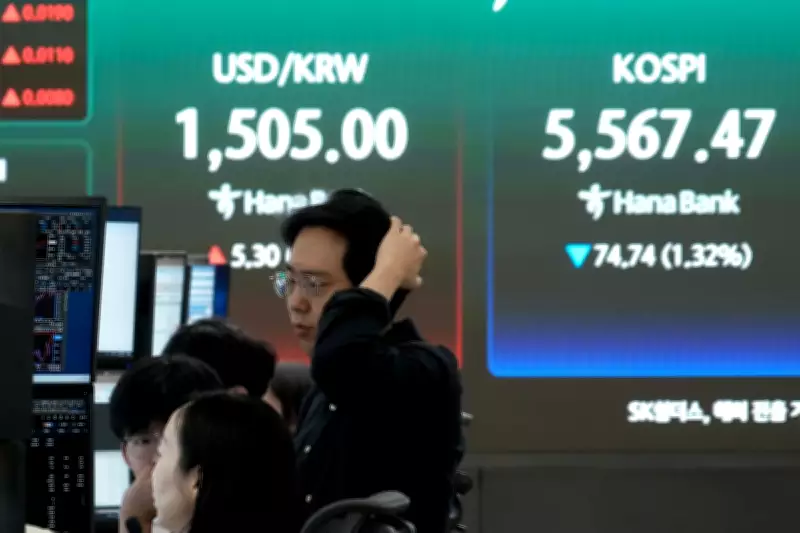
In Tokyo, the Nikkei 225 index traded 0.3% lower at 53,607.75 points, reflecting cautious sentiment among Japanese investors. South Korea's Kospi index suffered a more significant loss, dropping 1.9% to 5,537.30, indicating heightened risk aversion in the region.
Hong Kong's Hang Seng index fell 1.4% to 24,978.71, while the Shanghai Composite index in mainland China declined 0.6% to 3,909.16. Australia's S&P/ASX 200 edged down 0.2%, demonstrating a broad-based downturn across major Asian economies.

Taiwan's Taiex index provided a rare bright spot, trading 0.4% higher, though this minor gain was overshadowed by the overall negative trend across the continent.
Oil Prices Climb Amid Geopolitical Tensions
Oil prices resumed their upward trajectory on Thursday after a brief dip earlier in the week. Brent crude, the international benchmark, rose 1.3% to $98.51 per barrel, recovering from below $95 on Wednesday. Meanwhile, benchmark U.S. crude increased 1.6% to $91.75 per barrel.
The price surge followed Tehran's dismissal of a U.S. ceasefire proposal on Wednesday. The Trump administration had offered a 15-point plan to Iran, with President Trump delaying a self-imposed deadline to "obliterate" Iranian power plants in an effort to pressure Iran into reopening the Strait of Hormuz.
Regional Military Escalation
Military tensions remained high as Iran launched additional attacks on Israel and Gulf Arab countries. Simultaneously, Israel conducted airstrikes on Tehran, and the United States prepared to deploy more troops to the region, further complicating diplomatic efforts.
The Strait of Hormuz, a crucial waterway between Iran and Oman through which approximately one-fifth of the world's oil typically passes, has remained largely closed since the conflict began. This closure has contributed to oil price fluctuations, with prices climbing around 40% since the war started four weeks ago.
Wall Street and Other Market Movements
In contrast to Asian markets, Wall Street stocks closed higher on Wednesday. The S&P 500 gained 0.5% to 6,591.90, while the Dow Jones Industrial Average climbed 0.7% to 46,429.49. The Nasdaq composite rose 0.8% to 21,929.83, buoyed by strong performances in technology stocks.
U.S.-listed shares of Arm Holdings jumped 16.4% following the U.K. company's announcement that it would launch and sell its own chips, a move expected to drive future revenue growth. Conversely, Swiss sportswear company On Holding fell 11.2% in U.S. trading after CEO Martin Hoffmann stepped down, with the company naming two co-founders as co-CEOs.
Commodities and Currency Markets
In other early Thursday dealings, precious metals prices declined. Gold prices dropped 0.8% to $4,513.90 per ounce, while silver prices lost 0.9% to $71.97 per ounce, suggesting some shift away from traditional safe-haven assets.
Currency markets showed modest movements, with the U.S. dollar falling slightly to 159.42 Japanese yen from 159.47 yen. The euro traded at $1.1570, up from $1.1559, indicating some dollar weakness amid the geopolitical uncertainty.
U.S. futures pointed to a cautious opening, down 0.1%, as global markets continued to grapple with the implications of the ongoing Iran conflict and its impact on energy prices and economic stability.